Why Setting Up Camp Before Dark Actually Matters More Than People Think
Ask any seasoned camper why setting up camp before dark actually matters more than people think, and the answer is simple: daylight is the only time you can truly read...
Why Setting Up Camp Before Dark Actually Matters More Than People Think
Ask any seasoned camper why setting up camp before dark actually matters more than people think, and the answer is simple: daylight is the only time you can truly read terrain. After sunset, every task gets slower and easier to get wrong.
The real danger is how fast mistakes stack. One rushed call in the dark, a bad spot, turns into a crooked tent, a sleepless night, and a rough morning.
Ahead, you'll learn what goes wrong after sunset, why your headlamp works against you, how veterans handle late arrivals, and a simple two-hour rule for arrival timing.
Here's why setting up camp before dark matters: picking a site is a visual job. Flat ground, clean drainage, safe trees overhead, every one of those checks depends on seeing the terrain. Once the sun drops, the same job turns into guesswork.
As the Sky View Tents team puts it, after sunset the world outside becomes something heard rather than seen. That creek you hear sounds peaceful, but it tells you nothing about whether your tent pad slopes toward it or sits in a low pocket that pools water overnight.
Picture rolling in at 9 pm and sweeping a headlamp across the trees. Past that small circle of light, the site is a blank. The dead branch above your spot, the roots and rocks under your floor, the ant nest two feet from your door, none of it shows up until morning. These are exactly the details behind staying safe and warm in the wild, and daylight is the only time you can catch them.
Check for level ground, because even a mild slope means waking up pressed against the tent wall.
Trace the drainage path by reading low spots and debris lines, so rain pools away from your floor instead of under it.
Look up for widowmakers, dead or cracked branches that can drop on your tent in the night wind.
Clear the footprint of roots, rocks, and ant nests while you can still see them.
Walk a slow 360 around the whole site before unpacking a single thing, pacing off your distance to water and the trail, because two minutes of looking beats a night of regret.
The Campsite Checks That Only Work in Daylight
Every check on that list runs on full, even light. Headlamp beams act like spotlights, flattening the very shadows that reveal slopes, stains, and dead limbs, so a quick scan at 9 pm tells you almost nothing.
Skip them and the morning grades your work. You wake against the downhill tent wall, spot a cracked limb over the fly, and find a debris line under your floor. All of it was visible at 6 pm.
Set a bottle on the tent spot. If it rolls, so will you.
Stand where your head will rest and look straight up.
Treat debris lines and dark soil as high-water marks.
End with one slow lap of the site, because two slow minutes now save a miserable night later.
Why Your Headlamp Is Working Against You
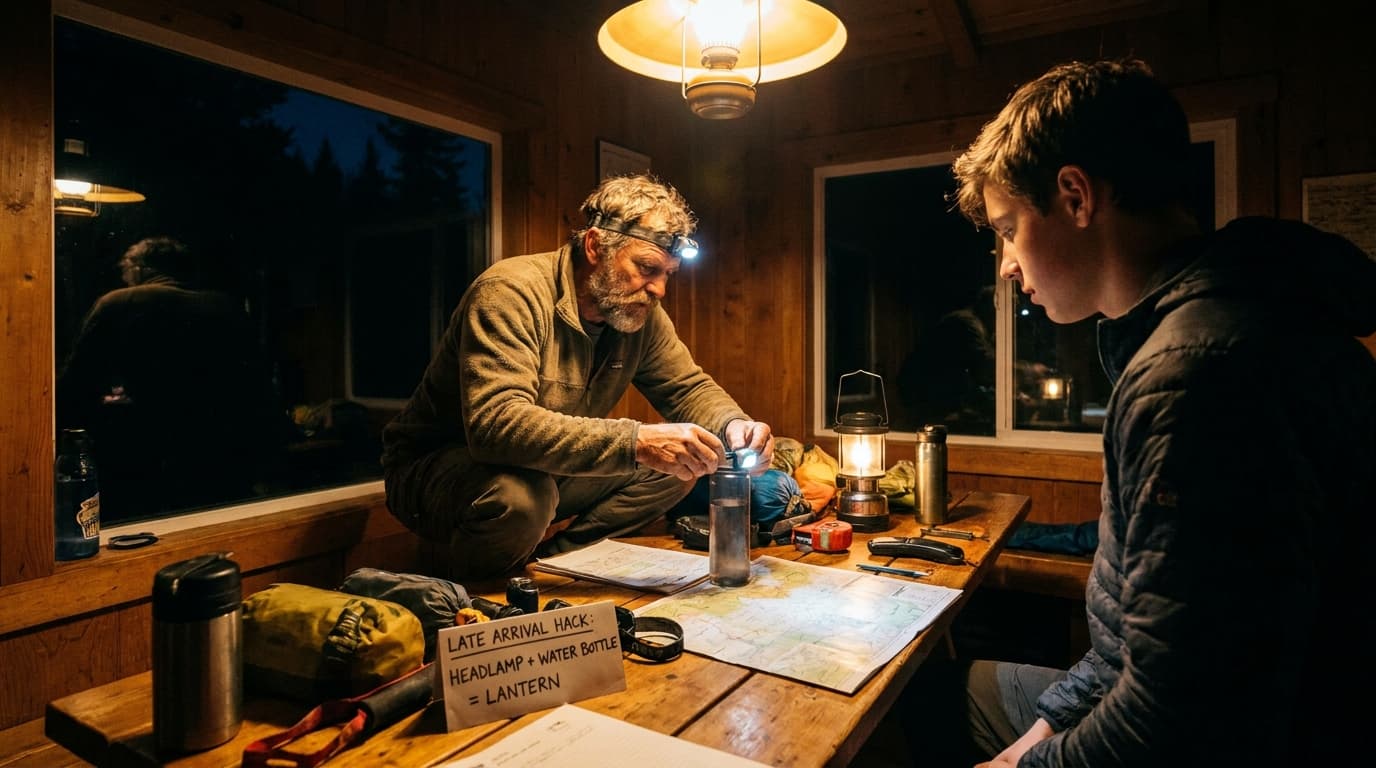
A bright headlamp feels like it should cancel out the dark. It doesn't, because the real problem after sunset isn't the darkness itself. It's your light. Your eyes adjust to low light on their own, but the process takes real time, and NASA guidance cited by Sky View Tents is blunt about it: bright screens and artificial light interfere with night vision. Every full-blast burst from a headlamp or quick glance at your phone resets that clock.
A headlamp also only lights the small circle where you're pointing it. Everything outside that beam gets darker by comparison, because your eyes never get the chance to open up and take in the rest of camp.
Picture a typical late arrival. You're halfway through pitching the tent, a message buzzes, and you glance at your phone for three seconds. When you look up, the world beyond the beam is a black wall. Two steps toward your pack and your boot catches the guyline you staked ten minutes ago, the one you would have seen easily with adjusted eyes.
The frustrating part is how gradual dark adaptation is. Your vision keeps sharpening the longer you stay away from bright light, and in a genuinely dark place the payoff is big. Fully adjusted eyes can pick out individual stars, the band of the Milky Way, even satellites sliding overhead. That's the level of sight you trade away for one screen check, and every reset means another long wait before it comes back.
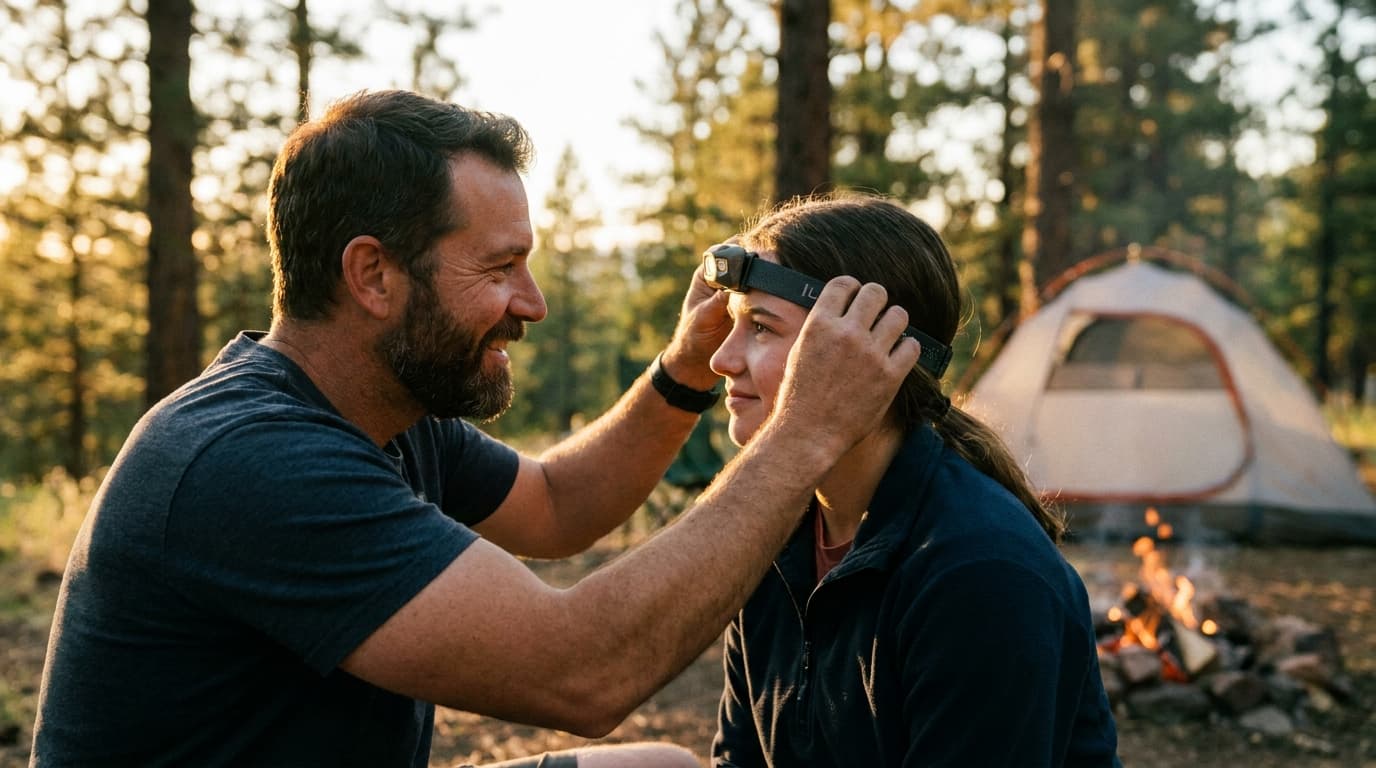
Switch your headlamp to red-light mode if it has one, since red light disturbs night vision far less than white.
Run the lowest brightness that gets the job done instead of defaulting to full power.
Stash the phone in your pack until camp is finished, because one glance undoes minutes of adjustment.
Handle the fiddly jobs like staking guylines and sorting gear while there's still natural light to work with.
Treat light like a budget after sunset and spend it only on tasks that truly need it.
How Long Your Eyes Really Need to Adjust
Longer than you think, and it happens in stages. The first few minutes in the dark only buy you rough shapes. The useful detail, the texture of the ground, the treeline, the faint end of the star field, shows up later, after a long stretch with no bright light at all.
Take a camper who douses the lantern at 9. At 9:10 her site is a gray sketch. Left in the dark, her eyes keep working, and by 9:40 she can read the slope of the ground and see stars that weren't there before. One phone check at 9:35 erases most of that climb.
That's the real trade: every light you fire up costs you minutes you can't shortcut. The fix isn't more gear, it's fewer interruptions.
Batch every chore that needs light into one burst instead of ten small ones.
Wait one more minute before flipping a switch, because most tasks get easier as your eyes catch up.
The Setup Mistakes You Won't Notice Until Morning
Two problems stack when you pitch camp in the dark. You pick a worse spot, then you do a worse job pitching on it. Neither gets confirmed until daylight, which is what makes it sting. Arriving at night is a bet that your site choice holds up once morning shows you what's actually around you.
Even people who set up after dark on purpose admit this. The packgoats crew, backcountry hunters who arrive in the evening as a deliberate strategy, put it plainly: "we set up where we know we'll be in good position when daylight comes." The real verdict on a nighttime pitch arrives with the sun, no matter how experienced you are.
Then morning collects the bill. The tent door faces the wind. A rock digs through the floor right where your hip goes, on ground that felt flat at 10 p.m. Or you wake cold in a shallow basin that pooled overnight rain, which is why advice on staying safe and warm in the wild starts with where you pitch, not what you wear.
Do a first-light walkaround before you unpack anything, because last night's mistakes are now visible and still cheap to fix.
Check for rocks and slope under the tent, look up for dead limbs overhead, and note which way the wind hits your door.
Move the tent while it's still empty if the spot fails the daylight test, since ten minutes of repitching beats a second night of bad sleep.
It Starts With Picking a Bad Spot
Bad site choice is the first domino, and it falls because of tunnel vision. A headlamp lights one tight circle, so you end up judging a whole piece of ground by the few square feet you can see.
Take a patch that looks perfect in the beam: clear, flat dirt. What the light hides is the slope it sits on, the drainage line running through it, and the dead limbs overhead. Commit to the circle and you inherit everything outside it.
Sweep your beam wide, well past the tent footprint, before you unpack anything.
Check uphill for slopes and gullies that rain could funnel toward your tent.
Scan the trees overhead for dead limbs before you commit to the spot.
Why Every Chore Takes Longer in the Dark
A bad spot is only the first domino. The second is fumbled setup: every chore done on that ground gets slower and sloppier because you lose visual feedback on each step. Stakes go in crooked, guylines tangle, and small gear vanishes into the dark.
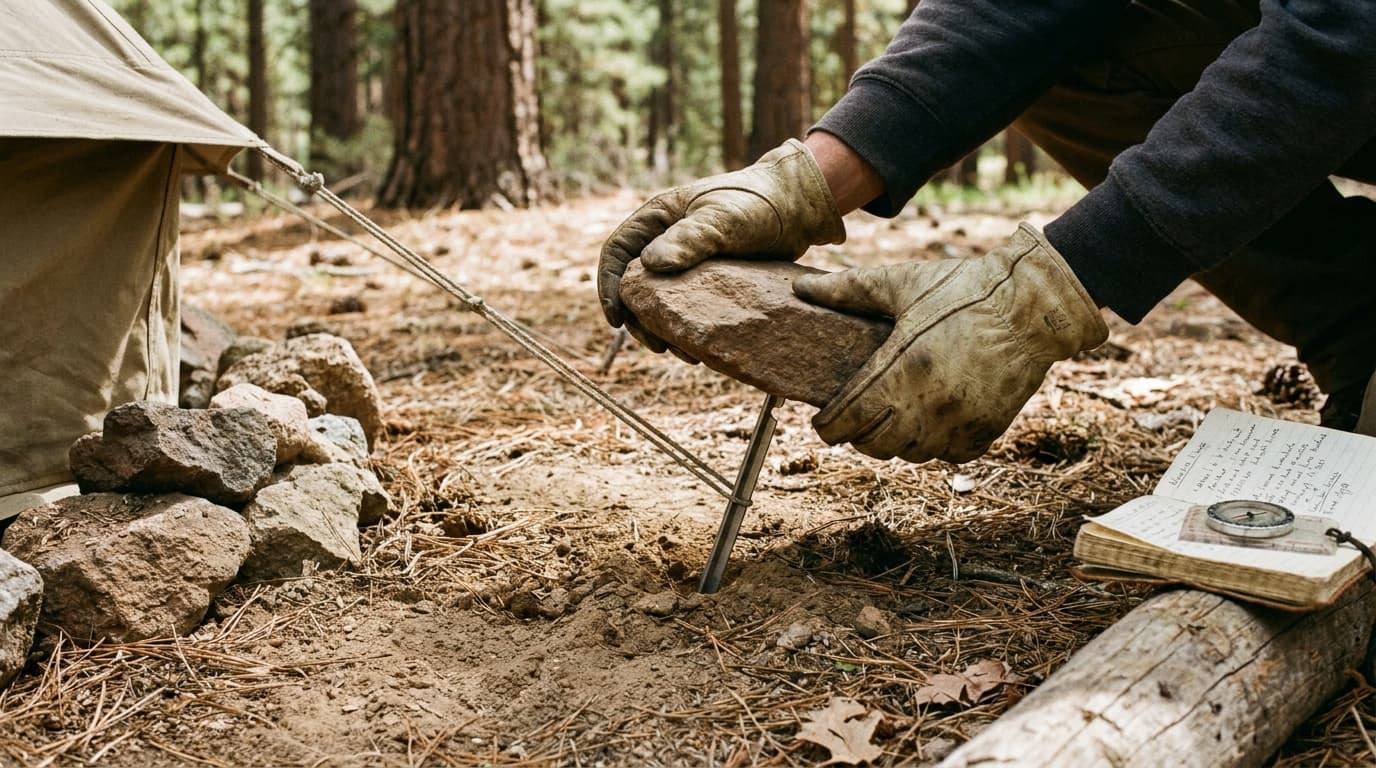
Take a tent pitch that runs ten minutes in daylight. At night it stretches to thirty, with more mistakes baked in. A crooked stake holds fine at 10 p.m., then pops loose at 2 a.m. when the wind picks up.
Practice pitching your tent at home until it's muscle memory, so dark setup runs on your hands, not your eyes.
Keep your headlamp, stakes, and mallet in one grab bag at the top of your pack.
Clip small items like lighters and line tensioners to a cord or bright stuff sack so they can't disappear.
How Seasoned Outdoors People Handle Late Arrivals
Yes, experienced campers do set up after dark sometimes, but only as a deliberate strategy with real trade-offs, never as a casual default. The hunters behind packgoats.com admit evening arrival takes a little more planning than a daylight one. It works because years in the field taught them to read terrain by sound instead of sight.
That's the distinction that matters. It's a hunting tactic backed by extra preparation, not proof that pitching late is easy. Even these veterans bet on morning light to confirm what they picked in the dark.
Picture one of their evenings. They roll in near dusk, then stop and wait for the woods to go quiet, with no map and no headlamp sweep. They listen for elk, because as they put it, a bugle across the drainage tells you a whole lot more than a map ever will. Then they choose camp by ear, setting up where they'll be in position when daylight comes, since for them the dark isn't downtime but the scouting tool itself.
Unless you carry that kind of experience and a specific reason to arrive late, let the rule run the other way. Daylight is the default, and the exception is earned with homework, from studying the map to checking your survival essentials checklist before you leave.
Treat late arrival as an exception that demands more planning, not less, and only for a real reason.
Study the area beforehand and mark two or three candidate spots you can find again in the dark.
Stop and listen before committing to a spot after sunset, since sound is the one sense that still works at night.
Set a firm cutoff on travel day and fall back to a closer site if you slip past it.
The Night Is the Best Part, So Don't Spend It on Chores
The cost of evening setup goes beyond the hassle. It burns the exact hours that make a trip memorable. Stargazers and backcountry hunters describe the dark the same way: a time for watching and listening, not working. Rush through chores after sunset and you trade the quiet, the sounds, and the sky for fumbled setup.
That trade matters more now than it used to. Dark-sky tourism keeps growing, light pollution means millions of people rarely see a full night sky from home, and phone-free evenings have become a stated goal of many trips. The night isn't downtime anymore. For a lot of campers, it's the reason they came.
Picture a campsite in a dark-sky area, far from the nearest town's glow. The sun drops, the woods go quiet, and the sky starts filling in as your eyes adjust. In a genuine dark-sky location, the Milky Way, constellations, satellites, and meteors all come out, and small sounds sharpen too. One site over, the late arriver is still fighting a rainfly under a glaring headlamp, missing all of it.
Work backward from sunset so camp is fully pitched before the light fades.
Finish cooking and cleanup before dark so you're free when the first stars come out.
Learn a few constellations before the trip so you can watch the sky without a screen.
Treat the evening as the reward, not the catch-up window.
How Early Should You Get to Camp?
Here's the rule worth building your day around: get to your campsite with at least two hours of usable daylight left. That means two hours before the light stops being useful for real work, not two hours before sunset on paper.
That number isn't random. It covers the real arrival sequence: scouting the site, pitching the tent, organizing gear, cooking dinner, and cleaning up. Rush any of those into the dark and the compounding problems kick in, a worse site picked blind and a sloppier pitch on top of it. Give each step its share of daylight and nothing spills past sunset.
Take a summer evening with a 9 p.m. sunset. Roll in by 6 and the math works: tent up, camp set by 7:30, dinner and dishes done by 8:30. When the first stars come out, you're in a camp chair watching instead of wrestling a rainfly under a headlamp. That easy last hour is exactly what the buffer buys you.
Of course, arrival times slip because of traffic, wrong turns, or a trail that takes longer than the map promised. Treat two hours as the target, then protect it with a few habits. And if you still roll in late, the stripped-down backup plan below keeps one rough evening from becoming a rough trip.
Build a 30 to 45 minute delay buffer into your arrive-by time, because the drive and the approach almost always run long.
Keep your tent and headlamp where you can grab them first, at the top of your pack or right inside the trunk, never buried under the cooler.
Learn your tent's pitch at home until the steps are automatic, so a late arrival turns into an inconvenience instead of a crisis.
Damage Control If You Have to Arrive Late
Sometimes late arrival just happens, even with a solid plan. When it does, the goal shifts from building the perfect camp to buying yourself a safe night. A stripped-down backup plan, decided before the trip, is what makes that work.
Say you roll in at 10 p.m. Because you studied the site's layout on maps and photos back home, you already know where the flat ground is. You keep your light dim to protect what night vision you have, and you take the boring spot with nothing dead hanging overhead instead of the one with the pretty view. The view can wait until morning.
Pitch only the essentials: tent, sleep setup, and water within reach.
Skip the fire and the elaborate dinner. Eat something simple and save real cooking for daylight.
Walk the site again at first light and move your tent if morning reveals a problem, before you fully unpack and settle in.
Common Questions About Setting Up Camp Before Dark
These questions come up every camping season, so here are the straight answers.
Is it ever smart to set up camp after dark? Rarely, and only on purpose. Backcountry elk hunters do it as a calculated move, arriving at dusk, waiting for the woods to quiet down, and listening for bugles across the drainage to choose a position, and even they admit it takes a little more planning. For everyone else, a daylight arrival is the safer default.
Doesn't a good headlamp make up for the lost daylight? Not really. Your eyes need real time to adjust to darkness, and every blast from a headlamp or phone resets that adaptation, the same reason NASA tells meteor watchers to keep their phone screens dark. The beam lights one small patch and leaves the rest of camp invisible.
What's the biggest risk of pitching in the dark? Your site choice becomes a guess you can't verify until morning. Flat ground, drainage, dead branches overhead, and rocks under the tent floor are all visual calls, and after sunset you're left judging by sound instead.
Is racing the sunset actually worth it? Yes, because the dark hours are the payoff. Away from light pollution, the Milky Way, constellations, satellites, and meteors all come out as your eyes adjust, a sky millions never see from home. Spend them wrestling a rainfly and you've traded the trip's best hours for a fumbled pitch.
Default to a daylight arrival and treat after-dark setup as the exception that takes extra planning.
Keep headlamps dim and phones pocketed once the sun drops so your night vision can do its job.
Save the camp chores for daylight and leave the dark hours free for the sky you came to see.
The Bottom Line on Beating the Sunset
Here's the whole case in one breath. Once the sun drops, picking a site turns into guesswork, your headlamp fights your own eyes, and every mistake stays hidden until morning. Worst of all, the dark hours you came for get burned on chores instead of the night sky.
Yes, skilled outdoors people break this rule. Backcountry elk hunters roll in at dusk on purpose and choose camp by ear, and even they admit it takes a little more planning plus years of practice. That's not a loophole. It's proof the rule holds, because the only people who beat the dark are the ones who plan around it.
So keep it simple on your next trip. Set a hard arrive-by time two hours before sunset and treat it like a reservation you can't move. Then walk the site slowly before unpacking, checking the ground, the drainage, and the branches overhead while you can still read them. Ten calm minutes in daylight beats an hour of fixing mistakes by headlamp, and if rain threatens, these wet-weather outdoor hacks for when nature gets grumpy go a lot smoother while you can still see.
Frequently Asked Questions
Here's the thing most timing advice misses: sunset and dark aren't the same moment. You usually get a stretch of usable twilight after the sun drops, so pulling in right at sunset still leaves you working light. But that gap shrinks fast in forests, canyons, and winter, so treat sunset itself as the deadline.
Also, plan off the actual sunset time for your date and location, since it can swing by hours between seasons. Then pad it. The campers who get burned aren't the ones who arrive late. They're the ones who arrive right on time and hit a full site, a wrong turn, or ground that looked flat on the map.
Shrink the job. After dark your goal isn't a finished camp, it's a safe place to sleep. Get the tent up, lay out your sleep system, and stop. Cooking, unpacking, and organizing all go faster and safer in daylight, so let them wait.
Stage gear before you need it: headlamp in an outside pocket, tent on top of the pack. Keep your light dim, because every bright blast resets your night vision, which is exactly why NASA-cited stargazing guidance warns against bright screens after dark. Then walk the site at first light and be ready to move the tent if you find a dead limb overhead or a dip that pools water. A dark setup is a draft, not a final decision.
Blame the contrast, not the darkness. Your eyes calibrate to the brightest thing around, so when a headlamp beam fills your view, everything beyond it looks pitch black by comparison. Full dark adaptation takes a real stretch of time, and one flash of white light resets the whole process. That's why NASA's advice for watching meteor showers boils down to two things: give your eyes time, and keep bright screens away.
Here's the trick most campers never learn: night vision is actually sharper in your peripheral vision. The center of your eye is built for color and detail, which are useless in the dark, while the edges handle dim light far better. So to spot something faint, like a trail marker or a dim star, look slightly beside it instead of straight at it. Stargazers do this constantly. Pair that with the lowest lamp setting or red mode, and the world outside your beam slowly starts showing up.
It depends on how well you know the ground. Rolling into a developed campground with a reserved, level site you've seen in photos? Low risk. Same goes for a spot you've camped at before, because memory fills in what your eyes can't. The real gamble is an unvetted backcountry site, where you can't check the slope, the drainage, or what's hanging overhead.
If a late arrival is truly unavoidable, shrink the job. Pitch only what you need for the night, keep your light on its dimmest setting, and let everything else wait. Then do a full site check at first light and be ready to move if morning reveals a problem. Even the backcountry hunters who set up after dark on purpose treat it as a bet that only pays off at daylight, backed by extra planning and years of practice. For most campers, night setup should be a backup plan, not a strategy.
Conclusion
Here's what it all comes down to. Setting up camp before dark matters more than people think because every problem stacks on the last one. A spot you couldn't really see leads to a pitch you rushed, which leads to a night of sliding into the tent wall and a morning of finding out what was actually around you. Daylight isn't a nice extra. It's the one tool that lets you read the ground before you commit to it.
The good news is the fix costs nothing. On your next trip, set a hard arrive-by time about two hours before sunset, then spend the first ten minutes walking the site slowly before you unpack a single thing. And if a late arrival can't be avoided, pitch only the essentials, keep your light low, and give the spot an honest second look at first light before you settle in.
Because the night was never meant for chores. It was meant for the quiet, the stars, and the whole reason you went camping in the first place. Beat the sunset, and the best part of the trip takes care of itself.
Every WilderReady guide is researched, written, and fact-checked in-house against trusted references such as the American Red Cross, the National Park Service, and the CDC before it goes live. We publish under this shared byline instead of invented personas, so you always know who stands behind the guidance you are reading.