Wet Wood and Cold Nights: Outdoor Hacks for When Nature Gets Grumpy
Picture this. You wake up to the sound of rain hitting your tent and realize every stick in the woods is soaking wet. It is the kind of morning that...
Wet Wood and Cold Nights: Outdoor Hacks for When Nature Gets Grumpy
Picture this. You wake up to the sound of rain hitting your tent and realize every stick in the woods is soaking wet. It is the kind of morning that usually ruins a trip, but it does not have to be that way if you have the right mindset. The difference between a cold, miserable weekend and a legendary story often comes down to simple resourcefulness and a bit of grit.
You can still enjoy the wild even when the weather turns sour by using a few clever Outdoor Hacks & Tricks. We will show you how to start a fire with wet wood for beginners and share the essential bushcraft knots that actually keep your gear from blowing away. These skills are not just for experts. They are for anyone who wants to feel confident when nature gets a little grumpy.
This article walks you through building a diy survival water filter and staying warm with cold weather camping hacks that actually work. You will also learn about easy primitive fish trap designs to keep you fed without a fishing pole. By the time we are done, you will be ready to handle whatever the forecast throws your way.
Fire-Starting 101: What to Do When Everything is Soaking Wet
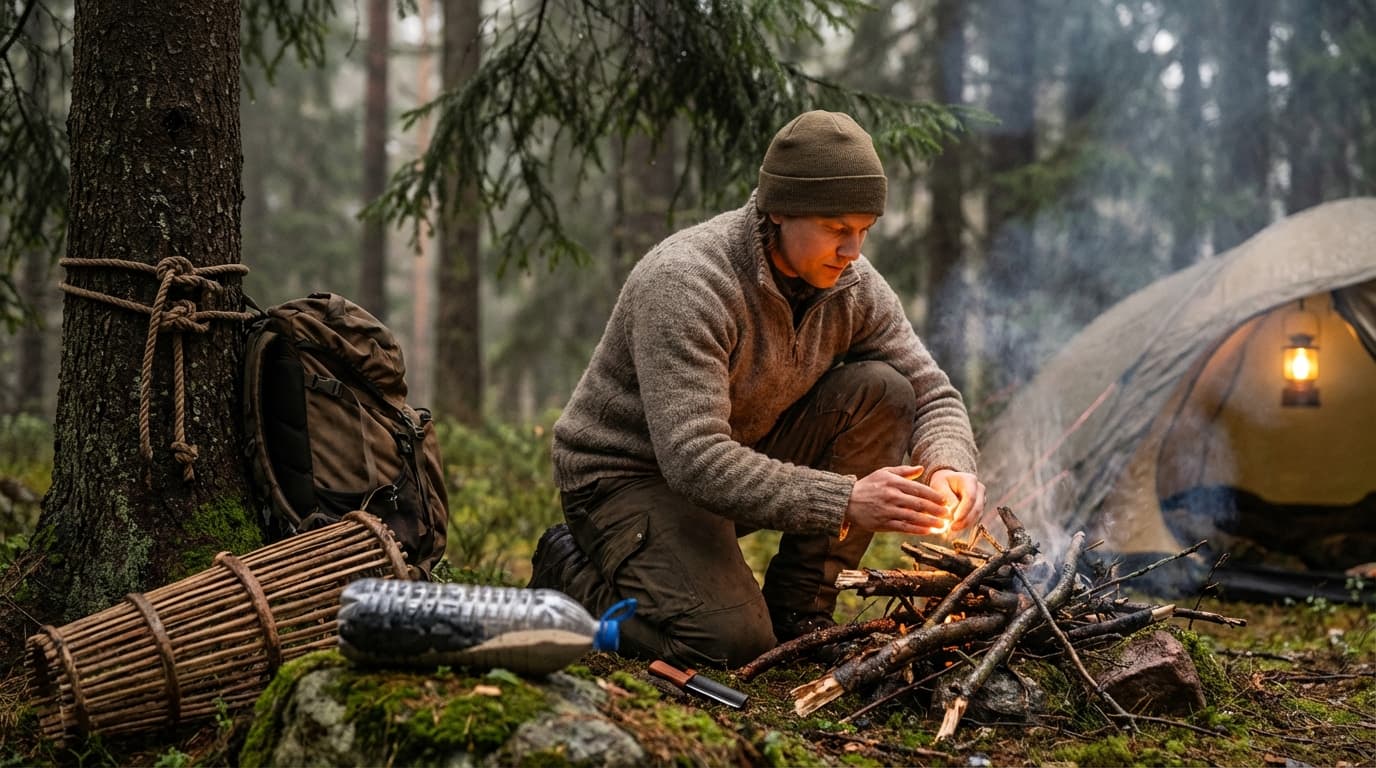
You are standing in the rain, looking at a pile of soggy logs and wondering if you will be eating cold beans for dinner. It is a common frustration, but knowing how to start a fire with wet wood for beginners is actually a fundamental survival skill. Even when the woods feel like a giant sponge, there is dry fuel hiding right in front of you. Members of the RV Hacking community often share tips for these exact moments because they know a little moisture should not ruin the trip. If you have a decent knife and a bit of patience, you can find the dry core inside almost any piece of wood.
The secret is looking for what is on the inside. Ground-soaked branches are usually a lost cause, so look for standing deadwood instead. These are trees that died but did not fall, keeping their inner wood away from the damp earth. Once you have a log, use your knife to split it open and reach the heartwood. This inner layer stays dry even in a downpour because the outer bark acts like a natural raincoat. To make it catch fire easily, try the feather stick technique. You basically shave thin curls of wood that stay attached to the stick, creating a high surface area that catches a spark much faster than a solid log.
Sometimes you need a little extra help to get things moving. This is where natural boosters like pine resin and fatwood become your best friends. Look for pine trees with sticky sap oozing out. That resin is highly flammable and burns hot even when it is damp outside. Fatwood is just wood saturated with that same resin, often found in the stumps of old pines. If your fuel is still a bit stubborn, try the upside-down fire method. You put your largest logs on the bottom and build the fire on top. As the fire burns down, the heat dries out the damp logs underneath before they ever need to ignite.
Key insights:
Standing deadwood is significantly drier than wood found on the forest floor.
The 'RV Hacking' community is a great source for crowdsourced wet-weather camping tips.
Splitting wood to find the heartwood is the most reliable way to access dry fuel in a storm.
Natural resins act as a powerful fire accelerant when conditions are working against you.
Finding the 'Dry' Inside the 'Wet'
You’re standing in the rain, staring at soggy branches, wondering if a fire is even possible. It is, but you have to look past the surface. The secret to starting a fire with wet wood is realizing that moisture usually only goes skin-deep. While ground-soaked branches are basically rotten sponges, standing deadwood - trees that died but haven't fallen - stays remarkably dry. Gravity helps pull the water away from the upper limbs, keeping the core protected.
Once you’ve found a solid piece of standing wood, split it open with a knife or hatchet. The heartwood inside is almost always bone-dry and ready to burn. To make it catch, use the feather stick technique. Shave thin, curly ribbons into the dry wood without cutting them all the way off. This creates a massive amount of dry surface area that catches a spark or small flame way faster than a solid block ever could.
This is a fundamental survival skill often shared in outdoor communities like 'RV Hacking Camping Ideas' because it actually works when things get tough. It is the difference between a cold, shivering night and a warm, comfortable camp. So, the next time nature gets grumpy, just remember that the dry wood you need is usually hiding just an inch below the bark.
Key insights:
Standing deadwood is superior to ground wood because gravity prevents total saturation.
The feather stick technique is essential for increasing the surface area of dry heartwood.
Digital camping communities are great resources for crowdsourcing these specific wet-weather hacks.
Natural Boosters: Using Resin and Fatwood
Have you ever stared at a pile of soggy logs and wondered if you’d ever be warm again? Starting a fire with wet wood is more than just a chore; it is a fundamental survival skill. When the clouds break, your first move should not be reaching for a lighter, but looking for a pine tree. This is where nature provides its own survival kit.
Pine resin is essentially nature's version of a fire-starter. You can usually find this sticky, amber sap oozing from bark or old knots. But the real treasure is fatwood. This resin-saturated heartwood stays dry inside even during a deluge. Because fatwood is so pitch-heavy, it ignites easily and stays lit. It is truly a camper's best friend when everything else is dripping wet.
In communities like 'RV Hacking Camping Ideas,' members often swap tips on managing these tough conditions. A favorite strategy is the upside-down fire method. You stack your largest, dampest logs at the base and build your small fire on top. The heat radiates downward, drying out the heavy fuel so it can actually catch. It sounds backward, but it works.
Key insights:
Pine resin and fatwood act as natural, waterproof accelerants that are easy to forage in the wild.
The upside-down fire method uses radiant heat to dry out fuel from the top down, making it ideal for wet conditions.
Knots for People Who Actually Want Their Gear to Stay Put
Ever watched a tarp slowly sag as the rain starts to pour? It is a classic camping nightmare. Most people think they need to memorize dozens of complicated ties to be a pro, but that just is not the case. You really only need to know about three essential bushcraft knots for securing camping gear to handle almost any situation. Unlike the standard shoelace tie we all learned as kids, bushcraft knots are designed to work with the rope's tension. They actually get tighter the more the wind blows. This changes everything.
This matters because gear safety is directly tied to how well you manage tension. If your lines are loose, your shelter catches the wind like a sail. This is why online groups like 'RV Hacking Camping Ideas' spend so much time sharing tips on maintaining a solid camp. They know that a secure setup is the first step in surviving the elements. Think of it this way: a knot isn't just a loop of string. It is a mechanical tool that keeps your gear from becoming a wet mess on the ground. These communities understand that moisture makes ropes stretch and wood slick, so your ties have to be smarter than average.
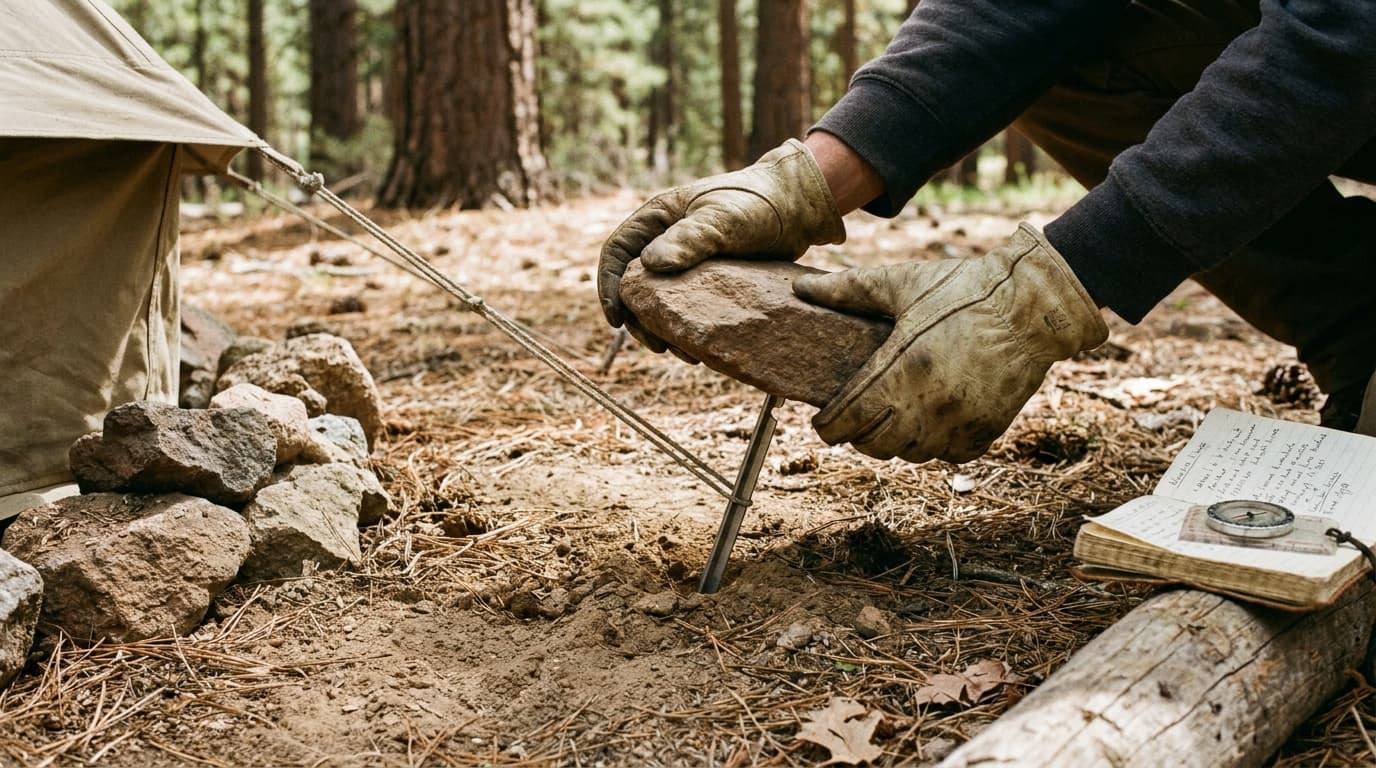
If there is one knot that feels like a magic trick, it is the Taut-Line Hitch. It is the secret to a sag-free tarp because it lets you slide the knot to adjust tension without ever having to untie your lines. Imagine you are in the middle of a storm and your rainfly starts to flap. Instead of fumbling with wet rope in the dark, you just slide the hitch, tighten the line, and the knot grips the rope to stay in place. It is simple logic: two wraps on the inside, one on the outside, and you have a line that stays tight until you decide otherwise. This is great for beginners because you do not have to get the tension perfect on the first try.
This kind of practical skill is what survival experts like Sergio Outdoors call fundamental. While social media is full of quick lifehacks, the real value comes from these reliable methods that work when things get grumpy. Whether you are trying to keep your wood dry for a fire or just making sure your tent does not fly away, getting the hang of a few high-utility knots is better than knowing thirty you can’t remember when it counts. It keeps things simple, keeps you dry, and ensures your gear actually stays where you put it.
Key insights:
Tension management is the difference between a secure camp and a gear failure.
The Taut-Line Hitch allows for easy adjustments without untying knots in wet conditions.
Focus on a few versatile knots rather than trying to memorize complex manuals.
The Taut-Line Hitch: The Secret to a Sag-Free Tarp
Ever set up your tarp only to have it sag the moment a little rain hits? It is frustrating. You want your gear tight, but you do not want to keep untying knots with cold, wet fingers. This is where the taut-line hitch becomes your best friend. It is a sliding hitch that lets you adjust tension just by pushing the knot up or down the line.
Think about those nights when the wind picks up or your rope stretches from moisture. Instead of fighting with a tangled mess, you simply slide the knot to take up the slack. It is exactly the kind of practical solution that outdoor communities are always sharing to handle environmental challenges. It keeps your shelter solid and your gear safe without the headache.
To tie it, loop the rope around a stake and wrap the tail twice inside that loop. Then, wrap it once more on the outside before tucking it through. It grips the line under load but slides when you move it manually. This simple trick saves your gear from the elements and keeps you dry when nature gets grumpy.
Key insights:
There is a consistent demand in camping communities for practical solutions to moisture and tension issues.
The taut-line hitch allows for immediate gear adjustments without the need to untie or reset stakes.
Digital survival education frequently highlights these types of bushcraft knots as essential skills for adverse weather.
Clean Water on the Fly: Building a Filter from Scratch
Imagine you’re miles from the nearest tap and your water bottle is bone dry. You find a stream, but it’s full of silt and floaties. This is where a DIY survival filter saves the day. It’s a classic bushcraft trick that people in online communities like 'RV Hacking Camping Ideas' swear by when they’re off the grid. The secret isn’t just what you use, but how you stack it. Think of it like a sieve that gets tighter as the water moves down. You start with big stuff like pebbles at the top to catch twigs, then move to gravel, sand, and finally fine charcoal at the bottom.
Why does the layering order matter so much? If you put the sand on top, it would clog almost immediately. By layering from coarse to fine, you’re letting the big debris get caught early so the finer layers can do the heavy lifting. But here is the most important part: filtering is not the same as purifying. This setup removes dirt, sediment, and some chemicals, but it won’t kill tiny bacteria or viruses. You still need to boil that water before you take a sip. Think of this filter as the first step to making 'creek water' look like 'drinking water.'
Now, don’t kick those cold campfire coals aside just yet. That charcoal is actually your best friend for cleaning water. While it isn’t quite the 'activated' carbon you’d buy at a store, campfire charcoal acts in a very similar way. It helps remove impurities by giving them a place to stick. To make it work, you need to crush those black chunks into a fine powder. This creates more surface area, giving the water more spots to leave behind the nastiness you don't want to swallow.
Once you’ve packed your crushed coal into the bottom of your container, do a quick flow test. If the water gushes through, your layers are too loose. If it barely drips, you’ve packed it too tight. You want a steady, slow drip. It’s a bit of a balancing act, but getting it right means much clearer water. Just remember what survival experts often share under hashtags like #bushcraft: nature provides the tools, but you provide the technique. It’s all about working with what you have to stay safe and hydrated.
Key insights:
Filtering removes physical debris and some chemicals, but boiling or chemical treatment is still required to kill pathogens.
Layering materials from coarse (top) to fine (bottom) prevents the filter from clogging and ensures efficient sediment removal.
Crushing campfire charcoal increases its surface area, making it more effective at trapping impurities through adsorption.
A successful filter requires a controlled flow rate; water that moves too fast hasn't been properly filtered.
The Charcoal Layer: Why Your Old Campfire Is a Goldmine
Ever looked at the remains of last night's fire and thought it was just a mess? Those black chunks are actually a survivalist's best friend. When you are building a DIY water filter, charcoal acts like a magnet for nasty bits you cannot see. It is not exactly medical-grade, but it is close enough to do some heavy lifting in the wild.
To make this work, you need to get a little messy. Grab a rock and crush those coals into a fine powder. Why? Because more surface area means more room to trap impurities. Think of it like a sponge. More tiny edges mean better filtration. It is a clever trick often shared in camping groups where people love repurposing what they find.
Once everything is packed, watch the flow. You want a slow and steady drip. If the water rushes through, it has not spent enough time touching the carbon. If it is too slow, you will be waiting all day. Finding that sweet spot is a core skill, much like knowing how to start a fire with wet wood when nature gets grumpy.
Key insights:
Crushing coals into powder increases surface area for better filtration.
Charcoal acts as a natural magnet for microscopic impurities.
A slow drip rate is the best indicator of an effective DIY filter.
Primitive Fish Traps: How to Catch Lunch Without a Pole
Imagine you are miles from the nearest grocery store and your fishing pole is nowhere to be found. It happens to the best of us. While many beginners spend their time learning how to start a fire with wet wood, finding a reliable source of protein is just as important for staying energized. You do not need fancy lures or expensive reels to get a meal. Instead, you can use what the river gives you to build a primitive fish trap.
One of the most effective designs for moving water is the V-shape weir. Think of it as a funnel that points downstream. You build two walls of river stones or willow branches that meet at a narrow point. Fish swimming with the current get guided into the small opening. Once they are inside the trap area, the pressure of the water and the narrow exit make it very hard for them to find their way back out. It is a simple trick that works while you are busy doing other things like setting up your tent.
Building this requires a bit of patience and local materials. Willow branches are perfect because they are flexible and strong. You can weave them between larger stones to create a fence that water flows through but fish cannot. This kind of community knowledge is exactly what you see people sharing in groups like RV Hacking Camping Ideas. People are always looking for ways to work with nature rather than against it because it makes the whole experience easier.
Before you start stacking rocks, we have to talk about the rules. In the modern world, survival trapping is usually only legal in true emergency situations. Many states have strict laws against permanent or primitive traps because they can be too effective and disrupt local ecosystems. It is always a good idea to check your local fishing regulations before you practice these skills. Learning the how is great for your survival toolkit, but respecting the water is what keeps the hobby sustainable for everyone.
Key insights:
The V-shape weir uses natural water flow to guide fish into a capture zone without constant supervision.
Local willow and river stones are the best building blocks for a trap that blends into the environment.
Always verify local fishing laws because primitive traps are often restricted to emergency survival scenarios.
Staying Toasty When the Temperature Drops
Have you ever woken up at 3 AM feeling like a popsicle despite being buried in layers? It is a common frustration for anyone trying cold weather camping hacks to stay warm at night. The truth is that staying warm is about managing physics, not just piling on more fabric. While many people think a thicker sleeping bag is the only answer, outdoor enthusiasts in communities like RV Hacking Camping Ideas often share much smarter ways to trap heat without the bulk.
One of the most effective tricks involves thermal mass. Think of it this way: certain materials like rocks or water hold onto heat much longer than air does. If you place a few large stones near your fire and then move them near your sleeping area once they are warm but not scorching, they act like a natural heater for hours. You also need to understand the cold sink concept. Cold air is heavy and settles in the lowest spots of your tent or shelter. If you are sleeping directly on the floor in a low spot, you are essentially lying in a pool of cold. Raising your bed even a few inches can make a massive difference.
Sometimes your gear fails because of how you use it. If your sleeping bag is too big, your body wastes energy heating up all that empty space. If it is too tight, you compress the insulation and let the cold in. Also, remember that staying dry is part of staying warm. As experts like Sergio Outdoor point out in survival tutorials, even starting a fire with wet wood is a vital skill because moisture is the enemy of heat. If your clothes are damp from sweat or humidity, no sleeping bag in the world will keep you toasty.
When the temperature really drops, try the hot water bottle trick. Instead of just tossing a warm bottle at your feet, tuck it near your groin. This targets the femoral artery, which helps circulate warm blood through your whole body much faster than heating your toes would. It is a simple move that feels like turning on a radiator inside your sleeping bag. Just make sure the lid is tight and wrap the bottle in a sock to avoid burns or leaks. This prevents a damp mess and keeps the heat gentle against your skin.
Finally, keep in mind that a warm hat is often better than an extra blanket. Since your head is usually the only part of you sticking out of the bag, keeping it covered stops heat from escaping like a chimney. It is about being smart with the heat you already have rather than just fighting the cold.
Key insights:
Thermal mass from stones or water bottles acts as a natural heater inside your shelter.
Targeting the femoral artery with a heat source warms the entire body more effectively than heating extremities.
Avoiding the cold sink by elevating your sleeping surface prevents the ground from leaching your body heat.
The Hot Water Bottle Trick
Ever spent a night shivering in your sleeping bag, wondering why those extra blankets aren't doing a thing? It happens to the best of us. One of the most effective cold weather camping hacks to stay warm at night involves a simple bottle of hot water. But here is the trick: do not just toss it at your feet. Instead, tuck it between your legs near your femoral artery. This heats your blood as it circulates, warming your whole body from the inside out much faster than a pile of heavy quilts.
Safety is key here, so make sure that bottle is sealed tight and wrapped in a thick sock. You really do not want to wake up to a wet sleeping bag or a heat burn. Communities like the RV Hacking group often share these clever tweaks because they work. Another pro tip? Put on a warm hat instead of grabbing another blanket. Your head acts like a chimney, so trapping that heat at the source is way more efficient than adding layers on top. It is all about using your body's own mechanics to stay cozy.
Key insights:
Placing heat near the femoral artery warms the blood supply for faster full-body heating.
A warm hat is often more effective than extra blankets because it prevents heat loss through the head.
Always wrap hot water containers in fabric to prevent skin burns and check seals to avoid leaks.
Conclusion
At the end of the day, your pack might be full of gadgets, but they won't build a fire when the rain starts pouring. Survival is about what stays in your head, not just what is in your bag. Take that wet wood fire trick. It is a fundamental skill that experts and RV Hacking communities swap tips on because nature does not care how much you spent on your gear.
Do not wait until you are shivering in the woods to try these hacks. Spend an afternoon in your backyard messing with knots and fire-starting. It is better to fail near a warm kitchen than on a dark trail. You might see these tips on social media under tags like #bushcraft, but feeling the wood catch fire is what actually builds real confidence.
Nature is not an enemy. It is a teacher. When you stop fighting the elements and start working with them, even a grumpy, rainy night becomes manageable. So, grab some supplies and go practice. What is the first skill you will try this weekend?
Key insights:
Knowledge outweighs gear in true survival situations.
Backyard practice is the safest way to build outdoor confidence.
Viewing nature as a teacher changes your approach to challenges.
Frequently Asked Questions
You sure can. It is one of those survival skills that makes you feel like a total pro when you pull it off. Even if it has been pouring for days, the inside of a thick branch or log usually stays dry. You just need to get past the soggy outside to find the good stuff.
Here is the thing: try looking for dead branches that are still hanging on trees instead of ones on the ground. These stay drier because they are not sitting in the mud. Once you peel away the wet bark and get some dry shavings from the middle, your fire will be going in no time.
If you are in a rush, go for the Taut-Line Hitch. It is probably the most helpful knot for any camping trip because you can slide it to make a rope tighter or looser without untying it. It is perfect for when your tent gets a little floppy in the wind or your gear starts to shift.
Think of it like a sliding lock for your rope. It holds tight when you pull on it but moves easily when you want it to. It is basically the duct tape of the knot world. Once you know it, you will find yourself using it for everything from clotheslines to securing your bags.
You can use it, but it is not a perfect fix. While campfire charcoal helps take out some of the bad taste and murky bits from water, it is not the same as the activated charcoal you buy at the store. Activated charcoal has been treated to have tiny pores that trap way more toxins.
Here is the thing you should remember. Even if you use charcoal from your fire, it will not kill tiny bugs or viruses that make you sick. You should always boil your water after it goes through your DIY filter. It is a great backup skill to have, but it does not replace a real filter or boiling.
The short answer is usually no. In most places, using a primitive trap is against the law for recreational camping. Fish and wildlife departments have these rules to make sure people do not overfish an area or hurt the local ecosystem by accident.
These traps are mostly meant for real survival emergencies where you have no other choice. If you just want to try it out for fun, make sure you check the local state laws first. Some parks might let you build one for practice as long as you do not actually catch anything or leave it in the water.
So what is the real takeaway here? It is that a rainy forecast or a freezing night does not have to ruin your trip. When you know how to find dry wood inside a wet log or how to keep your tarp tight with a simple knot, you stop worrying about the weather and start enjoying the challenge. These outdoor hacks and tricks are really about building confidence so you can handle whatever the trail throws at you.
If you want to get better at this, your next move is simple. Do not wait for a survival situation to try these out. Head to your backyard or a local park and practice starting a fire with damp wood or building that DIY water filter. It is much more fun to learn these skills when you have a warm house nearby if things get a bit messy.
At the end of the day, nature is not your enemy. It is a teacher that rewards patience and a bit of clever thinking. Once you have these basics down, you will find that even the grumpiest weather can lead to your favorite camping stories. Stay warm, stay dry, and keep exploring.
Every WilderReady guide is researched, written, and fact-checked in-house against trusted references such as the American Red Cross, the National Park Service, and the CDC before it goes live. We publish under this shared byline instead of invented personas, so you always know who stands behind the guidance you are reading.