Outdoor Hacks & Tricks for Staying Safe and Warm in the Wild
Have you ever felt that sudden pit in your stomach when you realize the trail does not look familiar anymore? Maybe the sun is dipping low and your phone battery...
Outdoor Hacks & Tricks for Staying Safe and Warm in the Wild
Have you ever felt that sudden pit in your stomach when you realize the trail does not look familiar anymore? Maybe the sun is dipping low and your phone battery just hit zero. It is a moment every hiker hopes to avoid, but being ready for it makes all the difference. Knowing a few reliable Outdoor Hacks & Tricks like how to find north without a compass in the forest can turn a potential disaster into a story you tell later.
In this guide, we are going to cover practical ways to stay comfortable and safe when things do not go as planned. You will learn the best knots for securing a survival tarp in high wind and how to build a dakota fire hole for efficient bushcraft cooking. These are not just for experts; they are simple skills anyone can use to stay warm and dry even when the weather turns sour.
We will also look at night survival hacks for staying warm without a sleeping bag and the lightweight survival kit essentials for everyday carry hiking. From finding your way with just a stick to keeping a fire hidden and hot, these tips will help you feel much more at home in the woods. Let's get started so you can head out on your next trip with confidence.
The forest is beautiful, but it’s also unpredictable. Lately, bushcraft skills have blown up on social media, with creators showing us that staying safe is more about smart tricks than expensive gear. We all want a simple roadmap for staying warm, staying hidden, and finding our way when things get tough.
Take the Dakota Fire Hole. It’s a clever pit with a hidden air shaft that makes your fire burn hot with almost no smoke. It’s a win for cooking and stealth camping because it keeps your light low. Mix that with solid tarp knots, and you’re ready for anything the wild throws at you.
Key insights:
The Dakota Fire Hole uses a secondary air shaft to feed oxygen for high heat and low visibility.
Modern bushcraft focuses on low-impact techniques that minimize your visual footprint in nature.
Finding Your Way When the GPS Goes Dark
Imagine your phone dies just as the trail gets blurry and the sun begins to dip. That sudden spike in heart rate is totally normal, but you can shut it down by looking at the world a little differently. Navigation is not really about high-tech electronics or expensive gear. It is about paying attention to the small details we usually ignore when we are staring at a screen. When you learn to spot natural indicators, you stop feeling like a visitor and start feeling like you belong in the woods. That mental shift is everything. It turns a potential emergency into a manageable situation because you are never truly lost as long as you know where the cardinal directions are.
The reality is that people have traveled thousands of miles across unknown lands without a single satellite to help them. They used the same trees and sky you see right now. By learning how to find north without a compass in the forest, you are tapping into a very old human skill that never runs out of battery. It is not about overthinking every step or calculating complex angles in your head. It is about noticing where the light hits and how the wind moves. This kind of awareness does more than just keep you on the path. It makes the whole experience of being outside feel more grounded and real. You might even find that you prefer looking at the horizon instead of a glowing map.
The sun is your best friend when the GPS goes dark. All you need is a straight stick and a couple of small rocks. Push the stick into a flat, clear patch of ground and mark the very tip of its shadow with your first rock. Now, just relax for about fifteen or twenty minutes while the sun does its thing. As the sun moves, the shadow will crawl across the dirt. Mark the new tip of that shadow with your second rock. The line connecting those two points is your east-west axis. The first mark is always west and the second is always east. If you stand with the first mark on your left and the second on your right, you are facing north. This works surprisingly well even on hazy days because the sun still casts a faint shadow through the clouds.
You have probably heard the old myth that moss only grows on the north side of a tree, but that is a bit of a gamble. Moss likes moisture, and in a thick forest, that could be anywhere that is damp or shady. A much better hint is to look at the tree canopy. In the northern hemisphere, the side of the tree facing south usually gets more sun and grows fuller, heavier branches. At night, the stars take over the job. Find the Big Dipper and use the two stars at the end of the bowl as a pointer. They lead your eye right to Polaris, also known as the North Star. It stays put while the rest of the sky seems to shift, giving you a steady point to follow until the sun comes back up.
Key insights:
Navigation is a psychological game as much as a physical skill.
The stick and shadow method provides a reliable east-west line even in partial cloud cover.
Tree canopy density is often a more reliable directional indicator than moss growth.
The North Star remains the most consistent fixed point for night navigation.
The Stick and Shadow Method
Ever felt that sudden 'where am I?' panic while hiking? If your compass is gone, just look up. The stick and shadow method turns a simple branch into a reliable navigation tool that works without any fancy gear. Start by pushing a straight stick into a level patch of ground and marking the very tip of its shadow with a pebble.
Wait about fifteen minutes for the sun to shift, then mark the new position of the shadow tip. If you draw a line between these two marks, you have a clear east west axis. The first mark you made is always west, and the second is east. It is a simple way to find your bearings when you are turned around.
The best part? This works even on hazy, partially cloudy days when the sun is playing hide and seek. It is a simple, low impact hack that keeps you moving in the right direction without needing a single battery. Think of it as your natural GPS that never runs out of juice or loses signal.
Key insights:
The first shadow mark always points west because the sun rises in the east, casting the shadow in the opposite direction.
Using natural navigation methods supports the growing trend of low impact bushcraft and stealth camping.
Reading the Trees and Stars
Forget the old story about moss only growing on the north side of trees. Moss grows wherever it finds shade and moisture, so it could be on any side of a trunk depending on the local terrain. Relying on that myth can lead you in circles, which is bad news when you're scouting a spot for a stealthy Dakota fire hole where staying hidden is the main goal.
Instead, look up. Use the Big Dipper to find Polaris, the North Star. It stays fixed while everything else moves, giving you a reliable point of reference throughout the night. During the day, check the trees. Branches often grow thicker and the canopy looks fuller on the south side where the sunlight hits. These natural signs are much more dependable than a fuzzy rock.
Key insights:
Moss growth is determined by moisture and shade rather than a specific cardinal direction.
The North Star remains a stationary point for reliable night navigation in the northern hemisphere.
Sunlight exposure causes trees to grow more densely on the southern side, providing a natural compass.
The Dakota Fire Hole: A Stealth Camper’s Best Friend
Ever sat by a roaring campfire and felt just a little too visible? While a big, crackling blaze is awesome for a backyard party, it’s a bit of a problem when you’re trying to stay low-key in the woods. Standard fires throw light everywhere and send up smoke that basically shouts your location to anyone nearby. If you want to stay warm without the unwanted attention, you have to go underground. Enter the Dakota Fire Hole. It’s a stealth camper’s best friend because it’s efficient and keeps your presence a secret. Imagine a hidden furnace built right into the earth. It works using two holes connected by a small tunnel. One hole is for the fire, and the other is a vent that pulls in fresh air. This setup creates a natural draft that makes the fire burn hotter and cleaner than anything you’d build on the surface. Since the flames are tucked away below ground, the light is blocked by the walls of the pit. You could be just a few yards away and never see a flicker. For survival experts like the ones you see on TikTok, this is a go-to trick for staying invisible. It’s a clever way to cook and stay warm while keeping your campsite private and safe.
Getting the layout right is the secret to a good fire hole. You’ll want to dig your main fire chamber first, usually about a foot deep and just as wide. Then, about a foot away on the upwind side, dig your air intake hole. The important part is digging a tunnel at an angle to connect the bottom of both holes. Think of it like a straw feeding oxygen directly to the base of your fire. If you can find firm, clay-like soil, your pit will be nice and stable. Avoid super sandy spots where the walls might crumble. This design creates a chimney effect that keeps the oxygen flowing and the heat rising exactly where you need it. By optimizing the angle of that intake shaft, you ensure the flames get all the oxygen they need to stay hot without producing much smoke.
The heat you get from this setup is incredibly focused, which is perfect for a quick bushcraft meal. Instead of heat blowing away in the wind, it’s funneled straight up to your pot. You’ll find you can cook a whole dinner with just a few dry sticks, saving you the work of dragging around heavy logs. Plus, because it burns so hot, there’s hardly any smoke to give you away to anyone nearby. When you’re done, just fill the holes back in and scatter some leaves or forest debris. It’s like you were never there. It leaves the woods exactly how you found them, which is the heart of low-impact bushcraft and stealth camping.
Key insights:
The Dakota Fire Hole acts as a natural furnace, hiding light and reducing smoke for maximum stealth.
An angled air intake tunnel creates a chimney effect that feeds the fire constant oxygen.
Focused heat allows for efficient cooking with minimal wood compared to traditional surface fires.
Leaving no trace is easy. Simply fill the holes and cover with forest debris to hide your site.
How to Dig and Structure Your Fire Pit
Ever wonder how to keep a fire going without alerting everyone in the woods? Learning how to build a dakota fire hole for efficient bushcraft cooking is a must for stealth camping. You start by digging two holes about a foot apart. One is your fire chamber and the other is an air intake. The secret is the small tunnel connecting them at the base.
The angle of that tunnel matters most. A diagonal slope lets oxygen rush into the flames, creating a hot fire with almost no smoke. Just make sure the soil is stable and clay-like. Loose sand will cave in and ruin your setup before you can even start cooking. This method keeps your camp hidden while making the most of every bit of wood you find.
Efficient Cooking with Minimal Wood
Cooking in the wild doesn't require a big bonfire. The Dakota fire hole is perfect for bushcraft because it focuses heat directly onto your pot. By digging a main hole for the fire and a side hole for oxygen, you create a powerful chimney effect that generates high heat while using only a few sticks. This matters because it saves you time and energy when you are tired.
This setup is also great for staying hidden. Since the fire burns so hot, it produces very little smoke to give away your spot. When you're ready to leave, just fill the holes with dirt and cover the area with leaves. It is a simple way to stay warm and fed while leaving no trace behind.
Key insights:
The dual-hole design creates a chimney that pulls in air for a hotter, cleaner burn.
A hot fire produces less smoke, making it much harder for others to spot your camp.
Filling the holes with the original soil and ground cover leaves the area looking untouched.
Don't Let the Wind Win: Knots for a Secure Shelter
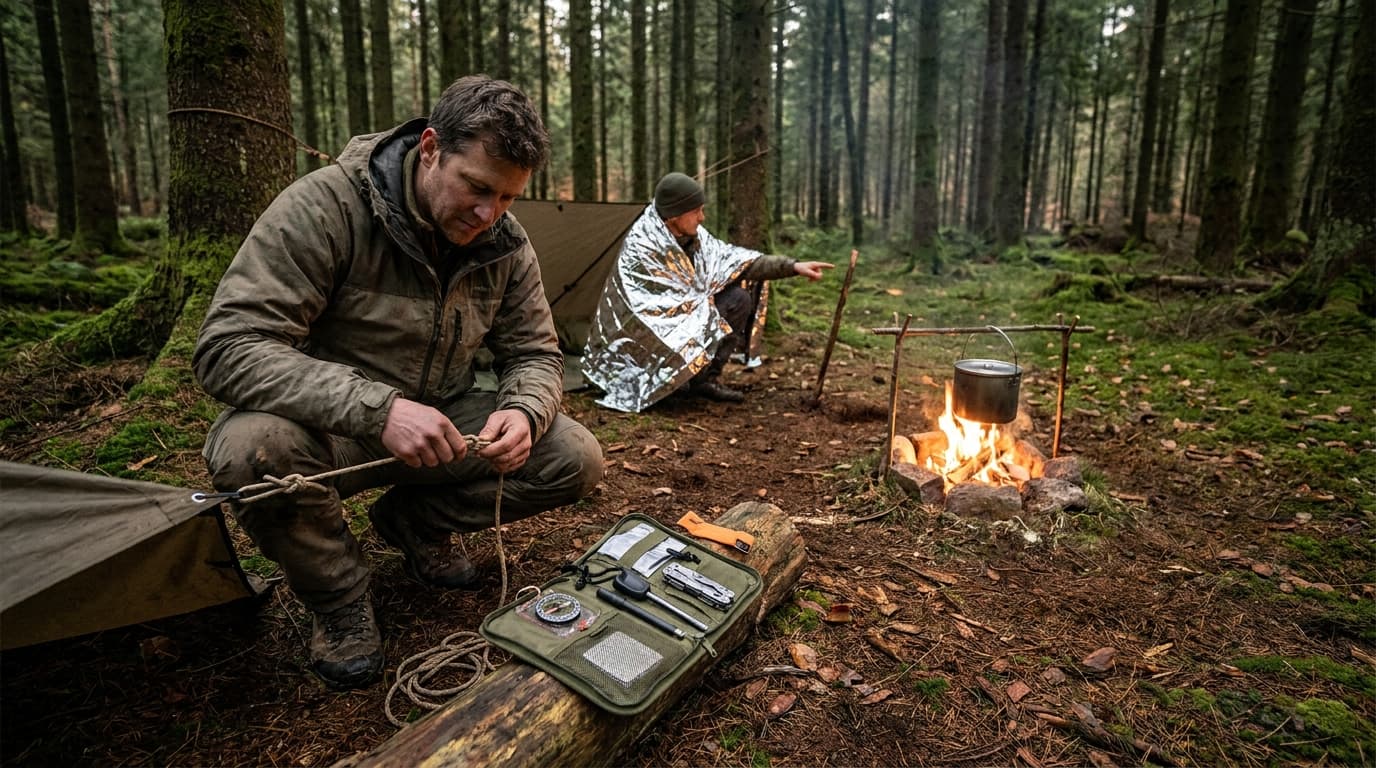
Imagine you are out in the woods and the wind starts howling. A loose tarp isn't just annoying. It is a liability that can leave you soaked and cold. The difference between a flimsy piece of plastic and a solid survival shelter often comes down to tension. If your lines aren't tight, the wind will catch the fabric like a sail and rip your stakes right out of the ground. You need knots that hold fast when the pressure is on but don't require a pair of pliers to undo when your hands are freezing.
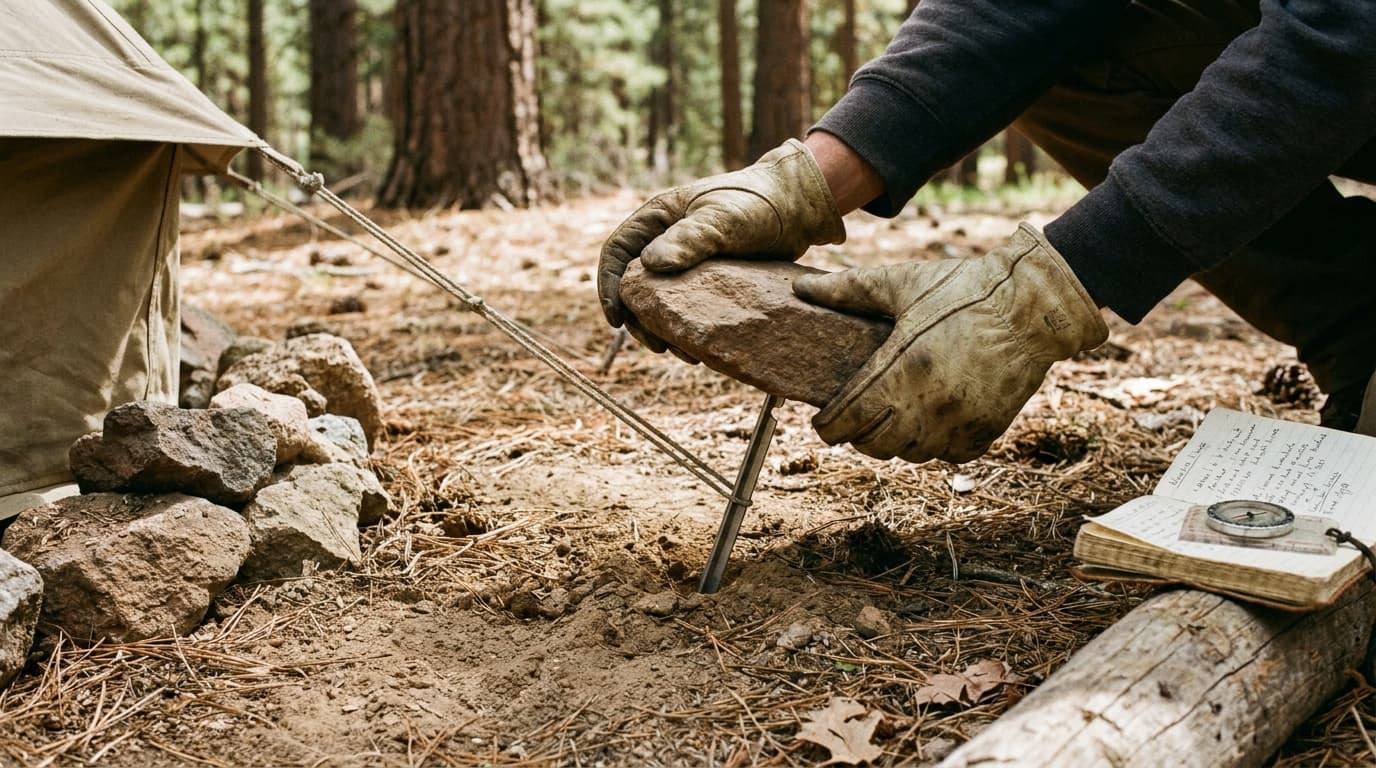
This is where the Taut-Line Hitch becomes your best friend. It is the go-to knot for securing guy lines because it acts like a sliding tensioner. Think of it as a manual adjustment dial for your shelter. It grips the line firmly when under tension. You can tighten the line as the fabric stretches or the wind picks up, and it stays locked in place once you let go. This keeps your tarp from slipping even during a heavy storm.
You might see bushcraft experts on TikTok showing these tricks in thirty seconds, but the logic is simple. Efficiency is everything. Just as a Dakota Fire Hole is used for stealth and heat efficiency, a properly tensioned tarp is about managing your environment with minimal effort. Using the right knots means you spend less time fighting the weather and more time staying warm and safe. It is a small detail that makes a massive difference when the weather turns.
Key insights:
Tension is the primary factor in preventing wind damage to survival shelters.
The Taut-Line Hitch allows for easy adjustments without untying the entire setup.
Survival skills are increasingly shared through short-form video platforms for rapid learning.
Efficient fire setups like the Dakota Fire Hole complement secure shelters for total forest stealth.
The Taut-Line Hitch for Adjustable Tension
Ever tried tightening a sagging tarp while the wind is howling? It is a nightmare if you are using basic knots that jam. This is where the Taut-Line Hitch saves the day. It is the best knot for securing a survival tarp in high wind because it acts like a sliding tensioner.
You just slide the knot up the line to pull everything tight, and it stays put. No more untying and re-tying when the weather shifts. It is a simple trick that keeps your shelter solid during a storm, so you can stay dry instead of fighting your gear.
Staying Warm When Your Sleeping Bag Isn't There
Imagine the sun just dipped below the treeline and you realize your sleeping bag is miles away. Suddenly, the woods feel a lot colder and the air feels sharper. To stay safe, you need to understand how your body loses heat. It happens through three main ways: convection from the wind, radiation from your skin, and conduction through direct contact with the earth. Most people worry about the air temperature, but the ground is actually your biggest enemy. It will literally suck the warmth right out of your bones if you let it. You have to get creative to trap every bit of body heat you can. Think of yourself like a thermos. You need layers of dead air space to keep the heat in. This isn't just about survival; it is about keeping your core temperature stable enough to think clearly. Have you ever noticed how a pile of dry leaves feels warm inside? That is the kind of natural insulation we are looking for. You also need to block the wind. Even a small breeze can strip away the thin layer of warm air your body works so hard to create. If you can find a natural hollow or build a small windbreak, you are already halfway there. The goal is to create a micro-climate where your own body heat stays put instead of vanishing into the forest.
Building a debris mattress starts with a simple rule. You need a lot more material than you think. Aim for the eight-inch rule, which means the pile stays eight inches thick even after you sit on it. Use dry leaves, pine needles, or old grass. If it feels crunchy, it is good. If it feels soft and damp, leave it alone. Wet materials will actually make you colder because they conduct heat away from you. You want to create a thick, dry mattress that keeps you high above the damp soil. It is basically a natural version of a high-end camping pad that keeps you dry and warm through the night.
Next, you need to think about your fire. A standard campfire loses most of its heat to the sky. Instead, try a Dakota fire hole. This setup is a favorite for stealth campers because it is incredibly efficient and keeps a low profile. It uses a secondary air shaft to feed oxygen directly to the flames, creating high heat with very little smoke. Survival creators like TA Outdoors often show how this keeps you warm without giving away your position. If you build a small reflector wall out of logs on the opposite side, that heat will bounce right back onto you. If you still feel a chill, keep your blood moving with small toe and finger wiggles.
Key insights:
Ground conduction is often the fastest way to lose body heat in the wild.
The eight-inch rule for debris mattresses ensures enough dead air space for insulation.
Dakota fire holes provide a high-heat, low-smoke solution for staying warm and cooking stealthily.
Building a 'Debris Mattress'
Ever feel the cold seeping into your bones even with a fire nearby? That’s the ground acting like a giant ice pack. When you’re out in the wild without a sleeping bag, a debris mattress is your best friend. It is a cozy, natural nest that keeps you warm and dry all night long.
To make one, grab plenty of dry leaves, pine needles, or grass. The trick is following the eight-inch rule. Your pile needs to stay at least eight inches thick even after you lay down on it. This separation is what provides the insulation needed to stay dry and keep your heat from escaping.
This low-impact hack is perfect for stealth camping and survival scenarios. Just like a Dakota Fire Hole saves fuel and stays hidden, this mattress saves your body heat without needing extra gear. It is a simple, effective way to stay snug when the temperature drops unexpectedly.
Key insights:
The eight-inch rule ensures enough compressed material remains between you and the cold ground.
Dry natural materials like pine needles and grass are excellent insulators for heat retention.
Ground insulation is often more important for staying warm than the air temperature itself.
The Radiant Heat Reflector
Ever feel like your fire is doing all the work but you're still shivering? Most of that warmth just drifts away into the dark. To fix this, you need to bounce that heat back onto yourself. A simple log wall or a space blanket tied behind you acts like a mirror. This is a total life saver when you're stuck without a sleeping bag.
Positioning is key. Keep the fire close enough to feel the glow but far enough to protect your gear. If you've built a Dakota Fire Hole, you're already using a highly efficient setup that focuses heat perfectly. Also, remember to keep moving. Small wiggles of your toes and fingers keep blood flowing throughout the night. These small shifts make a massive difference.
Key insights:
A heat reflector can double the warmth you feel from a small fire.
Constant micro-movements help prevent your extremities from getting too cold.
The Minimalist EDC: What Actually Belongs in Your Pack
Ever felt like you were lugging a small apartment on your back for a simple day hike? It is a common trap. We often pack for every possible disaster until the bag becomes too heavy to actually carry. Here is the shift you need: stop packing for the 'just in case' and start packing for the 'must-have.' A tiny kit in your pocket is infinitely better than a forty-pound ruck left in your trunk because it was too bulky to bring along. It all comes down to the weight-to-utility ratio. Every single item in your pack should earn its spot by being either essential or multi-purpose.
This is where the Five C's of Survivability come in. These are the non-negotiables: Cutting, Combustion, Cordage, Container, and Cover. If you have these, you can handle almost anything the woods throw at you. A solid fixed-blade knife or a reliable multi-tool is your best friend here. Think of it as the foundation of your kit. Then, look for dual-purpose heroes like a simple metal water bottle. Not only does it hold your hydration, but it also lets you boil water over a flame to make it safe to drink. A plastic bottle just can't do that.
For those who want to stay under the radar, efficiency is everything. Take the Dakota Fire Hole, for example. It is a clever fire pit design using a main hole for the fire and a secondary air shaft for oxygen. It creates a ton of heat for cooking while staying low-visibility and producing very little smoke. This is a favorite for stealth camping because it keeps you warm without calling attention to your camp. Whether you are learning how to build a dakota fire hole for efficient bushcraft cooking or practicing knots for a survival tarp, focus on the skills that let you do more with less gear. These lightweight survival kit essentials for everyday carry hiking are what truly keep you safe when things get unpredictable.
Key insights:
Prioritize the Five C's to ensure your basic survival needs are met without overpacking.
A metal water bottle is a vital multi-tool for both carrying and purifying water.
Stealth techniques like the Dakota Fire Hole provide high heat with minimal smoke and light.
The Five C's of Survivability
Think about your gear before you head out into the woods. Survival experts often talk about the Five C's: cutting, combustion, cordage, container, and cover. These are your absolute essentials for any kit. A reliable multi-tool or a sturdy fixed-blade knife handles the cutting. But for combustion, you need more than just a lighter. You need a smart strategy to keep that fire going without wasting energy.
This is where clever outdoor hacks come in. If you want to stay hidden and save fuel, learn how to build a dakota fire hole. This setup uses a main hole for the fire and a separate air shaft for oxygen. It creates a high-heat flame with almost no smoke. It is perfect for efficient bushcraft cooking while keeping your location low-profile.
Do not overlook your container. A simple metal water bottle is a dual-purpose hero because you can boil water directly in it to make it safe to drink. When you pair that with some strong cordage and a basic tarp for cover, you have a lightweight kit that handles the most dangerous situations. It is all about choosing tools that do more than one job.
Key insights:
A metal water bottle allows you to purify water over a fire without extra gear.
The Dakota Fire Hole is a top choice for stealth because it hides light and limits smoke.
Focusing on the Five C's ensures you have the most critical survival tools without overpacking.
Common Survival Questions Answered
Ever wonder why the big, crackling fires you see in movies are actually a bad idea for survival? Real bushcraft is about staying low-key and efficient. Many new hikers worry about staying warm, but they often overlook how much fuel they waste. This is where the Dakota Fire Hole comes in. It is a clever design with a main fire pit and a separate air shaft that feeds oxygen directly to the flames. Because it is underground, it hides your light and cuts down on smoke. It is a favorite for stealth campers who want to cook without drawing attention. Think of it as a hidden stove in the dirt.
The way we learn these skills is changing too. Instead of thick manuals, many people now get quick tips from short videos on platforms like TikTok. Creators show that survival is less about brute force and more about smart hacks. For example, if you are worried about your shelter blowing away, the secret is not a bigger stake but knowing the right knots to secure your tarp in high winds. You might also think you need a massive pack, but a lightweight kit for everyday hiking usually covers the essentials. What matters most is being prepared for the environment you are actually in, not the one you saw on a TV show.
Key insights:
Visual stealth is a top priority for modern survivalists and stealth campers.
The Dakota Fire Hole uses an air shaft to create high heat with minimal smoke.
Short-form video is quickly becoming the primary way people learn bushcraft skills.
Why Being Prepared Makes the Outdoors More Fun
Ever felt that tiny prickle of worry when the sun goes down in the woods? It is natural, but something shifts once you know how to handle yourself. Instead of fearing the shadows, you start seeing possibilities. Learning a skill like the Dakota Fire Hole changes your whole perspective. Because this design uses a secondary air shaft to feed oxygen to the flames, it stays hot and nearly invisible. When you can cook a meal without a smoky signal fire, the wilderness feels less like a threat and more like a home.
These methods link us back to our ancestors who used the same logic to stay safe and warm. Today, these survival hacks are making a comeback, proving you do not need a massive kit to feel secure. Go practice these tricks in your backyard or on your next hike. The more you know, the more fun you will have because you are no longer just surviving the outdoors - you are truly living in them.
Frequently Asked Questions
You'll find that the shadow tip method is likely the simplest way to get your bearings when the sun is out. You just need a straight stick and two small stones to mark the movement of the shadow over about fifteen minutes.
Because the sun always moves from east to west, the line you create between those two marks gives you a clear east-west axis. From there, finding north is easy. It's a classic trick because it doesn't require any gear and works as long as you have a bit of patience!
It really depends on the ground beneath your feet. While a Dakota fire hole is great because it's efficient and hard to see, it can be risky in forests with peaty soil or heavy root systems.
Here's the thing: fire can actually travel underground through dry roots or organic matter, starting a fire that stays hidden. You're much safer using this method in areas with mineral-heavy soil or clay. Always check the ground before you start digging to make sure you aren't creating a hazard that could spread after you leave.
You really only need a few reliable knots to handle most situations in the woods. The most important ones are the Taut-Line Hitch, the Bowline, and the Clove Hitch. These three will help you secure a survival tarp in high winds or tie gear to your pack without much fuss.
The Taut-Line Hitch is a personal favorite because it is adjustable. If your shelter starts to sag during a storm, you can just slide the knot to tighten the line back up. It is way easier than untying and redoing the whole thing when your hands are cold.
It sounds a bit wild, but stuffing your clothes with dry leaves or grass is one of the best ways to stay warm. These natural materials create little air pockets that trap your body heat, acting like a makeshift puffer jacket. It is a classic survival trick that actually works when you are in a pinch.
Also, if you can build a fire, try making a Dakota Fire Hole. Because it uses a secondary air shaft for oxygen, it burns very hot and stays low to the ground. This setup is super efficient for cooking and keeping you warm without wasting all your firewood or making a huge amount of smoke.
Conclusion
So what does all this mean for your next trip into the woods? It is about realizing that staying safe and warm is not just about the expensive gear you carry. It is about knowing how to use a simple stick to find north or why digging a dakota fire hole is better than a huge bonfire. When you understand how to tie a secure knot or build a mattress out of leaves, the forest stops feeling like a mystery and starts feeling like home.
You do not have to wait for an emergency to try these outdoor hacks and tricks. Your next move could be as simple as practicing that taut-line hitch in your backyard or testing a space blanket on a chilly evening hike. These skills are like muscles because the more you use them, the more natural they feel. Think of it as adding a few more tools to your mental belt every time you step outside.
The bottom line is that a little bit of knowledge goes a long way toward making the wild feel a lot more welcoming. Real confidence comes from knowing you can handle whatever the weather throws your way. So grab your kit, head outside, and have some fun out there. You have got this.
Every WilderReady guide is researched, written, and fact-checked in-house against trusted references such as the American Red Cross, the National Park Service, and the CDC before it goes live. We publish under this shared byline instead of invented personas, so you always know who stands behind the guidance you are reading.