How to Build a Fire That Lasts All Night Without Tending It
You can stay warm until morning if you know how to build a fire that lasts all night without tending it using a self-feeding ramp or a pyramid stack. These...
How to Build a Fire That Lasts All Night Without Tending It
You can stay warm until morning if you know how to build a fire that lasts all night without tending it using a self-feeding ramp or a pyramid stack. These setups use gravity and fuel density to keep your camp warm for up to 14 hours while you sleep.
Most campers struggle with fires that burn out every two hours, forcing them to wake up to add wood. Using dense hardwoods and specific stacking techniques solves this problem so you can actually get some rest.
This guide covers the one-inch rule for burn time and how to set up builds that feed themselves.
How to Build a Fire That Lasts All Night Without Tending It
A fire that lasts until dawn relies on fuel density and gravity rather than constant attention. Instead of a fast-burning teepee, use a pyramid or ramp to keep heat steady, which is a core survival skill.
Imagine sleeping soundly while your fire stays hot. A double-ramp build uses gravity to pull fresh logs into the center as the bottom ones vanish, providing warmth for up to 14 hours straight.
Choose hardwoods like oak or hickory for longer-lasting embers.
Use the one-inch rule to gauge burn time based on log thickness.
Stack your largest logs at the base to create a self-feeding foundation.
Sprinkle a thin layer of ash over the coals to slow the burn.
Why Your Choice of Wood Dictates Your Sleep Quality
Learning how to build a fire that lasts all night without tending it starts with your choice of fuel. The wood you toss on the fire before bed determines how many times you will wake up to fix it. Hardwoods are the secret to a long, uninterrupted sleep because they are much denser than softwoods. This density means the logs burn slower and, more importantly, they create a thick bed of hot coals that radiate warmth for hours.
Softwoods like pine or fir are full of resin, which makes them catch fire quickly but also makes them burn like paper. They might give off a lot of light and immediate heat, but they lack the structural integrity to last through the night. If you rely on pine, you will likely be out of fuel and shivering within sixty minutes. This is why experienced campers prioritize hardwoods like oak, hickory, or maple for their overnight foundations.
Imagine two campers on a cold night. The first gathers whatever fallen pine and cedar they can find near their tent. Their fire is roaring and crackly at 9 PM, but by midnight, it is just a pile of cold ash. The second camper uses seasoned white oak. They spend a little more time sourcing the right fuel, but their fire settles into a deep, pulsing red glow that keeps their shelter warm until the sun comes up. This difference in fuel choice is one of those essential survival skills that separates a miserable night from a restful one.
You should also pay attention to moisture. Burning wet wood is a losing battle because the fire has to spend all its energy boiling off water before it can produce heat. This results in heavy smoke and a fire that struggles to stay alive. To avoid this, always look for seasoned wood that has had time to dry out properly. When selecting your fuel, remember the one-inch rule. For wood over six inches in diameter, you can expect about an hour of burn time for every inch of thickness. This simple math helps you calculate exactly how much wood you need to reach morning without ever leaving your sleeping bag.
Prioritize hardwoods like oak, hickory, or maple for the base of your overnight fire.
Source seasoned wood to avoid excessive smoke and a rapid burn-off.
Use softwoods like pine only for the initial startup and kindling.
Apply the one-inch rule to estimate your total burn time based on log thickness.
Avoid wet or green wood that wastes heat energy on evaporating moisture.
Hardwood vs Softwood for Longevity
Dense wood is the only way to ensure your fire has the legs to make it through the night. Hardwoods are packed with more fuel fiber than softwoods, allowing them to burn at a slower, more consistent rate. This density creates the deep bed of embers necessary for long-term warmth. In fact, hardwood is the optimal fuel for long-burning fires because it produces hotter, more durable coals.
Take a hiker who gathers fallen birch and pine because it is easy to break by hand. By the time they finish their first hour of sleep, the fire has already collapsed into cold ash. If they had sourced a few thick chunks of seasoned maple, those logs would still be pulsing with heat when the sun began to rise. Sourcing the right fuel is one of those wilderness survival fundamentals that keeps you from shivering at 3 AM.
Prioritize dense hardwoods like oak, hickory, or maple for the core of your fire.
Avoid unseasoned green wood which produces more smoke than heat.
Use pine only for the initial kindling to get larger logs catching.
Check that logs are dry by looking for cracks or checking if they sound hollow when tapped.
The One-Inch Rule for Estimating Your Burn Time
You can stop guessing how much wood you need to get through the night by using the one-inch rule. This simple calculation states that for logs over six inches in diameter, you can expect roughly one hour of burn time for every inch of thickness. If you are using thinner wood, the math shifts slightly. Logs under six inches typically follow a half-inch rule, meaning they burn through their diameter much faster because they lack the dense core of a larger timber.
This calculation works best with seasoned hardwoods like oak or hickory because they are packed with fuel fiber. By measuring the diameter of your largest logs before the sun goes down, you can build a fuel pile that lasts exactly as long as you plan to sleep. It is one of those wilderness survival fundamentals that prevents the shivering 3 AM wake-up call when the fire has already collapsed into cold ash.
Imagine you are settling into your sleeping bag at 10 PM and want to stay warm until 6 AM without getting up. To get those eight hours of steady heat, you should look for a solid oak log that is at least eight inches thick. If you only have four-inch logs, you would realize you need to stack several of them or use a self-feeding ramp to keep the heat consistent, as a single thin log will be gone long before midnight.
Also, remember that oxygen flow and wood density play a role in this math. A thick log of soft pine will never match the burn time of a slightly thinner piece of maple or oak. If you find your wood is burning too quickly, you can actually slow the process down by adding a bit of ash to the fire to dampen the airflow, helping you stretch that one-inch estimate even further.
Measure your thickest logs to set a realistic baseline for your fire's total lifespan.
Calculate your fuel needs by allowing one hour of burn time per inch for logs over six inches wide.
Prioritize dense hardwoods like oak or hickory to ensure the rule holds up against the night air.
Look for seasoned logs with cracks in the end grain, as wet wood wastes energy on evaporation rather than heat.
Avoid using small branches for your overnight base since they burn through their diameter too rapidly to provide lasting warmth.
The Double Ramp Fire That Feeds Itself While You Sleep
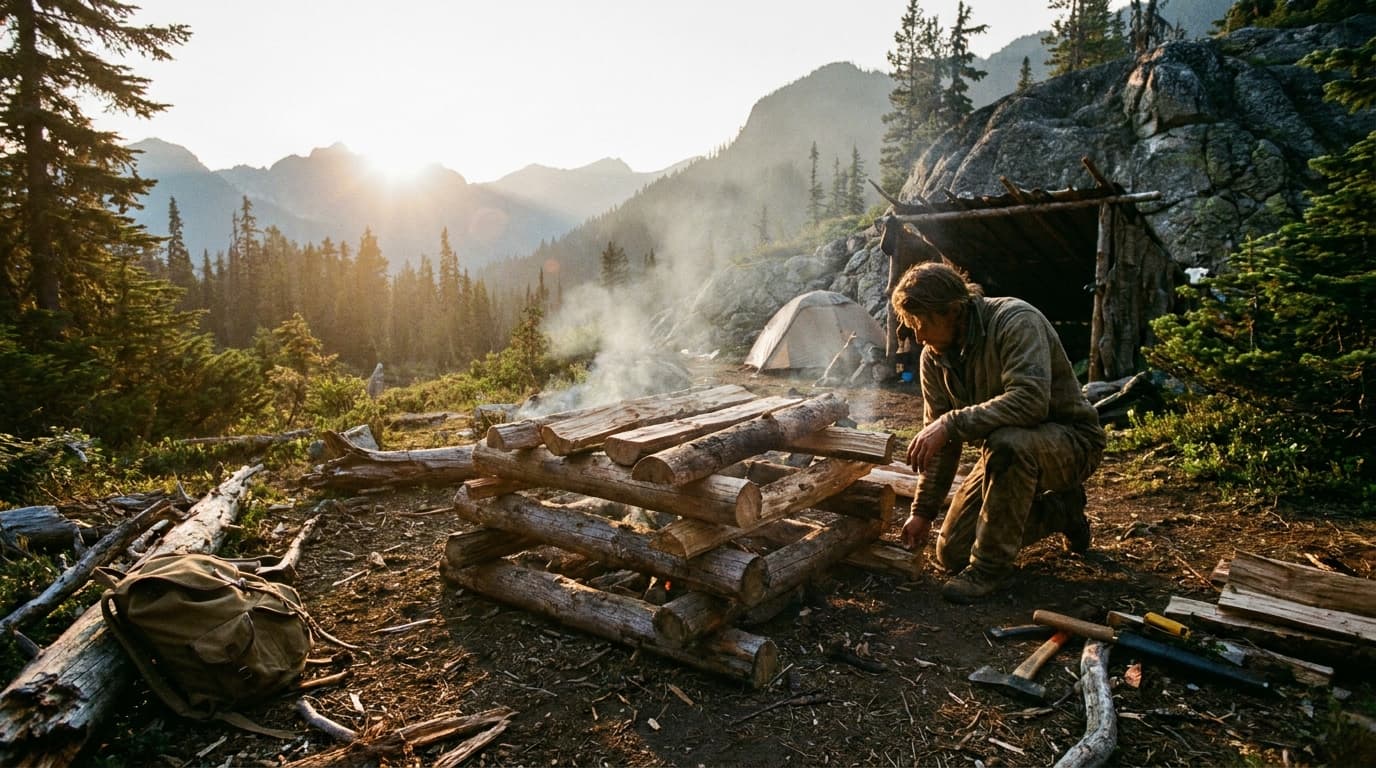
Building a double ramp fire is the most effective way to stop waking up every two hours to toss logs on a dying flame. This mechanical self-feeding system uses a V-shaped frame to hold a stack of logs above a central fire pit. As the bottom logs burn away and turn into coals, gravity naturally pulls the next pair down into the heat, creating a cycle that can last for up to 14 hours. It is a game-changer for anyone practicing wilderness survival fundamentals who actually wants to get a full night of rest without the shivering 3 AM wake-up call.
Imagine you are camping in late autumn when the temperature drops near freezing. Usually, you would have to climb out of your warm sleeping bag three times a night to fix the fire. With a double ramp set up, you can stack four or five thick hardwood logs on each side before bed. You fall asleep watching the bottom logs glow, and while you are dreaming, the weight of the upper logs slowly pushes fresh fuel into the embers. You wake up at dawn to a bed of hot coals and a fire that is still putting out steady heat.
The success of this build depends on wood selection and density. Hardwood like oak or maple is best because it is denser and creates the lasting embers needed to ignite the next log sliding down. If you use softwoods like pine, they might burn too fast for the gravity feed to keep up. Also, adding a thin layer of ash to the base can help throttle the oxygen, ensuring the wood burns slow and steady rather than in a quick, hot burst. This is a simple trick to stretch your fuel even further through the coldest hours.
Setting up the V-ramp starts with finding the right angle for your supports. If the slope is too flat, the logs will just sit there; if it is too steep, they might tumble out all at once. Aim for a moderate incline where the logs only move when the space below them clears. You should use heavy green wood for the ramp supports. Since green wood has high moisture content, it resists catching fire, keeping your ramp structure intact while the dry fuel logs burn through the night.
To prevent jams, make sure your fuel logs are roughly the same length and diameter. If one log is significantly crooked, it can snag on the ramp and stop the whole process. Lay them flat and parallel so they slide like a deck of cards. This attention to detail is what separates a frustrating night of tinkering from a worry-free survival scenario where you actually stay warm and safe until sunrise.
Construct two opposing ramps in a V-shape to automate the fueling process.
Use green wood for the ramp stakes so they do not burn up along with your fuel.
Select straight, uniform logs to prevent the stack from jamming on its way down.
Drive four sturdy stakes into the ground at a 45-degree angle to create the tracks.
Clear the ground of all organic debris to create a 10-foot safety radius around the ramp.
Setting Up the V-Ramp Construction
The V-ramp construction uses two opposing slopes to gravity-feed logs into a central fire pit. As the bottom wood turns to ash, the logs stacked above naturally slide down to replace them. For this to work, you must use heavy green wood for the ramp stakes. The high moisture content in green wood resists catching fire, ensuring the support structure stays solid while the dry fuel logs burn.
Imagine sleeping through a freezing night without ever leaving your warm bag to check the flames. Instead of waking at 2 AM to shiver and poke at dying embers, a properly built V-ramp can keep your camp warm for up to 14 hours without any tending. This setup turns a cold night into a successful survival scenario where you wake up safe and well-rested.
Angle your ramp stakes at roughly 45 degrees so logs slide smoothly without tumbling out.
Select straight, uniform logs of similar diameter to prevent the stack from jamming on the way down.
Drive the green wood supports deep into the soil to handle the heavy weight of the fuel stack.
Clear a 10-foot radius of all leaves and dry debris before lighting the central valley.
Why the Upside-Down Pyramid Is Better for Steady Heat
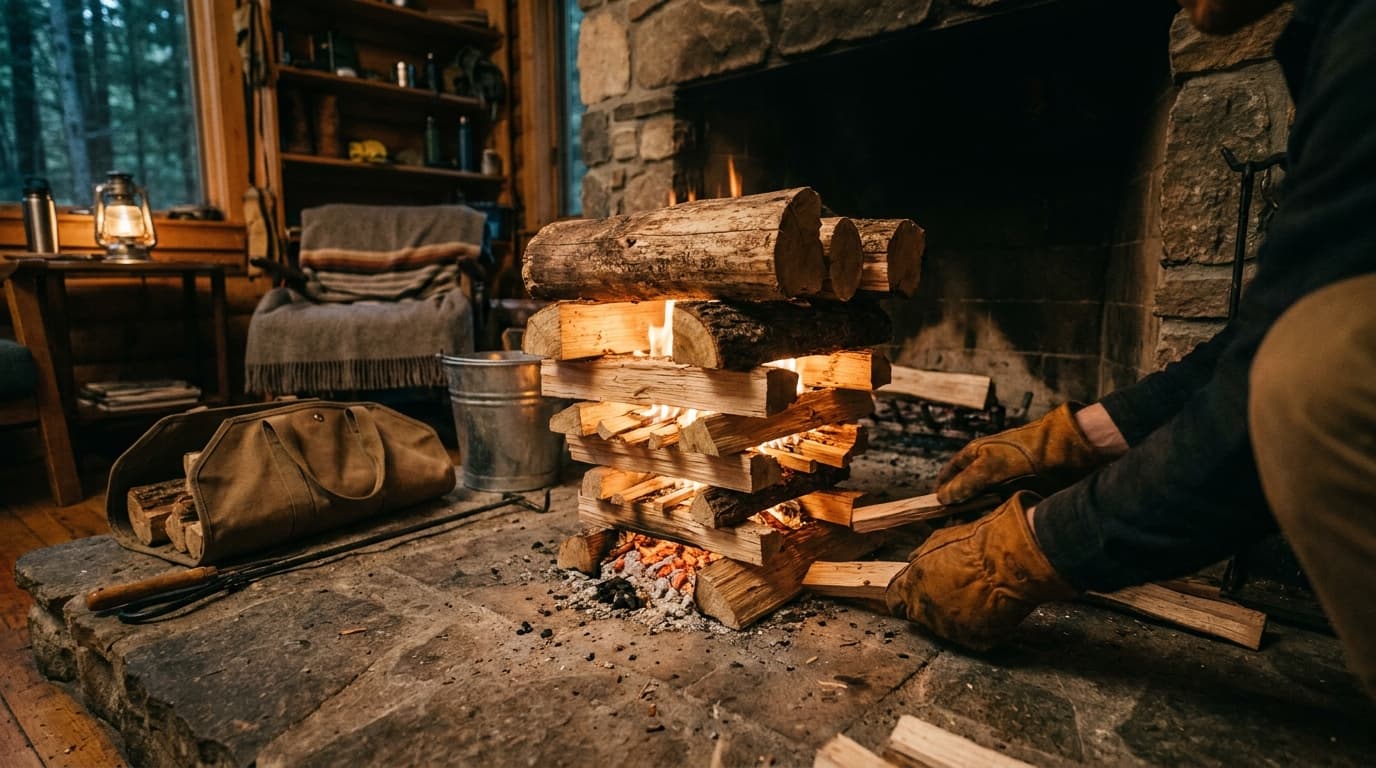
You do not need complex ramps or gravity-fed systems to stay warm through a freezing night. The upside-down pyramid, often called a top-down fire, works by reversing the traditional setup to create a self-feeding heat source. By placing your thickest hardwood logs at the base and building smaller layers upward, the fire slowly consumes itself from the top down. This prevents the structure from collapsing and smothering the coals, which is the most common reason a standard fire goes out while you sleep.
This method relies on the one-inch rule, where wood over 6 inches in diameter burns for roughly one hour per inch of thickness. Since the heat radiates downward, the bottom logs char and turn into a massive bed of glowing embers rather than burning away quickly. It is a highly efficient way to manage oxygen because the top layer acts as a natural cap, slowing the burn rate of the fuel beneath it. This is a great skill to practice for any survival scenario where you need to prioritize rest over fire maintenance.
Imagine you are settling into your sleeping bag after a long day of hiking. Instead of waking up every two hours to poke at a dying flame, you watch the small tinder at the very top of your pyramid slowly ignite the kindling below. For a first-time camper, lighting the top of a pile feels counterintuitive, but by the time you drift off, the fire has established a steady, self-sustaining heat source that requires zero manual movement. You can sleep soundly knowing the weight of the bottom logs keeps the foundation stable as the fire moves through each layer.
If you have access to a single large log instead of many small ones, the Swedish Torch is a powerful alternative for concentrated heat. You split a log that is at least 20cm wide and 60cm long vertically into four or six segments and tie them back together or wedge them firmly in the ground. By lighting the center, the log burns from the inside out using internal combustion. This vertical setup creates a chimney effect, providing a stable heat source that can last all night and even provide a flat surface for a morning coffee pot.
Stack four layers of wood, starting with your thickest hardwood at the base and decreasing in size with each layer.
Place the bottom logs tightly together to limit airflow and significantly slow the combustion process.
Choose a log at least 20cm wide for the Swedish Torch to ensure it remains stable and burns for several hours.
Sprinkle a thin layer of old ash over the bottom logs if you want to dampen the burn and preserve heat for the morning.
Use seasoned oak, hickory, or maple for the base to ensure the fire produces dense, lasting embers.
The Swedish Torch Alternative
The Swedish Torch is a clever way to get hours of heat from a single upright log. You split a large log vertically and light it from the center to create a chimney effect. This internal combustion allows the wood to burn from the inside out, providing a steady heat source that requires almost no maintenance once the core is glowing.
Imagine you are in a survival scenario with only one massive hardwood log and limited space for a wide fire pit. By making vertical cuts and stuffing tinder into the core, you create a self-contained furnace that stands firm against the wind. While a standard fire might collapse and die out, this vertical setup stays stable and even provides a flat surface for a morning coffee pot.
Choose a log at least 20cm wide and 60cm long to ensure it stays stable and burns through the night.
Split the log into four or six segments and keep them wedged together to concentrate the internal heat.
Use the one-inch rule to estimate burn time, as dense wood over 6 inches thick lasts about one hour per inch.
Light the fire inside the center slits so embers fall inward and sustain the combustion.
Slowing the Burn by Throttling Oxygen and Using Ash
Fire is a hungry beast. If you give it all the air it wants, it will devour your logs in a few hours, leaving you shivering by midnight. The secret to a long burn isn't just the wood you choose, but how you control the airflow. By limiting oxygen, you force the fire to smolder and eat through the fuel at a much slower pace.
You can do this by physically blocking the wind or choking the embers. Adding ash to a fire is one of the most effective ways to prolong its life because it acts as a thermal blanket. It keeps the heat in while preventing oxygen from reaching the core of the coals too quickly. This is a vital part of essential survival skills when you need to conserve fuel in a cold environment.
Imagine you’ve built a solid hardwood fire, but the wind starts picking up across the lake. Without protection, that breeze acts like a bellows, turning your slow-burning oak into a roaring furnace. To save your sleep, you bank the fire by raking a thin layer of old, cold ash over the glowing red heart of the pit. This keeps the embers alive until morning without letting them flare up and burn out, even in tough survival scenarios.
This technique turns your fire pit into a slow-cooker rather than a grill. It ensures that when you wake up, you aren't starting from scratch with cold tinder. Instead, you will find a bed of hot coals ready to be brought back to life with just a few small sticks.
Build a stone circle or a U-shaped wall of logs to block direct wind from hitting the base of the fire.
Sprinkle a thin layer of old, cold ash over active embers before bed to preserve heat for the morning.
Pack your largest base logs as tightly as possible to minimize the gaps where air flows.
Avoid using a deep, narrow pit that can create a chimney effect, which speeds up combustion.
Keeping the Camp Safe When You Aren't Watching the Flames
Sleeping while a fire is burning feels risky, but it doesn't have to be if you prioritize physical distance and containment. The goal is to create a dead zone where there is absolutely nothing for a stray spark to ignite. By clearing a 10-foot safety radius of all leaves, pine needles, and dry grass down to the bare mineral soil, you remove the fuel a forest fire needs to start. This simple preparation is one of the most essential survival skills for anyone spending a night in the bush.
Beyond clearing the ground, a heat reflector wall is your best friend for both warmth and safety. A simple wall made of green logs or stacked stones behind the fire does two things: it pushes radiant heat back toward your sleeping bag and acts as a physical barrier for flying embers. This setup ensures that even if a log shifts or pops, the debris is contained within the pit area rather than being blown toward your gear or the surrounding woods.
Imagine you are tucked into your bivy sack on a crisp October night. Instead of jumping at every crackle of the wood, you can relax because you know your fire is sitting in a dirt-cleared circle far wider than any coal could jump. You have stacked a wall of damp logs on the far side of the pit, which catches sparks before the wind can carry them into the brush. Because you followed the one-inch rule and used dense hardwood, the flames stay low and controlled while you drift off, making it easier to handle common survival scenarios like a sudden shift in wind direction.
Safety also comes down to the fuel you choose. Hardwood is the optimal fuel for long-burning fires because it is denser and produces hot, lasting embers rather than the volatile, spark-heavy flames of softwoods like pine. By banking your fire with a thin layer of ash before you close your eyes, you dampen the intensity and keep the heat concentrated at the core.
Clear a 10-foot circle around your fire pit until you see bare dirt or sand to eliminate ground fuel.
Build a reflector wall using wet or green logs to bounce heat toward your shelter and block wind-blown sparks.
Avoid using softwoods for the overnight burn because they pop and throw dangerous embers into the air.
Check the area above your fire for low-hanging branches that could catch heat or ignite from rising flames.
Bank the fire by raking a thin layer of ash over the coals to slow the burn and keep the fire manageable while you sleep.
Summary of the All-Night Burn Strategy
Staying warm until sunrise depends on your fuel and the fire's shape. Use dense hardwoods like oak because they create the heavy coals needed for longevity. By using the one-inch rule, where thick wood burns for about an hour per inch, you can judge if your stack will last all night.
Think about a camper who sets up a double ramp fire before bed. Instead of shivering at 3:00 AM, they sleep while gravity pulls fresh logs into the pit automatically. This is one of the wilderness survival fundamentals for beginners because it handles the work for you. It lets you focus on sleep rather than hunting for wood in the dark.
Select seasoned hardwood to get long-lasting embers instead of quick flames.
Build your ramp or pyramid structure before dusk so you can check the balance of the logs.
Measure the diameter of your wood to ensure you have enough thickness for your planned sleep time.
Sprinkle a light layer of ash over the hot coals to slow the burn and keep the heat concentrated.
Frequently Asked Questions
You'll want to stick with hardwoods like oak, hickory, or maple because they are significantly denser than softwoods like pine or cedar. This density is the secret to a long burn; hardwood is the optimal fuel because it creates a bed of hot, lasting embers that stay warm long after the initial flames die down.
But here is the thing: the species only matters if the wood is seasoned. Green wood is full of moisture and will spend all its energy trying to evaporate water instead of giving off heat. If you're scavenging, look for wood that has visible cracks at the ends and a dull clack sound when two pieces are hit together. If you're stuck with less-than-ideal wood, you might want to try a Swedish Torch, which focuses the heat inside a single log to keep it burning steadily.
The most reliable way to keep the heat going is to use a predictable timing method. If you're using logs under 6 inches in diameter, follow the one half-inch rule, which estimates about one hour of burn time for every half-inch of wood thickness. This helps you figure out exactly how high to stack your self-feeding ramp before you crawl into your sleeping bag.
Weather also plays a massive role that most people overlook. A sudden breeze can act like a bellows, making your fire burn twice as fast as you intended. If it's a windy night, try building a small stone wall or a reflector made of green logs on the windward side. This doesn't just bounce heat back at you; it protects the fire from excessive oxygen, ensuring your fuel lasts as long as the math says it should.
It is never completely risk-free, but a properly built self-feeding fire is designed to stay contained within its own structure. The biggest concern isn't usually the flames spreading, but rather a mechanical failure where a log gets hung up on the ramp and doesn't slide down. If one side of a V-ramp jams while the other keeps feeding, the fire can become lopsided and potentially tip.
To prevent issues, you should anchor your ramp supports deep into mineral soil rather than just resting them on the forest floor. According to experts, a double ramp self-feeding fire can burn for up to 14 hours, but you still need a clear three-foot 'safety zone' of dirt or rock around the pit to catch any sparks that might pop during the night.
You should plan on using at least six to eight thick hardwood logs to get through the night comfortably. While the One-inch Rule suggests an 8-inch diameter log will last eight hours, that is a theoretical maximum. In a real-world camp setting, you need the combined heat of multiple logs to keep the coal bed hot enough to ignite the next piece of wood.
Here is a tip most people miss: the weight of the logs is just as important as the count. If you are using a gravity-fed ramp, you need enough heavy logs stacked on top to provide the downward pressure required to slide the bottom logs into the fire. If the stack is too light, friction might stop the logs from moving, and your fire will die out before the fuel is actually gone.
Conclusion
Getting through a cold night without constantly poking at the embers comes down to two things: choosing the right fuel and letting gravity do the work. When you combine dense hardwoods like oak with a self-feeding ramp or an upside-down pyramid, you stop being a servant to the flames. You are basically setting a mechanical timer made of wood that ensures you stay warm from dusk until the first light of morning.
If you are new to this, start with the pyramid method. It is simpler to stack and incredibly stable. As you get more comfortable, you can experiment with the double ramp for even longer burn times. Just remember that no matter which build you choose, your safety setup is what actually lets you sleep soundly. A clear perimeter and a solid reflector wall turn a good fire into a worry-free heat source.
The real test of a successful build is waking up to a bed of glowing coals instead of a pile of cold ash. Once you get the hang of these techniques, you will never look at a standard campfire the same way again. Enjoy the extra sleep.
Every WilderReady guide is researched, written, and fact-checked in-house against trusted references such as the American Red Cross, the National Park Service, and the CDC before it goes live. We publish under this shared byline instead of invented personas, so you always know who stands behind the guidance you are reading.