Why Your Survival First Aid Kit is Useless if It Stays in the Truck
Think about your favorite sidearm for a second. It is completely worthless if it is not strapped to your hip when you actually need it. The same logic applies to...
Why Your Survival First Aid Kit is Useless if It Stays in the Truck
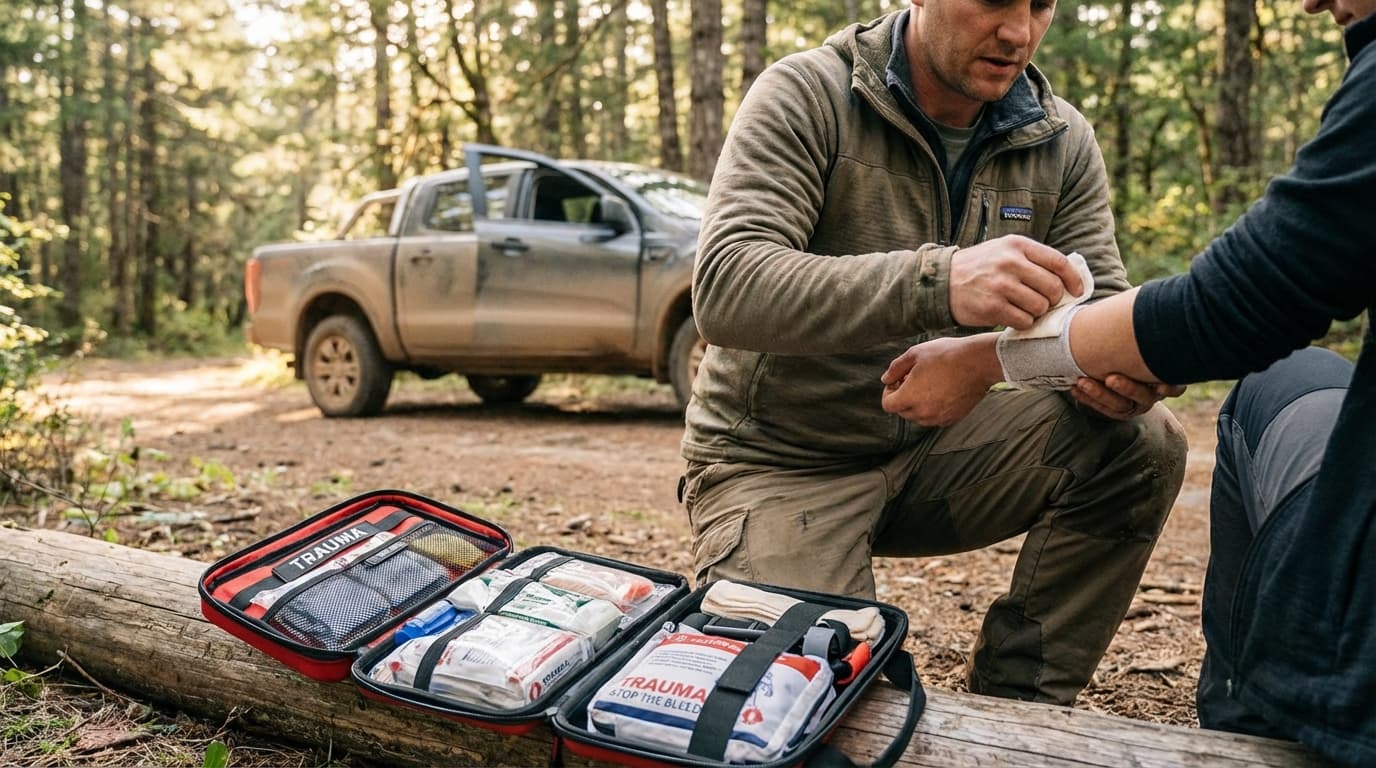
Think about your favorite sidearm for a second. It is completely worthless if it is not strapped to your hip when you actually need it. The same logic applies to your survival first aid kit. If your medical gear is sitting in the glove box while you are miles deep in the brush, it might as well not exist. Backcountry emergencies do not wait for you to walk back to the trailhead, so your gear needs to be as mobile as you are.
Modern backcountry medical supplies have evolved far beyond basic bandages and tiny antiseptic wipes. Today, smart hikers and hunters are carrying pro-grade tools like a stop the bleed kit to handle serious injuries. We are going to look at why portability is the most important factor in your setup and how to treat wounds in the wild using professional-grade gear that actually fits in a pocket or on a belt.
You will learn how to build a hybrid kit that combines medical essentials with survival tools and why emergency medical skills are just as vital as the gear itself. We will also cover specific items like tourniquets and chest seals that can save a life when every second counts. Let's make sure your gear is ready to go exactly where you go.
Imagine you’re miles from the trailhead when a bad fall happens. If your medical gear is sitting in your truck, it might as well be on the moon. Expert Jon Hunt says a first aid kit is like a sidearm because it’s worthless if it isn't strapped to you. Backcountry emergencies happen when you’re away from camp, so portability is everything.
The goal is a kit small enough to carry, like the BMG Summit Kit. You want professional-grade tools like Gen 7 CAT tourniquets or QuikClot gauze that stops bleeding five times faster than your body can. This is how you build a kit that actually stays on your person instead of gathering dust in the glovebox.
The Golden Rule: If You Won't Carry It, It Doesn't Count
You are miles from the trailhead when a simple slip turns into a deep, bleeding gash. If your trauma supplies are sitting in the glovebox of your truck, they might as well be on the moon. It is a classic hiker dilemma. Do you pack for every possible disaster or keep things light enough to actually enjoy the trek? Most people choose comfort, often leaving the heavy medical bag behind in the vehicle or at the base camp. But as Jon Hunt from Frontier Safety and Supply points out, a first aid kit is just like a sidearm. It is worthless if it is not strapped to you. This weight versus safety trade-off is a reality that every hiker and hunter faces.
The on-your-body philosophy is the only way to stay safe when things go wrong. If your medical tools are not physically on you, they do not count. Modern gear makes this easier because professional-grade trauma tools like the Gen 7 Combat Application Tourniquet or QuikClot gauze are now light and portable. QuikClot is designed to stop bleeding five times faster than your body can naturally. A CAT tourniquet uses a patented windlass system to apply pressure and save lives in seconds. When these items are small enough to fit in a pocket, you lose the excuse to leave them behind. This shift toward pro-grade gear means you can carry hospital-level tools without the hospital-level weight.
Keeping your kit small enough to matter is the best way to avoid gear creep. Jon Hunt warns that the biggest challenge is making sure your kit is small enough that you will actually bring it along. To keep things light, look for modular options like the BMG Summit Kit. It is priced around eighty-nine dollars and focuses on the absolute fundamentals while you improvise the rest. Use your pockets or belt attachments to stay connected to your gear even if you drop your pack. The psychology of portability is simple. If your kit is easy to carry, it becomes part of your routine. When your medical supplies are as easy to grab as your keys, you will never be caught without them.
Key insights:
The effectiveness of a first aid kit depends entirely on its portability and the user's willingness to carry it.
Modern backcountry supplies are shifting toward professional trauma tools like CAT tourniquets and HyFin chest seals.
Modular kits like the BMG Summit Kit help avoid gear creep by focusing on packing fundamentals and improvising the rest.
Keeping Your Kit Small Enough to Matter
Ever notice how your pack gets heavier every single season? Jon Hunt calls this gear creep, and it is a trap that makes your first aid kit useless. If your kit is a bulky brick at the bottom of your bag, you will eventually decide to leave it in the truck. But here is the reality: a medical kit is just like a sidearm. It is worth nothing if it is not strapped to your body when you actually need it.
This is where the psychology of portability comes in. You are much more likely to carry gear that fits in a pocket or clips to a belt. For example, the BMG Summit Kit is designed to cover the fundamentals while letting you improvise the rest. Modern tools like QuikClot gauze and CAT tourniquets pack professional grade power into very small spaces. By keeping your kit tiny, you make sure that when a crisis hits, the solution is in your hand instead of miles away at camp.
Key insights:
The effectiveness of a kit is directly tied to your willingness to carry it every day.
Using pockets and belt attachments prevents you from being separated from your medical supplies.
Focusing on high impact trauma tools like tourniquets allows for a smaller and more portable footprint.
Moving Beyond Band-Aids: The Rise of Pro-Grade Trauma Gear
Most people grab a cheap first aid kit from a big box store and think they are ready for anything. But those kits are often just a pile of plastic bandages and wipes that do nothing for a real emergency. If you are miles from a trailhead and someone gets a deep cut or a heavy bleed, a small adhesive strip will not help. This is why more people are carrying pro-grade trauma gear. Tools that used to be only for paramedics or soldiers are now becoming standard for hikers because they actually work when things go wrong.
Take the Gen 7 Combat Application Tourniquet for example. It uses a windlass system with a special internal band to put even pressure all the way around a limb. It is much more effective than a belt or a piece of rope which can often fail. You also have modern gauze like QuikClot. This stuff is designed to clot blood five times faster than your body can do by itself. Some versions even use antibacterial silver to stop infections before they even start. These tools are about buying you enough time to get to a hospital when you are far from help.
For serious chest injuries, you need more than just a regular bandage. That is where chest seals like the HyFin Vent come in. These are usually sold in twin packs so you can cover both where a wound enters and where it exits. This helps prevent a lung from collapsing after a bad accident. It might seem like overkill for a weekend hike, but having professional gear means you can handle high-stakes situations instead of just hoping for the best. Being prepared with the right backcountry medical supplies can be the difference between a scary story and a tragedy.
Key insights:
Standard store-bought kits are often insufficient for major backcountry trauma.
The Gen 7 CAT tourniquet provides reliable pressure that improvised tools cannot match.
QuikClot gauze speeds up the natural clotting process by five times.
Twin-pack chest seals are the industry standard for managing entry and exit wounds.
Stopping the Bleed: Tourniquets and Hemostatics
When you are miles from a trailhead, a deep cut is a race against the clock. This is why tools like the Gen 7 CAT tourniquet are now standard for hikers. It uses a windlass system with a special internal band to create enough pressure to stop blood flow fast. If you have ever tried to use a belt as a tourniquet, you know how difficult it is to get it tight enough. This tool takes the guesswork out of a high-stress moment.
For wounds where a tourniquet won't work, QuikClot gauze is the go-to choice. It helps blood clot five times faster than your body can on its own. Some types also use antibacterial silver to help prevent infection while you are still stuck in the woods. It is all about buying yourself time. These items are small, so keep them on your person. A kit left in the truck won't help when things go wrong.
Key insights:
The Gen 7 CAT uses a windlass and internal band for even pressure.
QuikClot gauze speeds up clotting by 500 percent.
Silver-infused dressings help block infection in dirty environments.
Managing Penetrating Trauma with Chest Seals
A puncture wound to the chest is one of the scariest things you can face miles from a hospital. This is where HyFin Vent Chest Seals become literal lifesavers.
They stop your lungs from collapsing by managing the air pressure inside your chest cavity. Since bullets or sharp branches often go all the way through, the standard is to use twin packs. This lets you seal both the entry and exit wounds immediately.
It is a pro-level tool that used to be for the military, but now you can keep it in your own gear. Managing a high-stakes injury like this comes down to having the right seal ready when every breath counts.
Key insights:
Twin packs are the standard because penetrating trauma usually leaves both an entry and an exit wound.
These seals manage air pressure to prevent lung collapse during high-stakes wilderness emergencies.
The Art of the Hybrid Kit: Survival Meets Medicine
Have you ever looked at a bulky medical bag and decided to leave it in the truck because it was just too heavy? You are not alone. Jon Hunt from Frontier Safety and Supply points out that many hunters make this exact mistake. He compares a first aid kit to a sidearm. It is worthless if it is not strapped to your person. This is why the art of the hybrid kit is so important. By mixing medical supplies with survival gear, you create a lightweight system that you will actually carry into the woods. Frontier Safety recommends this approach because it prepares you for both a scraped knee and a night lost in the brush.
The BMG Summit Kit is a great example of this mindset in action. Priced at $89.00, it focuses on packing the absolute fundamentals while leaving room for improvisation. You do not need to carry every single gauze pad or ointment. Instead, you carry the high-stakes items and learn how to use your environment for the rest. Think of it as a minimalist approach to safety where your skills matter as much as your gear. When you focus on the essentials, your pack stays light and your kit stays with you.
Sometimes the most important life-saving tools are not even medical. Specialized tape and safety pins might seem basic, but they are the glue of a hybrid kit. You can use them to fix a torn tent, secure a bandage, or even create a makeshift sling from a spare shirt. These items bridge the gap between survival and medicine. They offer versatility that a standard plastic bandage simply cannot match. When you are miles from the nearest road, that flexibility is what keeps a small problem from turning into a disaster.
One of the most impressive tools in this category is the C-Splint. It is a simple strip of aluminum alloy sandwiched between two layers of soft, closed-cell foam. It is flat and light, but it has a secret. When you fold the aluminum into a curve, it becomes incredibly rigid and strong. This simple piece of gear can replace a heavy, traditional brace that would take up half your pack. It is the perfect blend of engineering and practicality for the backcountry.
In the wild, you can use a C-Splint to stabilize a fractured wrist or support a twisted ankle with ease. Because it is so malleable, you can shape it to fit almost any part of the body. The real value comes from its reusability. On a long trip, you might need to adjust a splint or move it as swelling goes down. You just straighten the aluminum and start over. This kind of multi-use gear is exactly what makes a hybrid kit effective for long-duration wilderness travel.
Key insights:
The best first aid kit is the one you are willing to carry on your person at all times.
Hybrid kits save weight by using tools that serve both medical and survival purposes.
Improvisation skills allow you to carry a smaller kit without sacrificing safety.
C-Splints provide professional-grade stabilization without the bulk of traditional medical braces.
The Malleable Magic of C-Splints
Think about the last time you tried to pack for a long trip. If a piece of gear is heavy or bulky, it usually ends up staying in the truck. This is where the C-Splint shines. It is a simple strip of aluminum alloy sandwiched between layers of closed-cell foam. Because it is so light and flat, you will actually keep it in your pocket or pack instead of leaving it behind, solving the weight problem Jon Hunt often warns about.
The real magic is how it transforms. You can mold this pliable strip into a rigid support for a fractured wrist or even a makeshift neck stabilizer. It stays flexible until you bend it into a curve, which makes it surprisingly strong. Best of all, it is completely reusable. You can practice your splinting skills at home, flatten the strip back out, and it is ready for your next adventure.
Key insights:
A C-Splint provides medical-grade stability without the weight of traditional braces.
The aluminum core allows for custom shaping to fit specific injuries in the wild.
Reusability makes it a cost-effective and reliable tool for long-duration wilderness trips.
Specialized Add-Ons That Save Your Trip
Most people think of backcountry medical emergencies as dramatic, life-or-death trauma, but the reality is usually much more mundane. A trip-ending injury doesn't have to be life-threatening to send you home early. This is why we are seeing a shift away from massive, one-size-fits-all medical bags that people often leave behind. Instead, smart travelers are using modular sub-kits that address specific, painful problems without adding unnecessary weight to their packs.
Take a lost filling or a broken tooth, for example. It won't kill you, but it can turn a dream hunt into a week of pure misery. Specialized add-ons like a Dental Medic kit provide niche fixes that offer high-value relief when you are miles from a clinic. You can choose your level of preparation based on the trip. The BMG Summit Kit starts at $89.00 and focuses on packing the fundamentals while leaving room for improvisation, whereas larger Guide kits are built for professional-level expertise and longer durations.
The real challenge is keeping your gear small enough that you actually keep it on your person. As Jon Hunt from Frontier Safety and Supply points out, a first aid kit is only useful if it is with you; if it is too bulky, it usually ends up left in the truck or at base camp. By using modular gear and specialized add-ons, you can carry exactly what you need for your specific environment. This approach ensures you are ready for the small, nagging issues that ruin trips just as much as the major ones.
Key insights:
Modular kits allow you to customize medical supplies for specific trip risks without adding bulk.
Non-emergency issues like dental pain are common reasons for ending a backcountry trip early.
The BMG Summit Kit provides a foundational starting point for hikers who prefer to improvise with basic tools.
A kit's value is tied to its portability; if it is too heavy to carry on your person, it is useless in an emergency.
The Dental Medic and Niche Fixes
Imagine you are five days into a hunt and a filling drops out. The constant throb can ruin your week faster than a sprained ankle. This is why niche fixes like the Dental Medic kit matter. It is a tiny addition that offers high-value relief when you are miles from a dentist.
You can pick your level with tiered options. The BMG Summit Kit starts at $89 and focuses on the basics so you can improvise the rest. If you want more, go for the Guide kit. Just remember Jon Hunt's advice: a kit left in the truck is useless when you are out on the ridge.
Key insights:
Dental pain is a common but preventable reason for ending a backcountry trip early.
The BMG Summit Kit provides a budget-friendly foundation for those who can improvise supplies.
A medical kit only has value if it is small enough to stay on your person at all times.
Skills vs. Gear: What You Can't Buy in a Box
You can spend $89 on a BMG Summit Kit and feel ready for anything. But what happens when you actually see deep wounds? Having QuikClot gauze that stops bleeding five times faster than normal is great. But gear is just stuff if you do not know how to use it. Many people are all gear and no idea. They carry tools like the Gen 7 CAT tourniquet but have never practiced putting one on under pressure.
Wilderness medical training is the best investment you will ever make. It is not just about learning how a C-Splint uses aluminum and foam to stabilize a limb. It is about the mental prep. When things go wrong, your brain needs a plan. You need to know how to use chest seals without panicking. This matters because your survival depends more on your brain than your bag.
Think of it this way. A kit is just a box of potential. The real power comes from your ability to stay calm. Jon Hunt points out that gear is useless if it is left in the truck. Training stays with you. It does not add weight to your pack and it never gets left behind. Skills are the only thing you truly own when the trail gets rough.
Key insights:
Gear is a supplement to knowledge, not a replacement for it.
Mental preparation is what allows you to use trauma tools effectively during an emergency.
Training provides the ability to improvise when specific supplies are missing or left behind.
Common Backcountry Medical Questions
What good is a medical kit if it is sitting in your truck while you are a mile up the trail? Think of it like a sidearm. If it is not strapped to your body, it might as well not exist. Jon Hunt highlighted this reality in Hunt Alaska Magazine, noting that hunters often leave gear behind because it is just too bulky. The biggest hurdle for most of us is weight management. We want to be prepared, but we also do not want to carry a heavy suitcase through the brush. That is why kits like the BMG Summit Kit are becoming common. Starting at eighty-nine dollars, they focus on the fundamentals so you can improvise the rest without feeling weighed down.
You might wonder what actually belongs in a modern pack. We are seeing a huge shift toward professional trauma gear that used to be reserved for medics. For example, the Gen 7 Combat Application Tourniquet is now a staple for many hikers. It uses a windlass system with a special internal band to stop heavy bleeding fast. Then there is QuikClot gauze. This stuff is designed to help your blood clot five times faster than your body can do it alone. These are not just fancy gadgets. They are professional tools that buy you precious time when you are far from a hospital.
It is not always about life or death trauma either. Sometimes it is the small, nagging injuries that end a trip early. This is why modular kits are a growing trend. You can now find specific add-ons like a dental medic kit or a C-Splint for a broken limb. A C-Splint is simple but effective, using a thin core of aluminum alloy sandwiched between foam to keep a fracture stable. The real secret is keeping these items small enough that you actually bring them along. If your kit is too heavy, you will leave it at camp. And as the experts say, a kit left at camp helps nobody when you are actually in trouble.
So how do you keep your supplies ready for the field? Start by looking at your hemostatic agents. Modern options like QuikClot Silver use ionic silver to stop bleeding and fight infection simultaneously. You should also consider a twin pack of HyFin Vent Chest Seals for managing serious chest wounds. These used to be hard to find, but now they are standard in many outdoor shops. The best approach is a hybrid setup. You want medical supplies mixed with survival items like safety pins or specialized containers. It is about being smart and staying mobile so your gear is always where it belongs: on your person.
Key insights:
A first aid kit is only useful if it is small enough to be carried on your person at all times.
Modern backcountry kits are incorporating professional-grade tools like windlass tourniquets and chest seals.
Modular kits allow you to customize your medical gear for specific needs like dental issues or bone fractures.
Hybrid kits that combine medical supplies with survival essentials offer the best protection in remote areas.
Final Thoughts: Preparedness is a Habit, Not a Product
Owning a BMG Summit Kit does not make you prepared if it sits in your truck while you are miles up a trail. True safety is a habit. It is about keeping medical supplies on your person every single time you head out. As Jon Hunt noted, gear is worthless if it is not strapped to you. If your kit is back at camp, it might as well not exist.
High-quality tools like CAT tourniquets or QuikClot gauze are now small enough to fit in a pocket. This removes the excuse that medical gear is too heavy or bulky to take along. When you carry these supplies, you gain a quiet confidence that changes your experience in the wild. Being ready is not about what you bought. It is about what you have within reach when it actually matters.
Key insights:
The effectiveness of your medical gear is entirely dependent on its portability and your discipline to carry it.
Modern trauma tools allow you to carry hospital-grade capability in a pocket-sized footprint.
True peace of mind comes from knowing you can stop a bleed or stabilize a limb without needing to hike back to a vehicle.
Frequently Asked Questions
The most important item isn't actually a specific bandage or a pill. It's the kit itself, provided you actually have it on you. Experts like Jon Hunt point out that a first aid kit is just as useless as a sidearm left in your truck if you don't carry it into the field. If it's too big or heavy, you'll probably leave it at camp, and that's when you'll usually need it most.
So, the real secret is portability. You want a kit small enough to fit in a pocket or clip to your belt. Many people are moving toward hybrid kits that mix medical basics with survival gear like safety pins. The goal is to make sure the kit stays with you no matter where you go so you can handle an emergency the moment it happens.
You could try in a desperate pinch, but it's rarely effective. Regular belts just don't have the mechanical advantage needed to stop major bleeding. A dedicated tool like the Gen 7 Combat Application Tourniquet uses a special windlass system and an internal band to create enough pressure all the way around the limb. Without that system, you're likely just making the person uncomfortable without actually stopping the blood loss.
That's why so many outdoor enthusiasts are now carrying professional grade trauma gear. Tools like the CAT or QuikClot gauze, which helps blood clot five times faster than normal, used to be just for the military or medics. Now they're standard for anyone heading into the backcountry because they work so much better than anything you can make on the fly.
You'll want to give your kit a good look at least once a year, but checking it after every big trip is even better. Many items like QuikClot gauze and chest seals have expiration dates because the sterile packaging can wear down or the chemicals can lose their punch over time. Adhesives on bandages and tape also tend to dry out and lose their stickiness after sitting in a pack through temperature swings.
It's also easy to forget what you've used. You might have grabbed a few safety pins or used up your last bit of medical tape on your last hike. Checking regularly ensures you aren't caught off guard when you actually need those supplies. If you're using something like a C-Splint, just make sure it's still clean and hasn't been bent so many times that the aluminum core is getting weak.
Absolutely, but it is a smart move to take a basic stop-the-bleed course so you feel confident using it. We're seeing more professional-grade tools like the HyFin Vent Chest Seal in standard outdoor kits because they are the best way to handle serious chest injuries that standard bandages just can't touch.
Even if you aren't a pro, having one in your kit means someone else with more training might be able to use it to help you. The key is keeping your kit small and portable. As Jon Hunt from Frontier Safety and Supply points out, a first aid kit is just like a sidearm - it doesn't do you any good if you leave it back in the truck because it was too bulky to carry.
Conclusion
So where does all this leave us? The bottom line is that the best survival first aid kit in the world is just dead weight if it stays in your truck while you are miles deep in the woods. Real safety happens when you bridge the gap between pro-grade backcountry medical supplies and a kit light enough to actually wear. Treating wounds in the wild is only possible when your stop the bleed kit is within arm's reach, not back at the trailhead.
But remember that gear is only half the story. Your emergency medical skills are the real lifesavers because tools are only as good as the person using them. Making preparedness a habit means more than just buying a fancy bag; it means knowing how to use every item inside and having the discipline to carry it every single time you head out.
Your next move is to audit your gear and trim away anything that makes you want to leave the kit behind. Focus on the high-impact essentials that fit in a pocket or on a belt. Being truly ready for a rough day brings a peace of mind that no store-bought box can match. Stay safe and keep your gear on you.
Every WilderReady guide is researched, written, and fact-checked in-house against trusted references such as the American Red Cross, the National Park Service, and the CDC before it goes live. We publish under this shared byline instead of invented personas, so you always know who stands behind the guidance you are reading.