How to Keep Your Gear Charged Outdoors Without Feeling Like a Tech Support Agent
Imagine sitting by a crackling campfire while your favorite playlist keeps the mood going and your camera stays ready for that perfect sunrise shot. Portable power has turned roughing it...
How to Keep Your Gear Charged Outdoors Without Feeling Like a Tech Support Agent
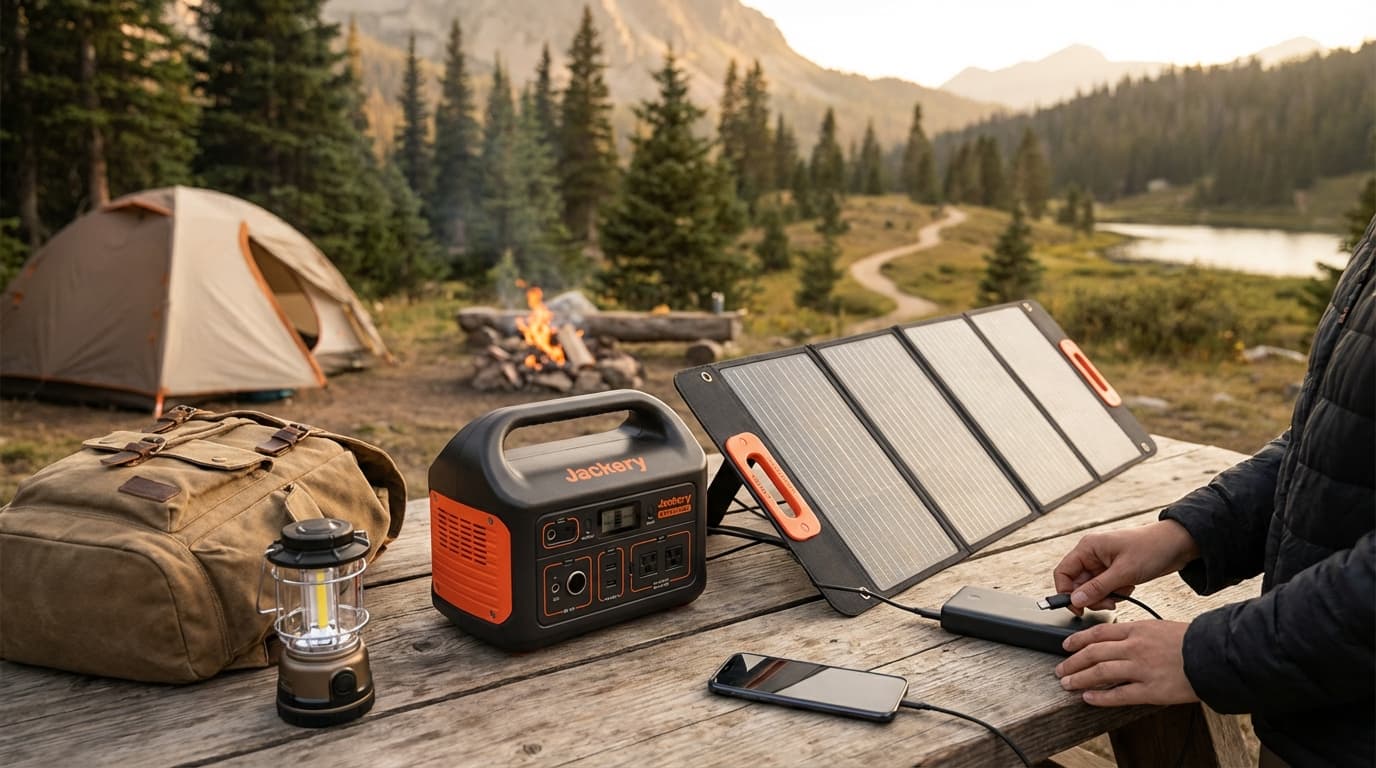
Imagine sitting by a crackling campfire while your favorite playlist keeps the mood going and your camera stays ready for that perfect sunrise shot. Portable power has turned roughing it into a comfortable escape where you don't have to choose between nature and a full battery. Finding the best portable solar panel for camping is now just as important as packing your sleeping bag if you want a stress-free trip.
The days of loud, greasy gas generators that ruin the quiet of the woods are over. Modern off-grid power solutions are silent, light, and surprisingly fast to charge. Whether you are looking for a high capacity power bank for hiking or a station that can run a heater, understanding the tech helps you avoid feeling like an unpaid IT consultant at your own campsite.
We are going to settle the Jackery vs EcoFlow for camping debate and share practical solar charging tips to keep your gear running. You will discover why battery chemistry matters and how to pick a setup that fits your trunk, even if you are just trying to keep a pet camera going so you can check on your fluffy friends. Let's look at how to stay powered up without the hassle.
The 'Goldilocks' Power Station: Why the Anker Solix C1000 Hits the Sweet Spot
Selecting a power station often feels like a game of extremes. You either get a tiny block that barely charges a phone or a massive beast that requires a gym membership to lift. The Anker Solix C1000 is different. Experts call it the 'Goldilocks' pick because it hits the middle ground perfectly. It packs 1,800W of output - enough for a coffee maker or a portable heater - yet stays small enough to fit in a crowded trunk next to your cooler and sleeping bags.
Most campers do not need a whole-home backup system, but they do need reliability. This unit provides enough juice for a long weekend without the bulk of a traditional gas generator. Since it uses LiFePO4 battery tech, it is built to last through thousands of discharge cycles. It is the rare device that balances high-draw performance with actual portability, making it the most balanced choice for the average outdoor enthusiast.
Speed matters because life is messy, and the 1.4-hour charging reality is a genuine game-changer for weekend planning. Standard charging takes about 84 minutes, but the UltraFast mode drops that to just 65 minutes. Lab tester Sentry Kelly found this vital for last-minute prep when they realized they forgot to juice up before a trip. It turns a potential disaster into a minor blip while you finish packing the car.
This speed removes the stress of power management. You no longer need to plan your life around a charging cable twenty-four hours in advance. Instead, you get a silent, exhaust-free companion that is ready as fast as you are. It allows you to focus on the woods rather than acting like a tech support agent for your own gear. Think of it as energy that fits your schedule, not the other way around.
Key insights:
The Anker Solix C1000 is currently considered the most balanced 'Goldilocks' pick for general consumers.
UltraFast charging reduces preparation time for trips from several hours to approximately 65 minutes.
LiFePO4 batteries provide a significantly longer lifespan of 3,000 to 6,000 cycles compared to older technologies.
Speed Matters: The 1.4-Hour Charging Reality
Ever been ready for a trip only to see your power station is at zero? It’s a sinking feeling that usually means a long delay. But the tech has caught up. The Anker Solix C1000 hits a full charge in just 1.4 hours. In a hurry? Its UltraFast mode finishes in 65 minutes.
This changes everything for weekend planners. Lab tester Sentry Kelly found this speed vital after forgetting to juice up before heading out. Instead of waiting overnight, you can plug in while you pack the car. It turns off-grid power solutions into a tool that actually fits your life.
You can now prep for a getaway in the time it takes to grab lunch. No more waiting by the wall outlet while the sun is already out and the mountains are calling.
Key insights:
The Anker Solix C1000 charges in 1.4 hours normally or 65 minutes on UltraFast mode.
Rapid charging allows for spontaneous trips without needing to charge gear overnight.
Jackery vs. EcoFlow: Choosing the Right Side of the Great Camping Rivalry
Choosing between Jackery and EcoFlow feels a lot like the old Mac vs. PC debate. You have Jackery, the brand that basically invented the modern portable power station with its friendly orange accents and dead-simple interface. Then you have EcoFlow, the tech-obsessed rival that seems to release a new, faster model every few months. If you want something that just works the second you take it out of the box, Jackery is usually the go-to. But if you care about things like app control and insanely fast charging, EcoFlow often takes the lead. As Karuna Eberl from GearJunkie puts it, these stations have forever squashed the notion of roughing it while camping.
The real split happens when you look at how these brands handle growth. EcoFlow has positioned itself as the king of high-capacity solutions. For example, their Delta Pro 3 starts at 4.0 kWh but can scale all the way up to 48 kWh for a full home backup. Jackery is catching up, but their heart is still in the campsite. While brands like Bluetti are hitting 92% efficiency with their Elite 200 V2, the Jackery vs. EcoFlow choice usually comes down to your personal tech tolerance. Do you want a simple tool or a high-performance gadget? The industry is shifting toward LiFePO4 batteries because they can handle 3,000 to 6,000 discharge cycles, making these a long-term investment rather than a disposable toy.
When Lighter is Better: The 7-Pound Jackery Advantage. Sometimes, less really is more, especially when you are hauling gear from the trunk to a secluded picnic spot. This is where the Jackery Explorer 300 shines. At just 7.1 pounds, it is officially the lightest recommended model for short-term use. You can literally carry it with two fingers. The trade-off is obvious: you aren't going to run a hairdryer or a microwave on a unit this small. But for keeping your phone, camera, and a small fan running through a weekend, that weight savings is a massive win. While the EcoFlow River 3 Plus is a strong budget choice, it struggles to match that specific 'grab-and-go' feel that makes the small Jackery a favorite for low-impact trips.
Regardless of which side you choose, make sure your station includes a pure sine wave inverter. Experts at Wirecutter point out that this is non-negotiable if you plan on charging sensitive gear like CPAP machines or laptops without frying the circuits. Think of it this way: the battery is the gas tank, but the inverter is the engine that makes that power usable. Whether you are eyeing the rapid 65-minute charging of an Anker Solix C1000 or the rugged simplicity of a Jackery, focusing on battery chemistry and inverter quality ensures you won't be left in the dark when the sun goes down.
Key insights:
Jackery remains the leader for user-friendly, lightweight portability with the 7.1-pound Explorer 300.
EcoFlow dominates the high-end market with massive expansion capabilities up to 48 kWh.
Modern power stations are pivoting to LiFePO4 chemistry for significantly longer lifespans.
Pure sine wave inverters are essential for safely powering sensitive medical and computing electronics.
When Lighter is Better: The 7-Pound Jackery Advantage
Ever tried to haul a 50-pound power station from the car to a secluded campsite? It usually ends with sore shoulders and a bit of frustration. If you are heading out for a quick overnight stay or a day at the park, you probably do not need a massive backup system. This is where the Jackery Explorer 300 shines. At only 7.1 pounds, it is the lightest model recommended for short-term use. You can basically carry it with one finger while your other hand handles the pet carrier.
There is a trade-off to keep in mind, though. Choosing such a light frame means you are giving up total watt-hours. While massive units like the Bluetti Elite 200 V2 offer huge capacity, they weigh much more. The Jackery is built for simplicity. It is perfect for charging a phone or keeping a pet camera running during a quick trip. If you want to keep things easy without feeling like you are moving heavy furniture, this small unit is a great choice.
Key insights:
The Jackery Explorer 300 weighs only 7.1 pounds, making it the most portable option for light travel.
Small units are ideal for charging phones and small electronics but offer less total capacity than larger backup systems.
Why Battery Chemistry Is the Most Important Thing You'll Learn Today
Have you ever wondered why some power stations die after a couple of years while others keep kicking? It usually comes down to what is happening inside the box. Most older units used standard Lithium-Ion batteries, but the industry is moving toward LiFePO4, or Lithium Iron Phosphate. This shift is a big deal for anyone who wants their gear to last. Think of it as moving from a disposable battery to something built to survive a decade of hard use. It is about having reliability when you are miles away from the nearest wall outlet.
Take the Bluetti Elite 200 V2 as an example. This unit can handle 6,000 discharge cycles before the capacity even drops below 80 percent. To put that in perspective, if you drained it every single day, it would take over 16 years to hit that point. That is a massive leap over the 500 or 1,000 cycles we used to see in older models. It is the difference between buying a tool you replace every few seasons and investing in equipment that stays in your kit for the long haul. You want something that works as hard as you do.
But longevity is only half of the story. Efficiency matters just as much when you are out in the woods. While the industry average for usable capacity sits around 85 percent, the Bluetti Elite 200 V2 hits a staggering 92 percent. This means if you are running a CPAP machine or a heater overnight, you are actually getting the power you paid for instead of losing it to heat. When every watt-hour counts, that extra efficiency can be the difference between a warm night and a cold one. It is about getting the most out of every single charge.
The tech is not stopping at LiFePO4 either. We are already seeing the next wave with brands like Yoshino. They are pushing into solid-state batteries, which could make your next power station even lighter and safer. Solid-state tech removes the liquid electrolyte found in traditional batteries, which reduces the risk of fires and allows for more energy in a smaller package. It is still early days, but this could eventually make heavy power bricks feel as light as a standard hiking pack. Imagine having massive power without the backache of carrying a heavy box.
What does this mean for you? It means you should stop looking at just the price tag and start looking at the chemistry. A cheaper unit might save you money today, but a LiFePO4 or solid-state station will still be powering your gear long after the cheap one has stopped working. This transition from gas to electric is happening fast because these batteries are finally becoming practical for everyday people. They are silent, they are clean, and they are getting smarter every year.
Key insights:
LiFePO4 batteries like those in the Bluetti Elite 200 V2 offer up to 6,000 cycles, lasting over a decade.
Higher efficiency ratings mean you get more actual run time for devices like CPAP machines and heaters.
Emerging solid-state technology from brands like Yoshino promises lighter and safer portable power in the near future.
Solid-State and Beyond: The Future of Your Power
Imagine a power source that weighs next to nothing but keeps your gear running for days. We are seeing a massive shift in storage. While LiFePO4 batteries in the Bluetti Elite 200 V2 are workhorses handling 6,000 cycles, the next generation is even more impressive.
Brands like Yoshino are introducing solid-state technology. This matters because it replaces flammable liquids with solid components, making gear lighter and safer. The Jackery Explorer 300 is only 7.1 pounds, but solid-state tech will soon pack more energy into that same small frame.
This is about total convenience. With the Anker Solix C1000 charging in about an hour, the future is all about instant power. It makes roughing it a thing of the past. You get the energy you need without the heavy lifting.
Key insights:
Solid-state technology from brands like Yoshino is making portable batteries lighter and safer than ever.
Modern LiFePO4 batteries already offer incredible longevity with up to 6,000 discharge cycles.
Future tech will allow high-capacity power stations to maintain a small, backpack-friendly footprint.
Don't Get Stranded: Practical Tips for Solar Charging in the Wild
You have finally reached that perfect remote spot, but there is a nagging problem: your gear is gasping for air. You set up your solar panels, expecting a quick recovery, but the numbers do not seem to add up. Here is the reality check: that 100-watt rating on your panel is a laboratory dream, not a forest reality. Most panels only put out about 75% of their rated power because of heat, atmospheric haze, or even a single stray leaf. To catch the best juice, you cannot just set them and forget them. You need to angle them precisely toward the sun and adjust them every few hours as the shadows stretch. It is a bit of manual labor, but it is the difference between a full battery and a dead brick by sunset.
While you are waiting for those photons to do their job, you need to be sure your power station is actually safe for your devices. A pure sine wave inverter is absolutely non-negotiable for anyone carrying a laptop or a camera. Think of it as clean, stable electricity that mimics the wall outlet in your living room. Cheaper, modified inverters produce choppy power that can permanently damage sensitive electronics or cause a CPAP machine to hum and overheat. This is why experts require pure sine waves in every recommended model. If you are in a rush, some units like the Anker Solix C1000 even offer an UltraFast mode that can top you off in just over an hour if you find a plug before heading back into the brush.
But what about those gloomy afternoons when the sun disappears? The cloudy day myth suggests solar is totally useless without direct beams, but that is not quite true. You will still get a tiny trickle of energy, though it will not be enough to run your whole camp. This is where managing your expectations and having high-capacity storage becomes your best insurance policy. You want a station that does more than just look good on paper. For example, the Bluetti Elite 200 V2 recorded 92% of its listed capacity in tests, which is significantly better than the industry average of 85%. That extra cushion is what keeps your lights on when the sky turns gray.
For people who live for the outdoors, the type of battery inside your station matters as much as the capacity. The industry is moving toward LiFePO4 chemistry because it is incredibly durable. These batteries can handle up to 6,000 discharge cycles before they even start to lose significant strength. That is basically a lifetime of camping trips. If you are planning a massive off-grid setup, modern systems like the EcoFlow Delta Pro 3 even allow you to add external battery packs to scale your power way up. It is about building a system that fits your specific journey, so you never find yourself stranded without a charge.
Key insights:
Solar panels rarely hit their advertised wattage in the wild due to heat and atmospheric conditions.
Angling panels toward the sun throughout the day is the most effective way to increase real-world charging speeds.
Pure sine wave inverters are essential for protecting expensive electronics from power fluctuations.
LiFePO4 batteries offer significantly better longevity, often lasting for 6,000 cycles compared to older lithium technologies.
High-capacity storage acts as a vital buffer during overcast days when solar input drops significantly.
The Myth of the Cloudy Day
What happens when the clouds roll in? Your solar panels suddenly stop being heroes. It's a total buzzkill, but you aren't stuck in the dark if you planned ahead. Solar is a fair-weather friend, so your battery must be the reliable partner.
The secret is storage. When the sky turns gray, you rely on what's in the tank. Units like the EcoFlow Delta Pro 3 provide a 4.0 kWh base, while the Bluetti Elite 200 V2 delivers 92% of the listed capacity, beating the 85% industry average.
Think of your station as a reservoir. With a LiFePO4 battery handling 6,000 cycles, you’re set for years.
Key insights:
High-capacity batteries act as a necessary buffer during poor weather conditions.
Efficiency matters because units like the Bluetti Elite 200 V2 provide more usable energy than typical standards.
From Backpacks to Whole Homes: Scaling Your Energy Needs
Think about the last time you went for a hike and your phone died right as you reached the summit. It’s a total buzzkill. That’s why 'backpack power stations' are becoming a staple for photographers and hikers who can’t afford to lose a charge. If you’re just out for the afternoon, something like the Jackery Explorer 300 is a no-brainer because it only weighs 7.1 pounds. It’s light enough that you won't feel like a pack mule, but strong enough to keep your gear ready for that perfect shot.
But what happens when you move from a day trip to a full-blown off-grid weekend or a home power outage? This is where the scale changes completely. The EcoFlow Delta Pro 3 acts as the bridge between camping gear and a whole-home backup system. It starts with a 4.0 kWh capacity, but you can actually scale it up to a massive 48 kWh. It’s silent, exhaust-free, and way less of a headache than those old, loud gas generators we used to rely on.
The real test for these units isn't just how long they last, but what they can actually turn on. You might wonder if a battery can handle a high-draw tool like a miter saw or even just a hair dryer. It all comes down to surge capacity. Modern high-performance units now offer AC outputs up to 2,600W with surges hitting 3,900W. Efficiency is also climbing; the Bluetti Elite 200 V2 hits 92% of its rated capacity, which is well above the 85% industry average.
The best part is how fast you can get back in the game. If you’re like most of us and forget to charge your gear until the last minute, the Anker Solix C1000 is a lifesaver. Using its UltraFast mode, you can go from zero to a full charge in about 65 minutes. It’s that 'Goldilocks' pick that balances speed, weight, and power, making sure you spend more time enjoying the view and less time acting like a tech support agent for your own gear.
Key insights:
Backpack models like the Jackery Explorer 300 prioritize weight, coming in at just 7.1 pounds for short-term use.
High-end units now feature surge capacities up to 3,900W to handle heavy appliances and power tools.
The shift to LiFePO4 batteries means modern stations like the Bluetti Elite 200 V2 can last for 6,000 cycles before losing significant capacity.
Frequently Asked Questions
Yes, you totally can. We have come a long way from the days of waiting eight hours for a charge. Models like the Anker Solix C1000 can hit a full charge in about 65 minutes if you use the UltraFast mode.
It is perfect for those moments when you are packing the car and realize the power station is sitting at five percent. Just remember that while wall charging is that fast, solar charging still takes a bit longer because it depends on how much sun you can catch.
This is the big debate! If your version of rugged involves hiking to a remote spot, you might love Jackery because they make some incredibly light gear. Their Explorer 300 is a featherweight at just over seven pounds, so it is easy to move around.
But if you want a tank that lasts for years, EcoFlow is a beast. They use battery tech called LiFePO4 that can be charged and drained thousands of times before it starts to wear out. It really comes down to whether you want to save your back with a lighter Jackery or invest in a long term powerhouse from EcoFlow.
Think of a power bank as a pocket sized battery for your phone, while a portable power station is like having a wall outlet you can carry to the woods. A standard power bank is great for a quick hike, but it usually only has USB ports. A power station is much bigger and features actual AC plugs for your larger electronics, which is perfect if you need to keep things running.
Even the lighter models like the Jackery Explorer 300 weigh about 7 pounds, which is a lot more than a phone charger but still easy to move around. This extra weight gives you the ability to run things like laptops or even a small pet heater that a simple power bank just cannot handle. It is the difference between keeping your phone alive and keeping your whole campsite comfortable for everyone.
You really do need a pure sine wave inverter if you plan on plugging in a laptop or any sensitive gear. These devices expect a very clean and consistent flow of electricity. Pure sine wave tech mimics the power from your home outlets perfectly, which keeps your expensive electronics happy and safe from damage while you are off the grid.
Here is the thing to remember. While cheaper modified sine wave inverters exist, they can cause motors to run hot or make your laptop screen flicker. Most pros say pure sine wave is a must have requirement for things like CPAP machines and motored tools. If you want to avoid a tech headache during your trip, sticking with a pure sine wave unit is the way to go.
Conclusion
So, what does all this tech talk really mean for your next trip? It means the days of noisy gas generators and dead phone batteries are over. Whether you choose the speed of an Anker or weigh the Jackery vs EcoFlow for camping debate, you are just picking the best way to keep the lights on. It is about finding that perfect balance between weight and power.
The real shift is in the battery chemistry. Moving to LiFePO4 tech means your gear will likely outlast your tent. When you pair the best portable solar panel for camping with a high capacity power bank for hiking and follow basic solar charging tips, you are running a silent power plant. It changes how you think about off-grid power solutions because you are finally free from the wall outlet.
Before you head out, do a quick backyard test. Charge everything and check your cables so you can focus on the stars instead of your battery percentage. Grab your gear, find some shade, and enjoy the quiet of a fully charged adventure.
Every WilderReady guide is researched, written, and fact-checked in-house against trusted references such as the American Red Cross, the National Park Service, and the CDC before it goes live. We publish under this shared byline instead of invented personas, so you always know who stands behind the guidance you are reading.