Survival Gear That Won't Let You Down (Even in a Downpour)
Imagine being stuck in a sudden storm and realizing your matches are wet and your lighter is out of fluid. The survival rule of 3s tells us that you only...
Survival Gear That Won't Let You Down (Even in a Downpour)
Imagine being stuck in a sudden storm and realizing your matches are wet and your lighter is out of fluid. The survival rule of 3s tells us that you only have about three hours to find shelter in extreme weather, so having reliable survival gear and essentials is more than just a hobby. It's a life saver. Most people pack for a sunny hike, but the real test of your kit happens when the clouds open up and everything you touch is damp.
We want to make sure you are ready for those moments without carrying a heavy load. In this article, we look at the best ferro rod for beginners wet weather and settle the debate of water purification tablets vs filters for survival. It is about finding that balance between being prepared and staying mobile enough to move fast when you need to.
You will also find tips on using an essential knots paracord kit for bug out bags and how to set up a lightweight emergency tarp shelter kit essentials. Whether you are building a compact edc survival kit for car emergencies or prepping your home, these steps will help you stay dry. Let's look at the gear that works when the weather gets wild.
Fire in the Rain: Finding a Ferro Rod That Actually Works
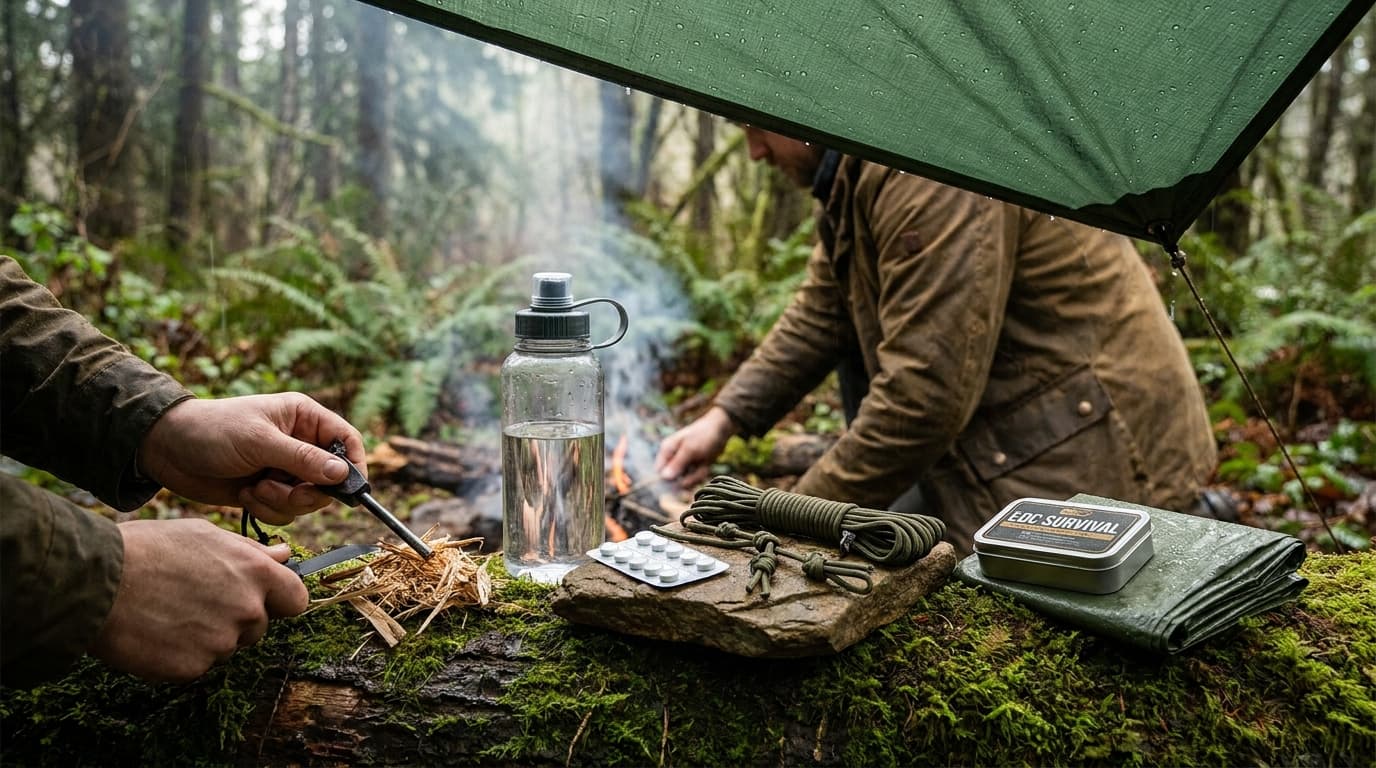
Imagine standing in a downpour, shivering, with a pile of damp leaves at your feet. Most beginners think a fire starter is a magic wand, but when the humidity hits ninety percent, that cheap sparker from the bargain bin usually fails. This is a high-stakes problem because of the Survival Rule of 3s. You can only last about three hours without shelter or warmth in harsh conditions. Fire isn't just for cooking; it's your primary way to stay dry and keep your core temperature up when the weather turns sour.
There is a massive difference between a five-dollar survival tool and a professional-grade ferrocerium rod. Cheap rods are often too hard, meaning they produce tiny, cool sparks that die before they even hit your tinder. A reliable rod uses a softer blend of metals that shaves off in larger, molten chunks. These sparks burn at over 5,000 degrees Fahrenheit, which is exactly what you need to evaporate moisture from wet wood shavings. If you're struggling, try this trick: slowly shave a small pile of ferrocerium dust onto your tinder before striking. This creates a mini-flare that gives damp material a real chance to catch.
When you are picking your first rod, look for something with a handle you can actually hold when your fingers are numb. Cold hands lose fine motor skills fast, so a thick, textured grip is much better than a bare metal loop. The striker matters just as much as the rod itself. You want a striker with a sharp, 90-degree spine that can really bite into the metal to throw a heavy shower of sparks. While some kits pack in dozens of tools, a dedicated, large-diameter rod is often the most important piece of gear you can carry.
Softer rods are generally better for beginners because they are easier to scrape and produce more material per strike. While multi-functional tools like paracord bracelets often include fire starters, those tiny rods are hard to use in a real emergency. Think of it this way: a larger rod gives you the heat and surface area necessary to stay on the right side of survival priorities. It's about having a tool that works when you're tired, cold, and out of options.
Key insights:
Prioritize softer ferrocerium blends to ensure sparks burn long enough to dry out wet tinder.
Choose rods with oversized, textured grips to maintain control when hands are cold or wet.
Use the 'shaving' technique to create a concentrated pile of fuel before attempting ignition in humid weather.
What to Look for in a Beginner-Friendly Rod
Ever tried lighting a fire when your fingers feel like frozen sausages? It is harder than it looks. For wet weather, the grip is everything. A tiny handle might look sleek, but you want something chunky. Large grips give you better control when your hands are numb. This matters because the Survival Rule of 3s says you only have three hours without warmth in harsh conditions. A solid handle keeps you from dropping your heat source into the mud.
Now, look at the striker. You need a sharp edge to create high-heat sparks. While some people use the back of a knife, a dedicated striker is usually more reliable for a beginner. Also, look for a softer rod. These throw bigger, hotter sparks that stay lit longer. This is exactly what you need when you are trying to get damp tinder to catch during a downpour.
You might see fire starters built into paracord bracelets that boast twenty different functions. These are clever tools to have, but a standalone rod is best for your main kit. If your gear works on the first strike, you can focus on staying dry instead of struggling. It is all about making a tough situation easier.
Key insights:
Prioritize grip size over portability to ensure you can use the tool with numb hands.
Choose softer ferrocerium alloys for wet conditions because they produce longer-lasting sparks.
Standalone rods are more reliable primary tools than the micro-starters found in multi-functional bracelets.
Drinking Safely: Tablets or Filters?
Ever tried carrying a few gallons of water in a backpack? You'll feel it in your shoulders immediately. Water weighs about 8.3 pounds per gallon, which is a massive burden when you're on the move. This is exactly why most mobile survival kits don't hold all the water you'll need for a long trek. Instead, they focus on tools to clean the water you find along the way. The 'Survival Rule of 3s' reminds us that you can only last about three days without hydration, so having a solid purification plan is the cornerstone of any prepper’s strategy.
Purification tablets are the classic quick-fix. They take up almost no space, making them the perfect lightweight backup for a bug-out bag. You usually choose between iodine or chlorine. Iodine is effective but often leaves that distinct 'pool water' aftertaste that can be hard to swallow. Chlorine dioxide options are a bit better on the palate but take a little longer to work. Either way, these are your best bet when you need to treat a bottle and keep moving, even if they don't filter out the dirt and sediment.
If you're hunkered down at home or with your family, gravity filters are the clear winner. Nobody wants to spend their afternoon manually pumping a hand filter until their arms go numb. With a gravity system, you just hang a bag of dirty water from a tree or a hook and let physics do the work. It’s a much better setup for treating large amounts of water for a group. While a compact EDC kit might rely on a small straw, a home setup benefits from something bigger that can handle the needs of an entire household.
So, which one should you pick? The smartest move is to have both. Use a filter as your primary method because it usually tastes better and removes sediment. Keep the tablets tucked away in a side pocket as a failsafe. If your filter cracks or gets clogged, those tiny tablets become the most valuable thing you own. It’s all about layering your defenses so you’re never left thirsty when things go sideways.
Key insights:
Water's weight of 8.3 lbs per gallon makes carrying a full supply impractical for mobile survival.
Purification tablets are the best lightweight backup for bug-out bags despite the chemical taste.
Gravity filters provide a hands-free way to treat large volumes of water for families and groups.
A redundant system using both filters and tablets ensures safety if one method fails.
The Quick Fix: When to Use Purification Tablets
Carrying heavy gear in the rain is hard enough without lugging gallons of water. Since water weighs about 8.3 lbs per gallon, it quickly becomes the heaviest part of your bag. But you cannot skip it. The survival rule of threes reminds us that you only have about three days without water before things get dire. This is where purification tablets save the day. They weigh almost nothing and fit in any pocket, making them the perfect lightweight backup for a bug-out bag.
When you use these, you will notice a difference between iodine and chlorine options. Iodine tablets are reliable but often leave that distinct pool water taste behind. Chlorine can be a bit better on the palate but sometimes takes longer to work. If you hate the chemical flavor, just remember that a weird taste is a small price to pay for safe hydration when you are on the move.
Think of tablets as your emergency insurance policy. While gravity filters are great for a permanent home setup, they can be bulky to carry. Tablets ensure you are not tied down by heavy jugs while trying to reach safety during a storm or an evacuation.
Key insights:
Water weight is a major constraint for mobile kits at over 8 lbs per gallon.
Iodine is a reliable standard but chlorine often tastes better.
Tablets provide a weight-saving alternative to bulky gravity filters.
The Long Game: Why Gravity Filters Win for Families
Ever spent an hour crouched over a stream pumping a tiny handle just to fill one bottle? It is exhausting. For a family, that repetitive motion becomes a full-time job you did not sign up for. This is where gravity filters change the story. Instead of using your muscles to force water through a membrane, you let nature do the work while you set up camp or prep a meal. It is about working smarter, not harder, when resources are low.
The math of survival makes this even clearer. Water weighs about 8.3 pounds per gallon, so moving it is hard enough without the struggle of manual filtration. At home, a standard survival kit should include at least a three-day supply for the whole family. While iodine tablets are okay for emergencies, they often leave a harsh taste. Systems like Waterdrop filters allow you to process large amounts of water for the group without the sweat or the chemicals.
Think of it as a simple, hands-off solution. You hang a bag, connect the hose, and let it flow into your reservoir. It is the best way to handle high-volume needs at a base camp or during a home emergency. When you look at the long game, saving your energy for other tasks is just smart planning. Why pump all day when you can just let gravity take over?
Key insights:
Gravity filters allow for passive water purification, freeing up time for other survival tasks.
Manual pumping is physically demanding and inefficient for providing the recommended three-day water supply for families.
Higher-volume systems are better suited for home-based survival kits where weight is less of a concern than mobile bags.
More Than Just Rope: Making the Most of Your Paracord Kit
Think about the last time you needed to fix something on the fly. In the woods, paracord is basically the duct tape of the outdoor world. It is strong, light, and does a hundred jobs at once. If you carry a 550 paracord kit in your bug out bag, you are holding a tool that handles everything from pitching a lightweight emergency tarp shelter to replacing a broken boot lace. It is a simple piece of gear that helps you secure shelter quickly when every minute counts. The survival rule of threes reminds us that shelter is a top priority, and a good rope makes that priority much easier to handle.
The real magic is inside the sheath. If you peel back the outer layer, you find several thin inner strands. These are perfect for emergency fishing line or even sewing up a ripped pack when you are miles from home. It is this kind of multi-functional design that makes it a top choice for survivalists. You also need to know at least three knots by heart because even the best rope is useless if it does not stay tied. Learning the bowline, the taut-line hitch, and the square knot will cover almost any situation you face in the wild.
When you look at gear, you have to choose between survival bracelets and bundled kits. You might see those 20-in-1 survival bracelets everywhere. They are popular because they cram in LED lights, whistles, and fire starters into one small package. They are great for moments when you are hiking and want a backup. But here is the reality. A tiny bracelet usually only gives you about eight to ten feet of cord. That is not much when you need to lash down gear or build a sturdy frame for a tent.
A dedicated 50-foot bundle of cord is often way more practical for a real emergency kit. While those gadgets on a bracelet are cool, they cannot replace the sheer utility of having enough length to get a real job done. Most survival kits on Amazon come with hundreds of pieces, but a solid length of paracord is still a cornerstone of any plan. Think of the bracelet as a nice gift or a secondary tool, but keep the bundle in your bag for the heavy lifting. It might weigh a little more, but when you need to secure a tarp in a downpour, you will be glad you have the extra length.
Key insights:
The inner strands of 550 paracord work well for fine tasks like fishing or emergency sewing.
A 50-foot bundle is more reliable for building shelters than a small survival bracelet.
Knowing a few basic knots like the bowline is just as important as the rope itself.
Survival Bracelets vs. Bundled Kits
You have seen those 20-in-1 paracord bracelets everywhere. They look like a handy compact edc survival kit because they pack in whistles and fire starters. But here is the truth: when you actually need to build a shelter, that tiny bit of cord on your wrist usually falls short. It is a decent backup, but it should not be your primary tool when the weather turns.
The Survival Rule of 3s says you only have three hours without shelter in harsh conditions. If you are setting up a lightweight emergency tarp shelter kit, you will need more than a few feet of string. A dedicated 50-foot bundle of paracord is much more practical for tying essential knots for bug out bags. It gives you the length to actually secure your camp and stay dry.
While top-selling kits on Amazon often pack in over 150 pieces, a simple bundle of cord is often the most useful item you can carry. Keep the wearable gear for the cool factor, but pack a real bundle so you are not left stranded.
Key insights:
Bracelets are better as backups than primary cordage for shelter building.
A 50-foot paracord bundle is necessary to satisfy the Rule of 3s for shelter.
Dedicated cordage supports complex knots that wearable items cannot handle.
The Trunk Essential: Building a Compact Car Survival Kit
Imagine you are stuck on a backroad with no cell service and a dead battery. It is a situation where a compact edc survival kit for car emergencies becomes your best friend. A lot of people think they can just throw an old hiking bag in the trunk and call it a day, but car kits are actually quite different. When you are on foot, every ounce matters because water weighs about 8.3 pounds per gallon. In a car, the engine carries the weight, so you can focus more on rugged tools and extra supplies. The main thing is to remember the survival rule of 3s. You can survive three hours without shelter in harsh weather, so your car kit should prioritize warmth and protection over snacks.
Space is your biggest constraint in a trunk, so multi-functional tools are the way to go. Consider the tactical pen. It looks like a normal writing tool, but it often includes a glass breaker, a flashlight, and even a wrench. These are the kinds of items found in best-selling survival kits that pack up to 262 pieces into a tiny footprint. You might also look at paracord bracelets that tuck fire starters and whistles right onto your wrist. These gadgets are great because they take up almost no room but provide massive value when things go sideways. It is all about being smart with the limited space you have.
Here is a tip most people miss: your car is basically a giant oven in the summer. High heat can degrade first aid adhesives and ruin certain foods. You also have to deal with the annoying sound of gear rattling around while you drive. To fix this, try packing your items in a padded bag or use an emergency tarp to wrap the loose metal tools. This keeps things quiet and adds another layer of insulation. Also, while a home kit might need a three-day supply of water for the whole family, your car kit just needs enough to get you to help. Check your gear twice a year to make sure the heat has not done any damage.
Key insights:
Car kits can handle more weight than hiking bags, allowing for more water and heavy-duty tools.
The Survival Rule of 3s should guide your trunk kit priorities, focusing on shelter and water first.
Multi-tools like tactical pens and paracord bracelets save vital space in compact car kits.
Soft-sided storage and wraps prevent gear from rattling and help protect items from extreme summer heat.
Staying Dry: Lightweight Tarp Kits That Save the Day
Have you heard of the survival rule of threes? It is a simple way to remember what kills you first. You can survive weeks without food and days without water, but in a storm, you might only have three hours without shelter before hypothermia sets in. This is why a lightweight emergency tarp shelter kit is a non-negotiable part of your pack. While a tent offers more privacy, it often adds too much bulk for a mobile bug-out bag. Remember that water alone weighs about 8.3 pounds per gallon, so every ounce you save on your shelter means more room for hydration.
When you are looking at gear, you will likely see two main options: Mylar tube tents and sil-nylon tarps. Mylar is incredibly light and reflects your body heat back at you, which is perfect for a compact car kit. But it can be fragile. Sil-nylon is the tougher choice for those who expect to move through brush or face heavy winds. Many best-selling survival kits on Amazon include these because they pack down to the size of a deck of cards. Think about your environment before you choose. Are you just trying to stay warm until help arrives, or do you need a durable roof for a few days?
Speed is everything when the clouds open up. You can set up a basic lean-to shelter in under five minutes if you have some paracord and a few trees. Just tie a line between two points and drape your tarp over it. Use rocks or stakes to secure the bottom edges against the wind. This setup blocks the rain and creates a pocket of still air to keep you warm. It is not about being fancy or comfortable. It is about staying dry and alive until the sun comes back out. What would you do if the sky turned gray right now?
Key insights:
Shelter is a higher priority than water or food in extreme weather based on the rule of threes.
Mylar is best for heat retention and small kits, while sil-nylon offers better durability for long-term use.
A simple tarp setup can be completed in minutes to prevent heat loss and block wind.
Home Prep vs. Bugging Out: Why Water Storage Changes Everything
Have you ever tried carrying a few gallons of water for more than a mile? It is exhausting. Water weighs about 8.3 pounds per gallon, which is why your bug-out bag usually feels like a lead weight after just twenty minutes on the trail. In a mobile kit, every ounce is a battle between what you need and what you can actually carry. This is exactly why a 'bug-in' strategy changes the math entirely. When you stay home, weight isn't your enemy anymore. You can afford to be heavy because your floor is doing the lifting.
Think about your bathtub. Instead of just a place to wash up, it can become a massive reservoir. Using a specialized liner allows you to store up to 100 gallons in one go. That is a game-changer when you consider the 'Survival Rule of 3s,' which reminds us that you can only last about three days without water. While a standard home kit should have at least a three-day supply for everyone in the house, staying put lets you scale that up to weeks without breaking your back. You can use heavy-duty gravity filters or rain barrels that would be impossible to haul through the woods in a downpour.
Sean Gold from TruePrepper points out that a survival kit is the cornerstone of any plan, but it doesn't have to be a single box in the closet. In fact, it is often better to spread your resources throughout the house. This way, if one part of your home is damaged, you don't lose everything. You might keep a compact EDC survival kit for car emergencies in the driveway and a larger stash in the pantry. By diversifying where you keep your gear, from water purification tablets to gravity filters, you ensure that a single disaster doesn't take out your entire safety net.
Key insights:
Home-based kits allow for high-volume water storage solutions like bathtub liners and rain barrels that are too heavy for travel.
Spreading survival resources across different locations in the home prevents a single point of failure during a disaster.
The Rule of 3s makes water a higher priority than food, favoring stationary setups for long-term hydration.
Frequently Asked Questions
Most water purification tablets, like the iodine ones from Potable Aqua, usually stay effective for about four or five years as long as the bottle stays sealed. Once you pop that seal and let air in, the shelf life starts ticking much faster because moisture gets to them.
It is smart to check the expiration dates on your tablets every time you do a gear review. If they look discolored or start to crumble, they probably won't do the job anymore. Since water is so heavy, weighing about 8.3 pounds per gallon, having these tablets as a backup is way easier than trying to carry extra jugs on your back.
You definitely can, but do not expect it to be easy on your first try. The great thing about a ferro rod is that it works even when it is wet, which is why they are a staple in most survival kits. While a lighter might fail in the damp, a ferro rod will still throw hot sparks no matter the weather.
The real challenge isn't the rod itself, it is finding something dry to catch those sparks. For beginners, the best move is to keep some waterproof tinder or a bit of fatwood in your bug out bag. Trying to scrape together dry tinder from a wet forest is a tough skill, so having a little help in your pocket makes a world of difference.
You should definitely start with the taut-line hitch. It is basically the king of knots for shelters because it is adjustable. If your tarp starts sagging in the rain, you can just slide the knot to tighten the line without having to untie everything and start over.
Here is the thing: the survival rule of threes says you only have about three hours to get a shelter up in harsh weather. You do not want to waste time fumbling with complicated knots that do not hold. Using a taut-line hitch with some paracord makes it easy to keep your shelter sturdy even when the wind picks up.
A lot of people think they are just for show, but a tactical pen is actually a great multi-tool if you pick the right one. High-end versions are made from tough aluminum and come with glass breakers and flashlights built right in.
The real value is how much space it saves. For instance, instead of carrying three separate tools, you have a writing pen that can also help you get out of a car in an emergency. It is a smart way to carry extra functions in your pocket without things feeling heavy or bulky.
Conclusion
So, where does all this gear talk leave us? It shows that being ready for a storm isn't about buying every gadget on the shelf. It is about picking a few reliable basics - like a ferro rod that throws sparks in the rain or a water filter that saves your back - and knowing they will work when you need them most. When you look at the big picture, survival is really about simplicity and confidence.
The best thing you can do now is get hands-on. Take that paracord out and practice a few knots while you are relaxing at home, or tuck that compact car kit into your trunk so it is there if you ever get stuck. Gear is only as good as the person using it, so treat your prep like a helpful weekend project rather than a scary chore.
At the end of the day, having the right survival gear and essentials just means you can stay calm when things get chaotic. You do not need to be a pro to be prepared; you just need to be someone who took a few smart steps today. Stay safe, stay dry, and keep it simple.
Every WilderReady guide is researched, written, and fact-checked in-house against trusted references such as the American Red Cross, the National Park Service, and the CDC before it goes live. We publish under this shared byline instead of invented personas, so you always know who stands behind the guidance you are reading.