5 Survival Skills That Actually Save Lives When You're Solo in the Woods
You are deep in the woods on a solo hike when the trail suddenly disappears and the sky turns gray. It is a gut-wrenching moment that can happen to anyone,...
5 Survival Skills That Actually Save Lives When You're Solo in the Woods
You are deep in the woods on a solo hike when the trail suddenly disappears and the sky turns gray. It is a gut-wrenching moment that can happen to anyone, even if you are just out for a quick walk. Being ready for these survival scenarios is about more than just gear. It is about knowing exactly what to do when you only have yourself to lean on and the sun is starting to drop.
This guide is here to help you get through the worst-case moments, like using shadow sticks for daytime emergency navigation or figuring out how to start a fire with wet wood for survival. We will also talk about treating a sprained ankle in the backcountry solo because a simple trip becomes a big problem when there is no one around to help you walk out. These skills are the ones that actually make a difference when things go sideways.
You will also learn how to signal for rescue at night using a flashlight and the basics of emergency shelter building with limited tools to keep you warm. These five skills are simple to learn but they are the ones that bring people home safe. Let’s get into how you can protect yourself and stay calm during your next solo adventure.
A sunny hike can turn into a survival situation faster than you think. One wrong turn or a sudden change in weather, and suddenly, the woods feel very different. When you are solo, the stakes are much higher. There is no partner to call for help or help you carry your gear. You are the only person you can rely on to get home safely.
Being alone means you have to be your own navigator and medic. You might need to use a shadow stick for daytime navigation or signal for rescue with a flashlight after dark. If you twist your ankle, you have to treat it yourself. You also need to know how to start a fire with wet wood and build a shelter with whatever tools you have in your pack.
We are focusing on these five core skills because they actually save lives. They give you the confidence to stay calm and act fast when things go wrong. After all, being prepared is what turns a potential disaster into just another story to tell later.
Key insights:
Solo survival requires being your own first responder and navigator.
Simple tools like shadow sticks and flashlights are vital for signaling and direction.
Preparation is the best way to prevent panic during an emergency.
Starting a Fire When Everything is Soaking Wet
Imagine you're shivering in a downpour, miles from your car. Everything is grey and heavy. In this moment, a fire is about more than just drying your socks. It's a mental anchor. When you're cold and wet, your brain starts to loop on negative thoughts. A flame breaks that cycle. But if you try to light a fire the way you do at a backyard BBQ, you're going to fail. Standard tinder like dry grass or leaves is long gone, soaked through by the humidity. You have to look deeper.
To find fuel that actually burns, you need to ignore anything on the ground. Logs touching the earth are basically sponges for rot and moisture. Instead, look for standing deadwood. These are trees that died but haven't fallen yet. The bark might be wet, but the center is often bone-dry. This is the 'Dry Heart' strategy. Use your knife to baton, or split, these branches open to reach the dry core. Once you reach that inner wood, shave it into thin curls to create feather sticks. These tiny shavings have a high surface area and will catch a spark even when the air feels like a swamp.
One of the biggest mistakes people make is trying to build their fire directly on the wet forest floor. The cold ground will suck the heat right out of your tiny flame before it can grow. You need to build a platform first. Lay down a layer of thick, parallel logs to create a dry floor. On top of that, build a small log cabin structure. This setup keeps your fire off the mud and allows oxygen to flow underneath. When the fire finally catches, feed it slowly. Don't rush it with big logs. Give it time to dry out the next piece of wood before you toss it in.
Key insights:
Standing deadwood is your best friend because the wood is kept away from ground moisture.
Feather sticks create the surface area needed to turn a tiny spark into a real flame.
A log cabin base acts as both a floor and a chimney for better airflow in damp conditions.
Finding the Bone-Dry Wood Hiding Inside Wet Logs
Everything is soaked and you are shivering. It feels like starting a fire is impossible when the whole world is dripping. But here is the secret: wood rarely gets wet all the way through. You just have to get past that soggy outer layer to find the fuel that is actually ready to burn. It is a simple trick that keeps you warm when things get messy.
First, stop looking at the ground. Anything touching the soil is a sponge for moisture. Look up instead. You want standing deadwood, which are trees that died but stayed upright. These stay much drier because gravity pulls the water down and the breeze seasons them. If you find a thick branch that snaps with a sharp crack, you are on the right track.
Use your knife to baton through the center of your wood. By hitting the back of your knife with another stick, you split the log to reveal the dry heartwood inside. From there, shave thin curls to create feather sticks. These tiny shavings catch sparks much better than a solid chunk. It takes patience, but it beats a cold night every time.
Key insights:
Avoid ground wood because it absorbs moisture like a sponge.
Standing deadwood is your best bet for finding dry fuel in the rain.
Splitting logs reveals dry wood that the rain could not reach.
Feather sticks increase surface area to help wet-weather fires catch.
Building a Platform to Save Your Flame
Ever tried to light a match on a soggy sponge? That is basically what you are doing when you build a fire directly on damp earth. The ground acts like a giant heat sink, sucking the life out of your tiny sparks before they can even catch. To get things moving, you need to get your fuel off the floor. Think of it as building a dry foundation for a house, but in this case, the house is your warmth and safety.
You can do this by laying down a thick layer of parallel logs to create a platform. On top of that, stack another layer going the opposite way. This log cabin style base does two things. First, it keeps your tinder away from the moisture below. Second, it lets air flow underneath the flames. Without oxygen, your fire will just smoke and die, so that gap is your best friend.
Once you have a small flame going, do not get impatient. It is tempting to throw a big branch on there to get it over with, but wet wood needs time to dry out before it actually burns. Feed it tiny twigs slowly. You are basically using the heat from the center to bake the moisture out of the next layer of wood. It takes a bit of babysitting, but it is the only way to turn a struggling spark into a real survival fire.
Key insights:
Wet ground acts as a heat sink that drains energy from new fires.
A raised platform provides the necessary oxygen flow for damp fuel.
Slow feeding allows heat to dry out wet wood before it needs to burn.
Finding Your Way Using Just a Stick and the Sun
Imagine you're deep in the woods and your phone screen goes black. The GPS is gone, and a thick fog starts rolling through the trees, turning every direction into a blur of grey. It’s easy to feel that spike of panic in your chest. But here’s the thing: even when the sky is overcast, the sun is still up there, and it’s always doing exactly what it’s supposed to do. You don't need a high-tech satellite link to find your way home. You just need a straight stick and a bit of patience.
Shadows are reliable because physics doesn't take a day off. While your internal compass might be spinning because you're stressed, the earth’s rotation is constant. By using a shadow stick, you're tapping into a navigation method that’s worked for thousands of years. It’s about slowing down. When you feel lost, the biggest danger isn't usually the lack of a map; it's the urge to run in a random direction. Taking the time to set up a stick and watch a shadow move forces you to breathe and think clearly.
To get started with the shadow stick trick, find a clear patch of ground and a stick about three feet long. Push it into the dirt so it stands upright. Look at where the tip of the shadow lands and mark that spot with a small stone. Now comes the hard part: waiting. You need to give the sun at least 15 minutes to move across the sky. This is known as the 15-minute rule. After that time, the shadow will have shifted. Mark the new tip of the shadow with another stone.
Now, draw a straight line between those two marks. That’s your East-West line. The first mark you made is always West, and the second is East. If you stand with the first mark to your left and the second to your right, you’re facing North. It’s a simple trick, but in a survival scenario, it's the difference between wandering in circles and actually making progress toward safety. It works because the sun always travels from East to West, meaning the shadow must move in the opposite direction.
Key insights:
The first shadow mark always represents West, regardless of where you are.
Waiting at least 15 minutes is vital for an accurate reading.
Using a shadow stick forces you to stay calm and stop moving while lost.
This method requires zero tools other than what you find on the forest floor.
The Shadow Stick Trick: A Step-by-Step Guide
Imagine standing in a clearing with no compass. The trees look identical and you are not sure which way is out. This is where a simple branch becomes your best friend. Find a straight stick and push it into the ground where the sun hits it. Mark the tip of the shadow with a stone. This first mark is West because the sun moves across the sky.
Wait about fifteen minutes for the sun to move. As it travels, the shadow will slowly creep across the dirt. Mark the new position of the shadow tip with another stone. This second mark is East. It is a slow process, but it is reliable because the physics of the solar system do not change. Think of it as a natural compass that never runs out of batteries.
Draw a line between those two marks to find your East-West path. Stand with the first mark on your left and the second on your right to face North. This keeps you moving straight instead of in circles. In survival scenarios, using shadow sticks for daytime emergency navigation is a smart way to find your path when you are solo. It is a simple skill that gives you peace of mind.
Key insights:
The first mark always represents West because the shadow moves opposite to the sun's path.
A fifteen-minute wait is the sweet spot for a clear and measurable shadow shift.
This method works anywhere in the world, though the orientation of North and South flips in the southern hemisphere.
How to Get Rescued After the Sun Goes Down
Once the sun drops, the woods become a wall of black. You might think screaming for help is the best move, but sound is a weak traveler in the backcountry. Trees soak up your voice and the wind carries it the wrong way. Light is different. A single beam can cut through miles of darkness, catching the eye of a search team or a pilot from incredible distances. This is why your flashlight is actually your loudest whistle when it is dark out. It signals presence when sound fails because light travels in a straight line without getting muffled by the brush.
You need to be smart about how you use that power. Do not just leave your light on and hope for the best. You will burn through your batteries before midnight if you are not careful, especially in the cold where power drains fast. Instead, remember the Three of Anything rule. In the survival world, three of any signal is the international cry for help. Think of it as a universal SOS. Three flashes of light, three whistle blasts, or even three piles of rocks. Space your flashes out and then wait for a response. This saves your battery and gives rescuers a chance to spot the pattern against the static of the forest.
When you actually see or hear a search party, you need to be unmistakable. The SOS signal is your best friend here. It is three short flashes, three long ones, and then three short ones again. If you hear a helicopter, do not just point the light directly at the cockpit because that can blind the pilot. Instead, use a flash and scan technique. Move the beam across the horizon or toward the aircraft in a rhythmic motion. This creates a flickering effect that is much harder to ignore than a steady glow. It screams to the world that a human is down there looking for help.
What if you just need to make your whole camp visible to ground teams? You can turn a small flashlight into a glowing beacon by pointing it into a clear water bottle or a translucent jug. The water scatters the light in every direction. This creates a lantern effect that illuminates your immediate area and makes you a much larger target for anyone searching nearby. It also helps you stay calm by pushing back the shadows while you wait for the sun to come back up. Sometimes, being seen is just as much about your own peace of mind as it is about the rescue team finding you.
Key insights:
Light is more effective than sound because it is not absorbed by the environment as easily as a voice.
The Three of Anything rule is the standard for signaling distress in any survival situation.
Using a water bottle as a diffuser creates a 360-degree lantern that makes your location easier to spot from the ground.
Flashlight Patterns That Rescuers Can't Miss
When the sun goes down, the woods feel huge and you might feel invisible. But a flashlight turns you into a beacon if you use it right. It is not about waving the beam and hoping for the best. You need specific patterns that scream "help" to a rescue team.
Start with the SOS signal. Using a short, long, and short pulse pattern tells anyone watching that this isn't just a random light. If a helicopter is nearby, don't point the beam at the cockpit. Use a "flash and scan" move by aiming at the ground nearby. This creates a flickering signature that is easy to see from the air.
To light up your whole camp, strap your light to a clear water jug. The water scatters the light like a lantern, making your site visible from all sides. It is a simple way to stay seen and keep your camp bright while you wait for help to arrive.
Key insights:
Repeat your signal patterns consistently to prove they aren't accidental.
A diffused lantern light is easier for ground teams to spot from different angles than a single beam.
Always aim signaling lights slightly away from pilots to ensure their safety while being seen.
Fixing a Sprained Ankle When You're All Alone
You are miles from the trailhead when your foot catches a hidden root and that sickening pop echoes through the quiet woods. Suddenly the ground is coming up to meet you. In that split second, your heart starts racing and your mind jumps straight to the worst case scenario. Stop right there. Just sit down and breathe. Panic is your biggest enemy in the backcountry and it can cloud your judgment faster than the pain. If you let the adrenaline take over, you might make a mistake that turns a bad afternoon into a life threatening situation. Take five minutes to just exist before you even touch your leg. Think of it as a forced rest break to clear your head.
Once your breathing slows down, you have to figure out what you are dealing with. Is it a break or just a nasty sprain? Look for obvious signs like a bone that looks out of place or a limb that is bent at an impossible angle. If it is swelling fast but the shape looks mostly normal, it is likely a sprain. Try to wiggle your toes and check for feeling. If you cannot move them at all or the pain is so sharp it makes you nauseous, you are looking at a serious injury. You might wonder if you should try to walk it off, but the reality is that pushing through a real break will only cause permanent damage. Listen to what your body is telling you.
Here is the most important thing to remember: do not take your boot off yet. It is incredibly tempting to want to see the damage, but your boot is acting as a natural compression sleeve right now. It keeps the swelling down and provides the only stability you have. If you pull it off, your ankle might swell so much that you cannot get the boot back on. Then you are stuck barefoot in the dirt with a foot that will not hold weight and no way to protect it from the elements. Keep the laces tight and use the boot as your first layer of defense. This simple choice could be the difference between walking out and being carried out.
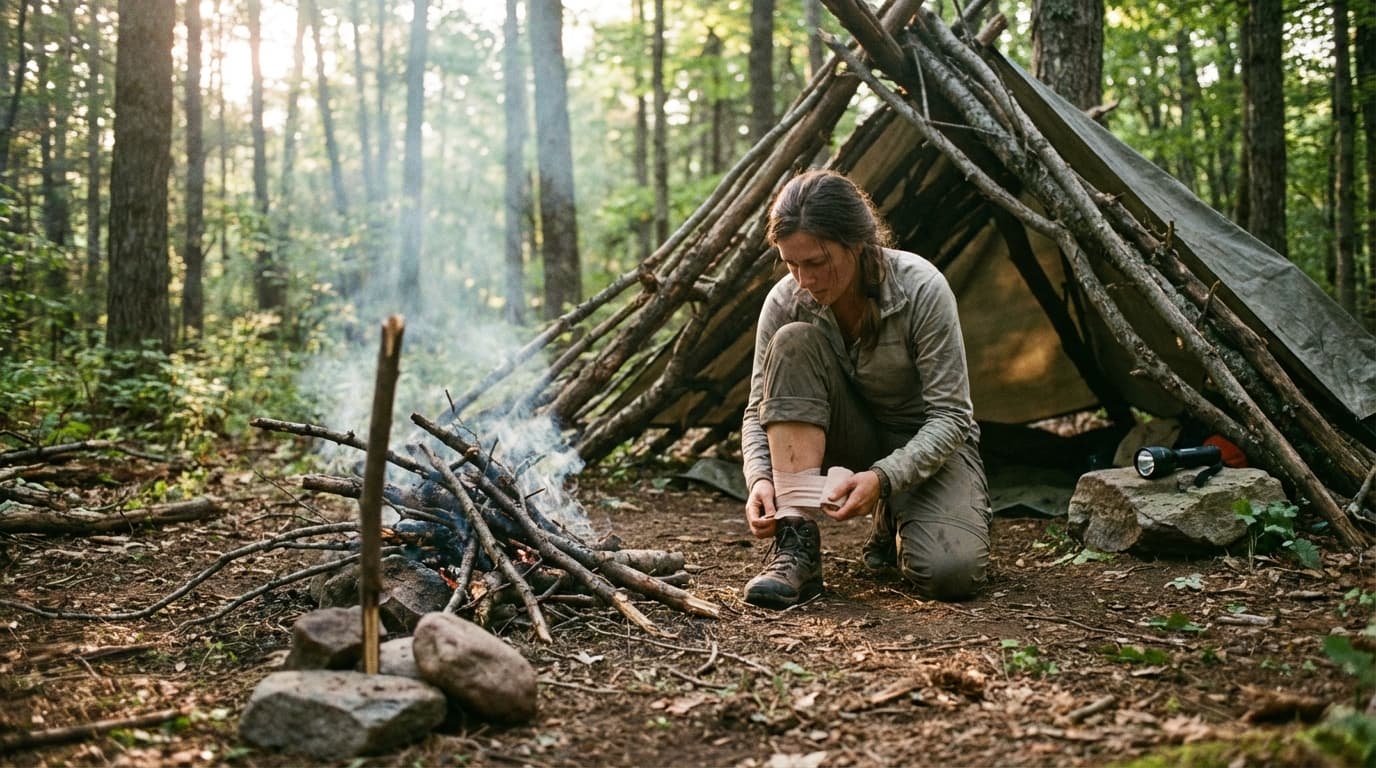
Since you cannot just call for a ride, you have to build your own support system. Look around for two sturdy branches about the length of your forearm. You want them thick enough not to snap but light enough to carry. Use a spare shirt or a base layer to wrap your ankle first so the wood does not rub your skin raw. This padding is essential because skin sores are the last thing you need when you are already limping. Think of this as a temporary cast made from the forest itself. It does not have to be pretty, it just has to be solid.
Now for the wrap. If you have a long lace or a bandana, use a Figure-8 pattern. Loop it under your foot, cross it over the top of your ankle, and wrap it around the back. This locks the joint in place without cutting off your circulation. It should feel very snug. You want that joint to feel like it is set in a cast so it does not wobble when you move. Also, find a long, sturdy branch to act as a crutch. Pad the top with a rolled up shirt so it does not bruise your armpit or chafe your side. Every bit of weight you keep off that ankle is a step closer to getting back to the trailhead. It will be slow going, but you are moving, and that is a win.
The Improvised Trail Splint
Imagine you are miles from the trailhead when your foot catches a hidden root. That sharp pop in your ankle is a sound you never want to hear while you are alone. Treating a sprained ankle in the backcountry solo is really about one thing: stability. If you cannot keep that joint still, you are going to have a hard time getting home. You need to act fast before the swelling makes it impossible to even move.
Look around for two straight and sturdy branches about the length of your forearm. These will act as your temporary bones. Before you strap them on, wrap your ankle in a spare shirt or a thick pair of wool socks. This padding is vital because it prevents the wood from rubbing your skin raw as you move. Once you have your padding in place, position the sticks on either side of your leg to create a solid frame.
Now you need to secure everything. Use a long bootlace or a bandana to tie a figure-8 wrap. Start at the top of the sticks, loop under the sole of your boot, and cross back over the front of your ankle. It should feel tight enough to stop the side-to-side wiggle but loose enough that your blood still flows. To finish the job, find a long Y-shaped branch to use as a crutch. This simple tool takes the weight off the joint so you can slowly limp back to safety.
Key insights:
Keep your boot on if possible because it provides natural compression and extra support for the joint.
Check your toe temperature every few minutes to ensure the wrap is not cutting off your circulation.
A sturdy Y-shaped branch works best for a crutch if it reaches comfortably from the ground to your armpit.
Building a Quick Shelter With Almost No Tools
Imagine you are lost and the sun is dipping low. Most people think about food first, but that is a mistake. You can go weeks without a meal, but you might only have three hours to live if you lose too much body heat. This is the Rule of Threes in action. When you are building an emergency shelter with limited tools, your main enemy is the cold air and the freezing ground.
Start by looking down. The earth will suck the heat right out of your body faster than the air will. You need to pile up at least a foot of dry leaves or pine needles to act as a mattress. Once that is done, keep the rest of the structure small. It feels better to have a big, roomy tent, but a tiny space is much easier for your body heat to warm up. If you can barely turn around, you did it right.
For a simple debris hut, you just need one long, sturdy branch called a ridgepole. Prop one end up on a stump or a low tree crotch and let the other end rest on the ground. Now, lean smaller sticks against it to create a rib cage. This is where the real work begins. You have to pile on layers of forest debris like it is your life on the line because it actually is.
Think of your shelter like a natural sleeping bag. You want to layer your leaves and needles from the bottom up. This creates a shingle effect where rain can slide down the outside instead of soaking through to your skin. If you do it right, the water stays out and the warmth stays in. It is not pretty, but it works when you have nothing else.
Key insights:
Prioritize insulation from the ground to prevent rapid heat loss.
Keep the interior space as small as possible to trap your body heat.
Use the shingle method when layering debris to ensure rain runs off the sides.
The Debris Hut: Your Natural Sleeping Bag
Imagine the sun is dropping and the woods are getting chilly. You have no tent, but you have the ground. This is where the debris hut becomes your best friend. It is basically a natural sleeping bag that keeps your body heat where it belongs. First, you need a ridgepole. Look for a thick, sturdy branch that is longer than you are tall. Prop one end up on a stump or a tripod of sticks. This is the spine of your house, so make sure it will not snap when you start adding weight.
Now comes the tedious but life-saving part. You need to pile on leaves, pine needles, and forest duff. We are not talking about a light dusting here. You want this layer to be at least two feet thick to stay warm. As you pile the material, think about how shingles look on a roof. Start from the bottom and work your way up. This shingle effect helps rain slide right off the sides instead of soaking through to your skin.
Before you crawl in for the night, give it a quick check. If you can see the ridgepole from the outside, you definitely need more debris. The goal is to create a tiny pocket of air inside that your body can actually warm up. It is a lot of work, but it beats shivering through the dark hours. Does it look like a giant pile of forest trash? Good. That means it is working.
Key insights:
A sturdy ridgepole is the foundation that prevents the shelter from collapsing on you.
Thickness is your best friend for insulation and should be at least two feet deep.
Always layer debris from the bottom up to ensure water runs off the sides.
Common Survival Questions
When you are alone in the woods, your brain starts playing a loop of every scary movie you have ever seen. What if the sun goes down before I find the trail? What if this rain never stops? These questions are not just nerves. They are your survival instincts trying to get your attention. Most people think they need a massive backpack full of gadgets to stay safe, but the truth is simpler. Your best tool is not something you buy at a store. It is the knowledge in your head.
Think about the gear vs. skill debate. You could have an expensive flashlight, but if you do not know how to signal for rescue at night, you are just a person with a light in the dark. Skill is what lets you start a fire with wet wood when your hands are shaking from the cold. It is what helps you build an emergency shelter with limited tools when the wind picks up. Gear can break or get lost, but what you know stays with you.
Mental prep is the secret sauce. Staying calm is harder than it sounds when you are treating a sprained ankle in the backcountry solo. If you panic, you make mistakes. But if you have practiced using shadow sticks for daytime emergency navigation, you feel more in control. You know you have a plan. That confidence keeps your heart rate down and your head clear.
So how do you actually get ready? Start small. Do not wait for a real emergency to try these things out. Go into your backyard or a local park and try to find north without a compass. See if you can find dry tinder inside a damp log. The more you do it, the less scary those scenarios become. You will stop worrying about surviving and start feeling capable of handling whatever the woods throw at you.
Key insights:
Knowledge weighs nothing but provides the most value when things go wrong.
Practicing skills like fire building and navigation reduces panic during real emergencies.
Mental toughness is just as important as having the right tools in your pack.
The Most Important Tool is Your Brain
You can have a fancy flashlight for signaling or know exactly how to use a shadow stick, but if you panic, that gear won't save you. Your brain is actually your most important tool. When things get scary, the best move is often to do nothing at all. Just sit down. Most survival stories have a happy ending because the person stopped moving before they made things worse.
This is where the STOP acronym comes in: Sit, Think, Observe, and Plan. Sitting down helps kill that frantic adrenaline that makes you want to run. When you stop to observe, you might notice a great spot for an emergency shelter or some dry wood hidden under a log. Once you have a plan, you are not just lost anymore. You are a person with a mission.
Practice these skills now, not when you are solo with a sprained ankle. Try starting a fire with wet wood in your backyard on a rainy day. That confidence is what keeps you calm when it really counts. Survival is not usually a big, dramatic movie scene. It is just a series of small, smart choices that get you back to your own bed.
Key insights:
The brain is the only survival tool that can prevent a situation from escalating.
The STOP method provides a physical and mental reset to stop the cycle of panic.
Low-stakes practice at home builds the mental resilience needed for real emergencies.
Frequently Asked Questions
The very first thing you need to do is stop exactly where you are. It sounds simple, but your brain's natural reaction is to keep walking faster to find a familiar landmark, which usually just gets you even more turned around.
Take a seat and have a little water or a snack if you have one. This helps calm your racing heart so you can think clearly. Rescuers always say it is much easier to find someone who stayed in one spot than someone who kept wandering and changing their location.
You absolutely can! The secret is remembering that wood usually only gets wet on the outside. If you find a thick enough branch, the wood inside is almost always still dry even after a few days of heavy rain.
You will want to use a knife or a sharp rock to shave off the wet outer bark and layers. Once you reach that dry middle part, you can make small shavings that catch a spark easily. It takes a bit more effort, but it is a total lifesaver when the ground is damp.
You will know it is working if you see a clear line forming between your marks. The most important part is making sure your stick is as vertical as possible. If it leans even a little bit, your east-west line will be skewed.
Also, try to wait at least fifteen to twenty minutes between marking your first and second spots. If you rush it and the marks are too close together, your line might be a few degrees off. It is not going to be as precise as a compass, but it is definitely enough to keep you from walking in circles.
If you do not have a light, your next best bet is using something reflective during the day or a signal fire at night. Even a small piece of foil or a glass bottle can reflect sunlight well enough to catch a pilot's eye from miles away.
For nighttime, you want to focus on a signal fire which is different from a regular campfire. You need to keep a pile of dry wood ready to go and have some green branches or pine needles nearby. Adding those green leaves creates thick white smoke that stands out against the dark sky. It is all about contrast so rescuers can spot something that does not look natural.
Conclusion
So what does all this mean for your next solo trip? It means that survival is less about having a fancy bag of gear and more about what is in your head. Whether you are turning wet wood into a warm fire or using a simple shadow stick to find your way when the GPS dies, these skills work together to keep you calm. When you know how to fix a sprained ankle or build a debris hut, you stop feeling like a victim of the woods and start feeling like you belong there.
The best move you can make is to get outside and practice these survival scenarios before you actually need them. You do not need a mountain to test a flashlight signal or try out a trail splint. Use your backyard or a local park where the stakes are low. The more you repeat these steps, the more natural they feel when the pressure is on.
The woods are a beautiful place to be alone, but they do not care about your plans. Your brain is the only tool that never runs out of batteries or gets lost. Keep it sharp, practice often, and get back home safe.
Every WilderReady guide is researched, written, and fact-checked in-house against trusted references such as the American Red Cross, the National Park Service, and the CDC before it goes live. We publish under this shared byline instead of invented personas, so you always know who stands behind the guidance you are reading.