Will They See You? How to Use Survival Signals to Get Found Fast
Imagine standing in a vast forest while a rescue plane flies right over you, but the pilot never looks your way. It is a terrifying thought, but it happens more...
Will They See You? How to Use Survival Signals to Get Found Fast
Imagine standing in a vast forest while a rescue plane flies right over you, but the pilot never looks your way. It is a terrifying thought, but it happens more often than you might think. In many survival scenarios, the difference between getting home and staying lost comes down to one thing: how well you can signal for help.
Search and rescue teams often describe finding a person as looking for a needle in a haystack. If you want to get rescued in the wild, you have to break the patterns of nature and make yourself impossible to ignore. Whether you are using survival whistle codes or flashing mirrors for survival signaling, your goal is to be as loud and bright as possible.
This guide breaks down the most effective ways to grab a rescuer's attention from miles away. We will look at emergency ground-to-air signals, the power of the rule of three, and why low-tech tools often beat expensive gadgets. By the time you finish reading, you will know exactly how to turn that invisible speck into a clear distress signal.
Don't Be a Needle in a Haystack: The Art of Getting Rescued
Imagine you're lost in the woods. You're small, the forest is massive, and you're starting to feel like a needle in a haystack. Search and rescue teams have a tough job, so your main goal is to make that needle as bright and noisy as possible. You have to break the natural patterns of the wild so you really stand out.
The golden rule of signaling is the number three. Three whistle blasts or three flashes of light tell the world you’re in trouble. It’s the international sign of distress because nature rarely repeats itself so perfectly. Instead of screaming, use a whistle. It’s much louder and won't wear out your voice like shouting will.
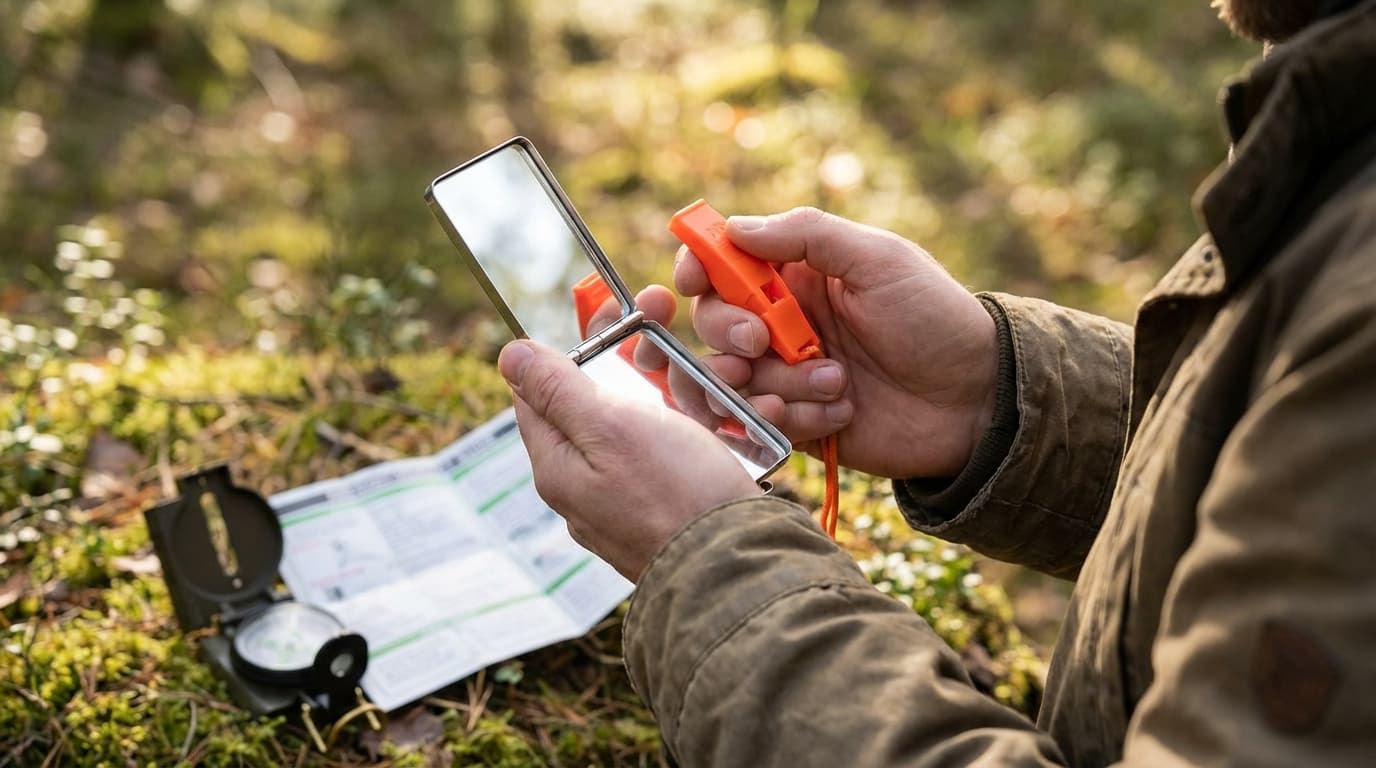
You also need to be seen. A signal mirror can flash light for ten miles, even on cloudy days. If you have a fire, toss on damp grass to create thick white smoke. The secret is contrast. You want to look like something that definitely doesn't belong in the trees. Using a bright emergency blanket or dark stones on snow helps rescuers spot you fast.
Key insights:
The Rule of Three is the most recognized pattern for signaling human distress to rescuers.
Whistles are superior to yelling because they save your energy and carry sound much further.
Visual signals like mirrors and smoke must focus on high contrast to be visible from the air.
The Rule of Three: Why Patterns Are Your Best Friend
Nature is chaotic and messy, which is exactly why patterns are your best friend in a survival situation. Think of it this way: a search party looking down from a helicopter is scanning a lot of random shadows and shapes. Finding a survivor in that mess is like looking for a needle in a haystack. But when they see three fires in a perfect triangle or three distinct piles of rocks, they know a person is there. Nature does not usually repeat itself in threes with such precision, but humans do. That is why three of anything in a row is the international sign for distress.
You can apply this rule to almost any tool you have. If you have a whistle, use it. Whistles are far louder than your voice and will not leave you exhausted like yelling will. Give three sharp blasts, pause, and repeat. If you are using a signal mirror, aim for three quick flashes toward the horizon. On a clear day, those flashes can be seen for 10 miles, and under the right conditions, up to 50 miles. The goal is to create contrast that shouts for attention. Use dark stones on snow or white bark on dark soil to make that pattern of three really pop against the background.
When the sun goes down, your strategy has to shift toward light. This is where the SOS rhythm becomes vital. It is a simple sequence: three short pulses, three long pulses, and then three short pulses. Using a headlamp or flashlight to 'speak' Morse code tells rescuers exactly what is happening without you saying a word. While a flare might catch someone's eye for a few seconds, a steady repeating light pattern provides a constant target for them to track. It turns a random flicker into a clear message that you are here and you need help.
Key insights:
Rescuers look for human-made patterns to distinguish survivors from the natural environment.
Visual signals are most effective when they provide high contrast, such as using dark rocks on light sand.
Manual signals like mirrors and whistles are often more reliable than flares because they can be used repeatedly for long periods.
The SOS Rhythm Everyone Should Know
Imagine you are stuck in the woods after dark with nothing but a headlamp. Your first instinct might be to wave it around wildly, but that is usually a mistake. Rescuers are trained to look for patterns that nature simply does not create. This is where the 'Rule of Three' becomes your best friend. Whether it is three whistle blasts or three flashes of light, any repeating sequence of three is the international sign of distress. It tells a search party that what they are seeing isn't a trick of the light - it is a person who needs help.
To 'speak' Morse code with your light, you just need to follow the SOS rhythm: three short dots, three long dashes, and then three short dots. It is a simple loop you can learn in seconds. Think of it this way: the dots are quick taps, and the dashes are held for a beat longer. This specific sequence is vital because finding a survivor is often like looking for a needle in a haystack. You have to make yourself the most obvious needle possible to stand out from the background.
Using a light is often better than shouting because your voice will give out long before your batteries do. While a handheld radio might fail if you lose line-of-sight, a clear signal can be seen for miles. The goal is to create a rhythm that breaks the natural silence or darkness. It is about being bright and being consistent until someone finally spots you.
Key insights:
The Rule of Three is the most critical pattern for rescuers to recognize human intervention.
Visual signals must prioritize contrast over natural surroundings to be effective.
Morse code SOS consists of three dots, three dashes, and three dots repeating.
Whistles vs. Yelling: Why Your Voice Isn't Enough
Imagine you have wandered a bit too far off the trail and cannot find your way back. Your first instinct is probably to start yelling for help. It feels like the right move, but your voice is actually your weakest tool in the woods. Within just an hour of shouting, your throat will be raw and your energy will be totally zapped. Experts like Craig Caudill from Field & Stream point out that whistles are far louder and will not wear you out like yelling does. In the world of survival, we call this part of the 'Trifecta of Survival,' and a good whistle is a total must-have for your pack.
So, why is a whistle better than a shout? It comes down to frequency and stamina. Search and Rescue teams are listening for sounds that do not sound like trees or wind. Think of it this way: finding one person in the wild is like looking for a needle in a haystack. It is incredibly tough even in the best weather. A whistle blast is sharp and carries much further than a human voice. Plus, it is easy to use. You can blow a whistle for hours without getting tired, which is a huge deal when you need to stay audible to rescuers for a long period.
The real secret to being found is the 'Rule of Three.' This is the international signal for distress. If you blow three short blasts, wait a second, and then do it again, you are telling everyone, 'Hey, I am over here and I need a hand!' Rescuers are trained to look for patterns of three, whether it is three fires, three light flashes, or three whistle blasts. It is a simple way to show that a human is making those noises on purpose, not just the environment making random sounds. It is the most critical pattern for rescuers to recognize that someone needs help.
While we all love our phones and GPS gadgets, they can run out of batteries or lose signal under a thick forest canopy. A whistle is a low-tech hero that works as long as you can breathe. It is reliable, lightweight, and could be the thing that gets you home to your favorite chair. When you are out there, save your voice and let the whistle do the hard work for you. It is a manual, long-lived signal that stays effective much longer than any flare or shout ever could.
Key insights:
The 'Rule of Three' is the universal language for signaling distress to rescuers.
Whistles save vital physical energy and protect your vocal cords during an emergency.
Audible signals are most effective when they create a clear, repeating pattern that does not occur in nature.
Mirrors: The Low-Tech Magic Trick That Reaches for Miles
Imagine standing on a remote ridge with nothing but a small piece of glass in your hand. It seems basic, but that little mirror is actually one of the most powerful tools in your survival kit. While a high-tech radio might fail or run out of batteries, a signal mirror relies on the most reliable power source we have. In normal sunlight, you can throw a flash of light ten miles away. If the air is clear and the sun is hitting just right, that signal can travel up to fifty miles. That is not just a guess. It is a proven reality that has saved lives when everything else went wrong.
You might think fancy flares or pyrotechnics are the best way to get noticed, but they have a major weakness. A flare burns for a few seconds and then it is gone forever. If a rescue pilot is looking the other way or checking their instruments, you just wasted your only shot. Mirrors are different because they are manually operated signals that last. As long as you have the sun, you can keep flashing. There is even a record of a survivor being spotted from 105 miles away at sea using a mirror. It is essentially a silent lighthouse that fits in your pocket.
Getting that flash to hit a moving plane or a distant boat takes a bit of technique. You do not just wave the mirror around and hope for the best. The most effective way is to use your free hand as a sighting guide. Hold the mirror near your eye and extend your other arm, using your fingers to frame the target. Peer through the sighting hole if your mirror has one, and move the reflection until the light spot hits your hand. Once the light is lined up with your fingers and the aircraft, you know you are on target. It is a simple mechanical connection that works every time.
It is also a common mistake to think mirrors only work on perfect, cloudless days. Even when it is bright but overcast, there is often enough light to create a flash that stands out against the gray background. It might not reach fifty miles in those conditions, but it can still grab the attention of a rescue team. The key is to remember the international sign of distress. Flash your mirror in a repeating sequence of three. This tells a searcher that the light they see is not just a random glint from a rock or water. It is a clear signal that someone is there and needs help.
Key insights:
A signal mirror can reach up to 50 miles in good conditions, far outperforming the one-mile range of most basic handheld radios.
The Rule of Three is the most critical pattern for rescuers to recognize that a signal is coming from a human.
Mirrors are considered long-lived signals because they can be used indefinitely as long as there is light, unlike flares which only last seconds.
How to Aim a Flash Without Losing Your Target
Aiming a mirror isn't just about waving a shiny object. You're trying to hit a moving cockpit miles away. Hold the mirror near your eye and extend your other arm, making a V with your fingers. Put the rescue plane right between those fingers and tilt the mirror until the light hits your hand. This simple sighting guide ensures your signal actually reaches the pilot instead of bouncing uselessly into the trees.
These flashes are surprisingly strong. In normal sunlight, your signal can travel ten miles, and under perfect conditions, rescuers have spotted them from fifty miles away. Even on those gloomy, overcast days, a mirror still works by catching ambient light. It won't be as blinding as a direct sunbeam, but it still creates a rhythmic flicker that looks out of place in nature.
This is where the Rule of Three becomes your best friend. Flash three times, wait, and repeat. Unlike a flare that fizzles out in seconds, a mirror is a long-lived tool you can use all day. That steady, repeating rhythm is the international sign of distress that tells a search team you are a person in need of help, not just a random reflection off a rock.
Key insights:
A signal mirror can reach up to 50 miles in the right conditions, far outperforming handheld radios.
The sighting guide technique is essential for making sure your flash actually hits the rescue craft.
Mirrors remain effective even on bright overcast days by reflecting ambient light.
Writing for the Sky: Ground-to-Air Signals That Pop
Imagine you are looking down from a plane at 3,000 feet. The ground looks like a giant, blurry carpet of green and brown. Search and rescue teams describe finding a survivor as looking for a needle in a haystack, and they are right. If you want to be found, you have to stop trying to blend in and start trying to look like a mistake. Your goal is to create something so out of place that a pilot cannot possibly ignore it.
The biggest secret to a good signal is contrast. Most people think size is what matters, but a huge signal that matches the color of the ground is useless. Contrast is king. If you are stuck in the snow, use dark rocks or dirt to mark your spot. If you are in a dark forest, find white birch bark or light-colored sand to build your message. You want a color that screams against the background. A bright orange emergency blanket or a pile of white logs on dark soil can be seen from miles away while a massive pile of brown sticks just looks like more woods.
Patterns are just as important as colors because nature rarely works in perfect sequences. This is where the Rule of Three comes in. Three of anything is the international signal for distress. Whether it is three fires in a triangle, three whistle blasts, or three piles of rocks, rescuers are trained to look for that specific repetition. When you are writing for the sky, an X or an SOS should be your go-to. Make the letters as large as possible, but keep the lines thick and the edges sharp. A pilot might miss a small person, but they will definitely notice a geometric pattern that clearly looks like human work.
Do not underestimate the power of simple tools either. A signal mirror is one of the most effective pieces of gear you can carry. In normal sunlight, a mirror flash can be seen for 10 miles, and in the right conditions, it can reach up to 50 miles. Compare that to a radio, which often only works for about a mile and needs a clear line-of-sight. If you have a fire, you can also signal during the day by throwing green leaves or damp grass onto the flames. This produces thick white smoke that stands out against the sky. These manual signals are often better than flares because they last as long as you have the energy to use them.
Think of your signaling as a conversation with the sky. You are trying to say I am here as loudly as possible without using your voice. By using high-contrast materials and the Rule of Three, you turn yourself from a hidden needle into a bright beacon. It takes work to build these signals, but when that helicopter finally circles back toward you, every rock you moved will have been worth the effort.
Key insights:
Visual signals must prioritize high contrast over large size to be effective from the air.
The Rule of Three is the most recognized pattern for signaling human intervention to rescuers.
Manual signals like mirrors and whistles are often more reliable than short-lived pyrotechnics like flares.
Smoke and Fire: Signaling During the Day and Night
Imagine standing in a dense forest as a search plane passes overhead. You shout, but the engine drowns you out. You wave, but you are just another shadow among the trees. This is why fire is your best friend in a survival situation. It is not just for warmth; it is a beacon that screams for attention. To make sure rescuers know you are not just a casual camper, you need to use the international sign of distress: the Three Fires triangle. By placing three fires in a distinct triangle pattern, you create a shape that never occurs naturally. It tells anyone looking from above that a human is down there and needs help.
During the day, a bright flame can be surprisingly hard to spot against the glare of the sun. This is where smoke becomes your primary tool. If you want to be seen against a dark forest floor, you need thick, white smoke. You can get this by throwing green leaves, damp grass, or even pine boughs onto a hot bed of coals. The moisture creates a heavy plume that rises high above the canopy. Rescuers often describe finding a survivor as looking for a needle in a haystack, so you want that needle to be as visible as possible. Contrast is everything.
The trick is to keep your signals ready without burning through all your fuel too fast. You do not need three massive bonfires going at once. Instead, keep three small, manageable fires or even just three piles of dry kindling ready to be lit the moment you hear a whistle or an engine. Since three of anything in a repeating sequence is the universal sign for help, this pattern works for everything from whistle blasts to flashes of light. It is all about creating a contrast that breaks the natural rhythm of the wilderness. Think of it as a visual SOS that tells the world exactly where you are.
While modern tech like GPS beacons is great, low-tech signals never run out of batteries. A signal mirror can flash for miles, but a well-maintained fire provides a constant presence. Just remember to keep your signal fire controlled. You want to be found, not start a forest fire that puts you in more danger. Keep your fuel dry, your green leaves handy, and your eyes on the horizon. When that rescue team finally spots your smoke, you will be glad you took the time to set things up correctly.
Key insights:
Three fires arranged in a triangle are a clear sign of human intervention because nature does not create perfect geometric patterns.
White smoke from damp vegetation provides the best contrast against dark green forests or brown earth during the day.
Preparedness matters more than size; keep your fuel piles ready so you can signal the moment a rescue craft is within range.
The international distress signal is three of anything, whether it is fires, whistle blasts, or mirror flashes.
The Truth About Tech: Radios and GPS Locators
You have probably seen those walkie-talkies at the store promising a 35-mile range. It sounds great until you are actually in the woods. In reality, most FRS and GMRS radios struggle to hit even a single mile if there is a hill or a few thick trees in the way. They rely on line-of-sight, which is hard to find when you are stuck in a ravine. This one-mile reality can be a rude awakening if you are counting on them to reach a distant rescue team.
Then there is the trap of what some call cell phone bravery. We have become so used to having a signal everywhere that we forget how fast a battery drains when it is searching for a tower that is not there. It is a common trend now where people get into trouble because they assume a quick call for help is always an option. But what happens when the screen goes black? That is when battery anxiety turns into a real survival situation. It is why having a backup plan is not just smart - it is necessary.
If you want a tech upgrade that actually makes a difference, look at GPS beacons and Personal Locator Beacons. These devices are changing the game by sending your exact coordinates straight to search teams. Instead of being a needle in a haystack, you become a clear point on a map. While these tools significantly reduce rescue time, they are still just tools. The best approach is to carry the tech but keep your manual signaling skills sharp in case the electronics fail you when it matters most.
Key insights:
FRS and GMRS radios are usually limited to a one-mile range and require a clear line-of-sight to work.
GPS beacons are the most effective modern tool because they provide search teams with exact coordinates.
Cell phone dependency creates a false sense of security that can lead to dangerous situations when batteries die or signals fade.
Frequently Asked Questions
If you ever find yourself in a pinch, just remember the number three. The international sign for distress is basically three of anything in a repeating sequence. This could be three loud whistle blasts, three flashes of light, or even three fires set in a triangle.
The reason this works so well is that nature does not usually make patterns that perfect, so rescuers know right away that a human is trying to get their attention. It is also way more effective than just shouting, which wears out your voice fast. While some people use Morse code SOS, sticking to the simple Rule of Three is the easiest way to stay visible.
In good sunlight, a signal mirror can flash a beam that is visible for about 10 miles. But if the weather is clear and the conditions are right, that signal can travel up to 50 miles. There is even a record of a rescue happening from 105 miles away at sea just because of a mirror flash.
While fancy gear like flares are great, they only last for a few seconds and are easy to miss. A mirror is a total lifesaver because you can use it over and over as long as there is some light out. It even works on bright, cloudy days if you aim the reflection toward the sound of an aircraft using your hand as a guide.
You should almost always stay right where you are. Unless you are in immediate danger from something like a forest fire or a flash flood, staying put is your best bet for getting found quickly.
Here is the thing: search and rescue teams usually start looking at the spot where you were last seen. If you keep moving, you are basically making the search area bigger and harder to manage. As the experts say, finding a person in the woods is already like looking for a needle in a haystack, so do not make it harder by being a moving needle. Plus, staying in one spot helps you save your energy for important tasks like staying warm and making signals.
The three heavy hitters you want in your pack are a signal mirror, a loud whistle, and a way to make fire or smoke. These are often called the trifecta of survival gear because they are reliable and can be used over and over again.
A whistle is vital because it is way louder than your voice and will not wear you out like yelling does. A mirror is also incredible because its flash can be seen from 10 miles away or even up to 50 miles if the weather is right. For the third one, a fire is great at night, but during the day you should throw green leaves or damp grass on it. This creates thick white smoke that stands out against the landscape so rescuers can spot you from the air.
Conclusion
Getting rescued in the wild is less about luck and more about how well you can break the rules of nature. While the woods are random and messy, your survival signals should be precise and repetitive. By using the rule of three with a whistle or a mirror, you turn yourself from a hidden needle in a haystack into a beacon that search teams can actually find. It is all about being as loud and visible as possible when it counts.
Your next move is simple: take a look at your day pack. You do not need a mountain of high-tech gear, but having a simple whistle and a signal mirror can change everything if you get turned around. These tools do not rely on cell service or battery life, which makes them your best friends in real survival scenarios. Even a small piece of gear can make a massive difference when you are trying to get rescued in the wild.
Remember that being lost is scary, but being invisible is what keeps you out there. Stay put, stay calm, and keep making noise. With the right signals and a little patience, you are never truly alone for long.
Every WilderReady guide is researched, written, and fact-checked in-house against trusted references such as the American Red Cross, the National Park Service, and the CDC before it goes live. We publish under this shared byline instead of invented personas, so you always know who stands behind the guidance you are reading.