Why Your Survival Knife Isn't Sharp Enough (And How to Fix It Anywhere)
You are out in the woods, the sun is dropping, and you need a fire fast. You reach for your blade to prep some cedar, but it just slides right off the bark. It is a frustrating moment, but it is also a dangerous one. Most people do not realize that survival knife safety starts with a sharp edge, because a dull blade forces you to use more pressure, which leads to slips and stitches.
Whether you are a seasoned hiker or just starting out, understanding bushcraft tool maintenance is what keeps you safe in the wild. We will talk about the trade-offs of a fixed blade vs folding knife and why edge retention is often the difference between a tool that works and one that fails. It is not just about buying the expensive gear; it is about knowing how to care for it when you are miles from home.
This article will teach you how to sharpen a knife in the field using simple, portable tools. We will cover everything from fixing nicks in your steel to the 18 to 25 degree rule that pros use to get a perfect finish. By the time we are done, you will know exactly how to keep your blade ready for any adventure.
Ever feel like your knife is fighting you? It’s a common frustration. Most people assume a dull blade is just annoying, but it’s actually a safety hazard. When you have to force a cut, you lose control, and that is when accidents happen. Whether you’re carrying a fixed blade or a folding knife, edge retention is key. If you aren't maintaining a consistent 18 to 25-degree angle, you are essentially carrying a blunt object into the woods.
The issue often starts with using the wrong tool for the job. We use 'bushcraft' and 'survival' interchangeably, but they serve very different roles. A survival knife is a powerhouse built for chopping and splitting. In contrast, bushcraft tools usually feature a Scandi grind designed for fine carving and woodcraft. Trying to use a heavy survival blade for detailed work is like trying to carve a whistle with a hatchet.
Staying sharp in the field is really about consistent care rather than big repairs. High-carbon steel is a popular choice for these tools because it is much easier to sharpen outdoors. Instead of waiting for the edge to fail completely, try regular honing. A simple rod realigns the metal without stripping it away. This small habit keeps your tool ready for whatever your adventure throws at you.
Key insights:
A dull knife requires more force, which significantly increases the risk of slips and field injuries.
Survival knives are built for heavy-duty impact, while bushcraft knives use specialized grinds for precision carving.
Regular honing realigns the blade edge without removing metal, making it more efficient than waiting for a full sharpening session.
Bushcraft vs. Survival: Why the Label Matters More Than You Think
Ever wonder why your survival knife feels clunky when you try to carve a simple notch? Most of us use the terms bushcraft and survival interchangeably, but as Josh Smith from Montana Knife Company points out, they really are not the same thing. One is a precision tool while the other is a sledgehammer. If you pick the wrong one for your task, you are going to struggle. It is not just about the name on the box. It is about how the blade is actually built to move through wood or bone. Matching your tool to your actual goals in the woods makes all the difference.
Think of the Scandi grind as a woodworker's best friend. This specific shape is the gold standard for controlled carving because the wide bevel acts like a guide. It stops the blade from digging too deep into the wood when you are making feather sticks or notches. This geometry provides incredible control, which is why it is the go-to for bushcraft tasks. Many of these knives use high carbon steel because it allows for much easier sharpening in field conditions. You get incredible precision, but you should probably not use it for heavy-duty chopping because that thin edge can be delicate.
On the other hand, survival knives are built for the brute work. These are the powerhouses meant for splitting wood and taking a beating. You will usually see edge angles maintained between 18 and 25 degrees here because that range provides enough strength to handle high impact tasks without chipping. While a thicker blade might feel like it can handle anything, it will never be a great carving tool. It is a trade-off where you give up fine motor control for pure, no-nonsense durability. When you need to baton through a log, this is the structural difference that keeps your knife in one piece.
Keeping these tools ready is about more than just a yearly grind. Regular honing with a rod realigns your edge without eating away at the metal, which extends the life of your blade. It is much easier to maintain a sharp edge than it is to fix a totally dull one. Whether you are using a coarse grit for damage repair or a fine grit for finishing, knowing your tool's purpose helps you keep it in top shape. The reality is that a sharp knife is a safe knife, so take the time to respect the steel.
Key insights:
Bushcraft knives are precision tools designed for carving and fine woodcraft.
Survival knives are high-impact powerhouses built for chopping and splitting tasks.
A Scandi grind prevents the blade from biting too deep during delicate work.
Maintaining an edge with regular honing is more efficient than restorative sharpening.
Survival knife edges are best kept at an angle between 18 and 25 degrees for durability.
The Scandi Grind: A Woodworker's Best Friend
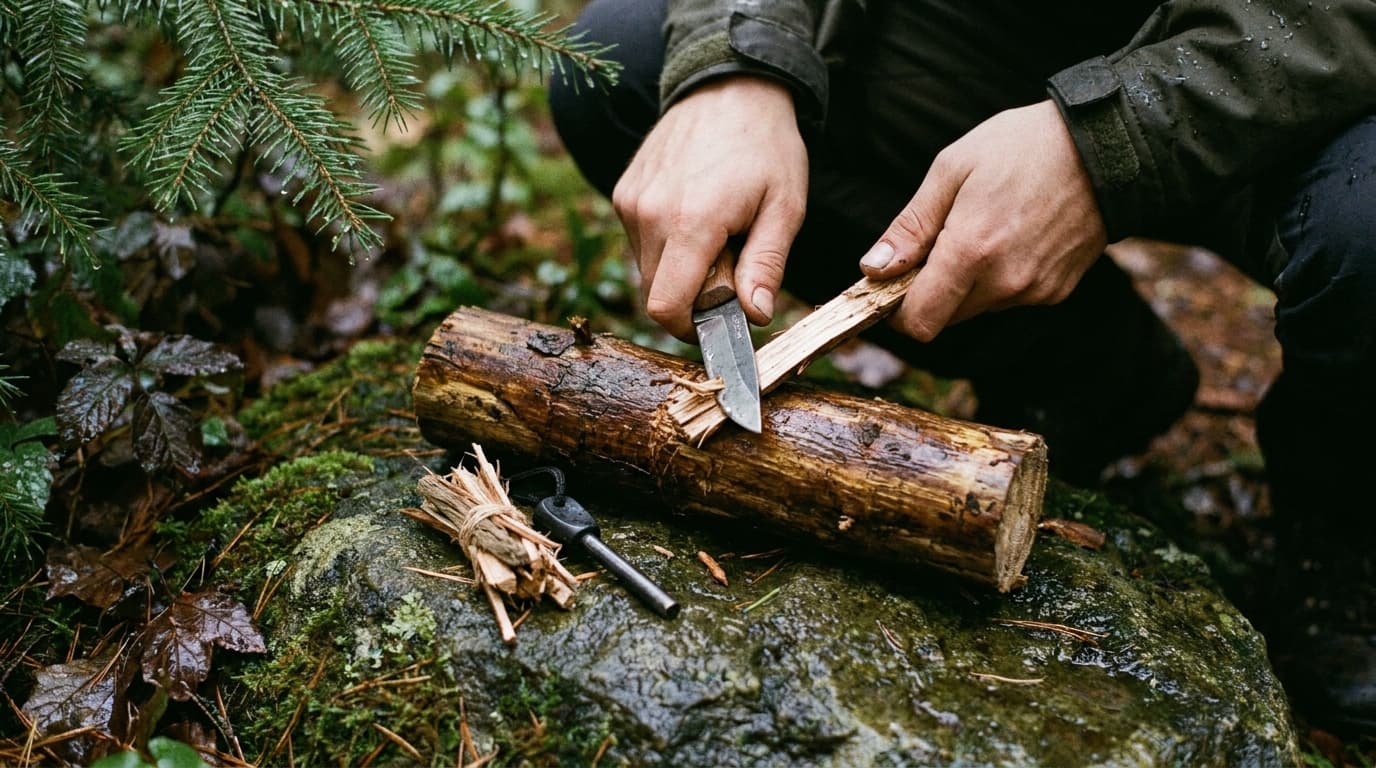
If you have ever tried to whittle a feather stick with a thick survival knife, you have likely felt the frustration of the blade biting too deep or sliding off entirely. This is where the Scandi grind shines. It is often called the gold standard for woodcraft because its single bevel acts like a guide, helping you feel exactly where the steel meets the wood. This matters because it turns a simple piece of metal into a precision tool.
This specific geometry is what prevents the knife from diving uncontrollably into the grain. Think of it as a built-in safety for your carving; it lets you peel away thin, curly shavings for fire-starting without ruining your project. Because these knives often use high-carbon steel, they are also much easier to sharpen when you are miles from a workshop using a simple whetstone.
But do not mistake precision for invincibility. While a Scandi grind is great for fine-motor tasks, it is not built for heavy-duty chopping or splitting logs like a survival powerhouse. You gain incredible control for crafting tools and triggers, but you lose some of that high-impact durability. It is a specialized choice for those who prefer thriving in the woods through craft rather than brute force.
Key insights:
The Scandi grind acts like a plane, providing a flat surface that tracks perfectly along wood for controlled shavings.
High-carbon steel Scandi blades are preferred for bushcraft because they are easier to maintain in field conditions.
The thin edge that makes carving easy is more prone to chipping during high-impact tasks like batoning.
Survival Powerhouses: Built for the Brute Work
Think about the last time you tried to split a log with a flimsy blade. It's a mess, right? That is where the survival knife earns its keep. These tools are built as no-nonsense powerhouses designed to chop and split without snapping under pressure. Unlike delicate carving tools meant for whittling, a survival blade is made for high-impact, heavy-duty work. It is the brute force partner you want when the situation gets rough.
You might assume a thicker blade is always better, but that's a common trap. If a knife is too thick, it becomes a clumsy wedge that won't actually cut. The real magic happens when you balance toughness with a proper edge angle, typically between 18 and 25 degrees. This specific geometry allows you to baton through thick wood while still having enough bite to slice through rope or gear.
But here is the thing: because these knives take such a beating, they need regular care. Keeping that edge sharp with a medium-grit whetstone is much easier than trying to fix a chipped, rolled blade after it fails. Consistent maintenance keeps your powerhouse ready for the brute work without letting it turn into a blunt pry bar. After all, a tool is only as good as the edge you keep on it.
Key insights:
Survival knives are built for high-impact tasks like chopping and splitting, whereas bushcraft knives focus on fine-motor carving.
Thicker blades aren't always superior; the right geometry is what ensures the tool actually cuts instead of just wedging.
Maintaining a consistent 18-25 degree angle is the secret to a blade that stays functional in the field.
Safety First: Keeping Your Fingers Where They Belong
Imagine you are out in the woods, the sun is dipping low, and you just need to shave a few pieces of kindling. It is a simple task, right? But here is the thing: most knife accidents do not happen during big, dramatic survival moments. They happen during these easy chores when your guard is down. When you are working with high-carbon steel, you have to respect the tool because it is built for high-stress work. A great habit is to establish a safety circle every single time you work. Just reach out your arms and spin in a slow circle. If you can touch another person or a piece of gear, you are too close. This simple move creates a buffer zone so that a slip does not turn into a trip to the emergency room.
There is a weird logic to knife safety that people often miss. A dull blade is actually way more dangerous than a razor-sharp one. When your edge is gone, you stop slicing and start forcing. You end up putting your whole weight behind a cut that should be effortless. This is where the physics of a slip get scary. Because you are pushing so hard, if the knife misses the wood, it travels much further and with more force than a sharp blade ever would. It is like a car with bad brakes. It is hard to stop once things go wrong.
You can avoid this by doing quick checks throughout the day to see if your blade is still biting. If your knife snags on a piece of wood or feels like it is sliding off the surface instead of cutting, stop immediately. Keeping your edge at that sweet spot between 18 and 25 degrees is about more than just clean carving. It is about control. Using a medium grit whetstone for a quick touch-up is much easier than trying to fix a trashed edge later. Think of it as a quick reset for your tool so you can get back to the fun stuff without worrying about your fingers.
Key insights:
Most accidents happen during routine tasks because users stop paying close attention.
A safety circle ensures that no one is within reach if your hand slips during a heavy cut.
Dull knives require more force, which makes the blade travel further and faster when it misses the target.
Frequent edge checks and maintenance at an 18 to 25 degree angle keep the tool predictable and safe.
The Danger of a Dull Blade
Think about the last time you struggled to cut through a branch. When a blade loses its edge, you start forcing the cut with raw muscle. This is the exact moment safety disappears. If the wood gives way or the blade catches, you lose control of that momentum.
Here is the scary part: a dull knife travels much further when it slips. Because it lacks the bite to dig in, it glances off surfaces with all that extra force you are applying. It does not just stop. It sails. This lack of control is why blunt tools cause more accidents than sharp ones.
Check your edge often. If it slides across your thumbnail instead of catching, or fails to slice paper, it is a liability. Maintaining that 18 to 25-degree angle is not just for show. It is what keeps the tool predictable and your fingers intact.
Key insights:
Forcing a cut creates dangerous, unpredictable momentum.
Dull blades glance off surfaces rather than biting into them.
A simple thumbnail or paper test can prevent a serious injury.
Sharpening in the Wild: Keeping an Edge Without a Workshop
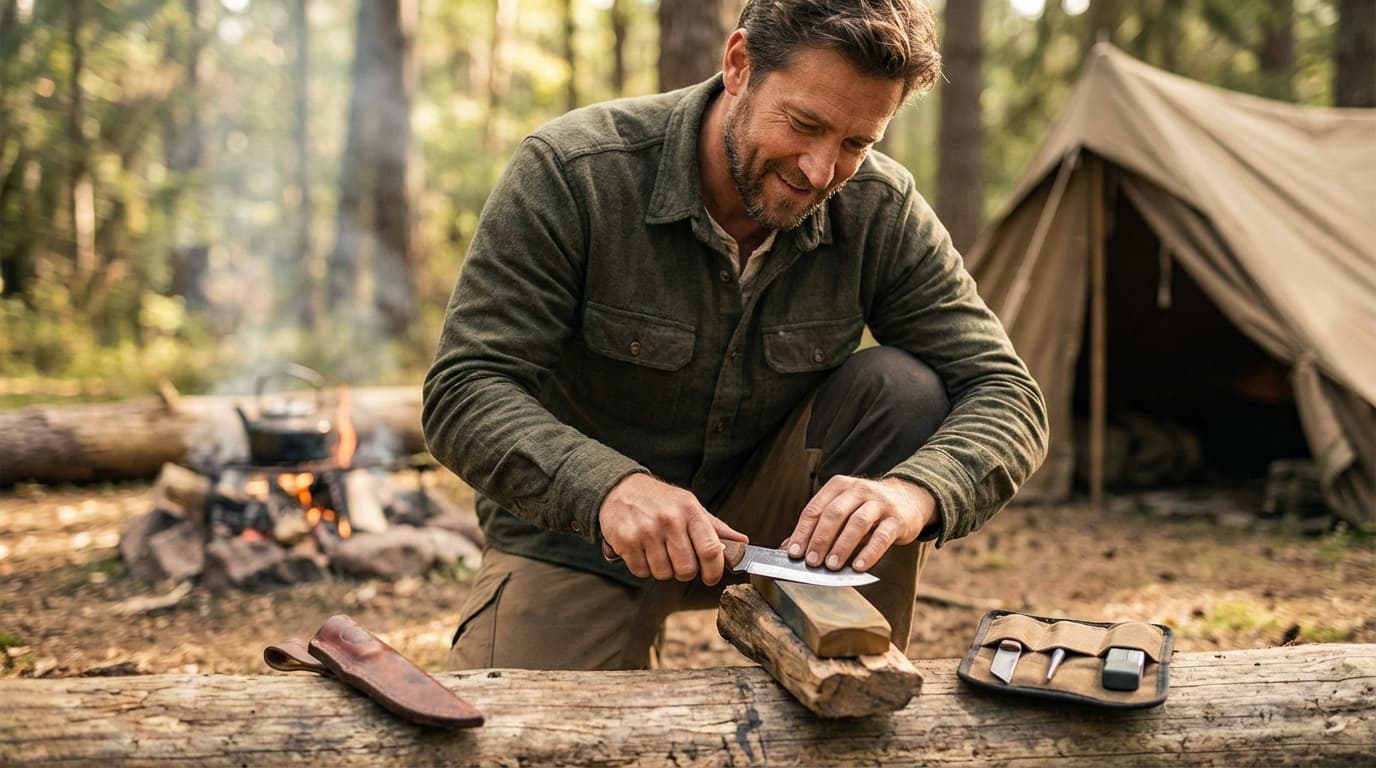
Ever tried to prep wood for a fire with a blade that feels more like a butter knife? It is frustrating and, honestly, a bit dangerous. When you are miles from a workshop, maintaining that edge is about consistency, not brute force. Most survival knives perform best when you keep the angle between 18 and 25 degrees. Think of it as finding that sweet spot where the steel bites without being too fragile. To get this right, you have to stabilize the blade. Whether you brace it against a log or your own thigh, that stability is what prevents a wobbly, rounded edge. While some people prefer circular motions, moving the blade in one steady direction across your stone usually makes it easier to stay consistent.
Grit levels can feel like a math problem, but they are actually quite simple to use. Think of it as a progression from fixing to polishing. If your knife has visible chips from heavy work, you need a coarse grit, usually in the 200 to 800 range, to grind away the damage. For your everyday maintenance, a medium grit between 1000 and 3000 handles the routine work. This is the stage where the knife starts feeling toothy and functional again. If you are chasing that scary sharp finish that glides through material, you will finish with a fine grit of 4000 or higher. For most people heading into the wild, a diamond sharpener is the best companion. It is light, durable, and handles the high-carbon steel found in many bushcraft knives much faster than a traditional stone. Since bushcraft knives often feature a Scandi grind, which is optimized for carving, using a diamond plate helps you maintain those clean lines without digging too deep into the metal.
Here is a secret that will save your blade and your sanity: you probably do not need to sharpen as often as you think. Most of the time, the edge is just microscopically bent out of alignment, not actually dull. This is where honing comes in. Using a simple rod realigns that edge without removing any significant metal. It is a quick fix that keeps the tool biting. If you make it a habit to hone your knife after every major expedition, you will rarely need to use a whetstone. This kind of daily maintenance does more than just keep things sharp; it extends the life of your tool by years because you are not constantly grinding it down. Think of it as preventative care. A few seconds with a rod can prevent the need for a full, metal-stripping sharpening session later on.
Key insights:
Consistency in your sharpening angle is more important than the amount of pressure you apply.
Diamond sharpeners are the preferred field companion for high-carbon steel blades.
Regular honing realigns the blade edge and significantly reduces the need for abrasive sharpening.
Understanding Grit: From Damage Repair to Razor Edges
Think of grit like sandpaper for your blade. If you have a visible chip or a rolled edge from heavy chopping, a fine stone won't do a thing. You need to start with a coarse grit, typically between 200 and 800, to actually reshape the steel. It is an aggressive process, but it is the only way to fix real damage and get back to a workable edge.
Once the edge is straight, move to the medium range, around 1000 to 3000 grit. This is your daily driver for routine maintenance. Most survival knives perform best when you maintain an angle between 18 and 25 degrees. This range is the sweet spot for durability and cutting power. If you want that 'scary sharp' finish, hit it with a fine 4000 grit stone or higher to polish the metal until it glides.
But what about when you are actually out in the woods? Carrying heavy whetstones is not realistic for most hikers. A diamond sharpener is the better field companion because it is light, fast, and bites into tough high-carbon steel easily. Also, remember to hone your blade regularly. It realigns the edge without stripping away metal, making your full sharpening sessions much easier down the road.
Key insights:
Use coarse grit (200-800) for chips and medium (1000-3000) for regular upkeep.
An 18-25 degree angle provides the best balance of strength and sharpness for survival tools.
Diamond sharpeners are the most practical choice for maintaining high-carbon steel in the field.
Regular honing extends the life of your edge by realigning the metal instead of grinding it away.
Honing vs. Sharpening: The Secret to Longevity
Ever feel your knife dragging? Before you grab the heavy stones, remember your edge might just be bent, not gone. Honing is the secret. A simple rod nudges those microscopic teeth back into line without stripping away the steel. It is like a quick tune-up instead of a full engine rebuild.
Staying on top of maintenance is easier than saving a dead edge. If you hone after every trip, you can skip the whetstone for months. Most survival knives perform best at an angle between 18 and 25 degrees. Honing keeps that sweet spot intact. It works. This matters because every time you use a grit stone, you are wearing the knife away.
High-carbon steel is a favorite for bushcraft because it is so easy to fix in the field. But why grind it down? Using a rod for daily care preserves the blade geometry, especially on a Scandi grind. It keeps your tool ready for carving without the drama of a full sharpening session. A little love goes a long way.
Key insights:
Honing realigns the blade edge without removing significant material.
Consistent maintenance with a rod is more efficient than restorative sharpening.
Survival knife angles are best maintained between 18 and 25 degrees for longevity.
Fixed Blade or Folding? Choosing Your Lifeline
Imagine you are staring down a thick piece of hickory that needs splitting for a fire. This is exactly where the debate between a fixed blade and a folding knife gets real. Most people use the terms bushcraft and survival interchangeably, but they really are not the same thing. A true survival knife is a powerhouse designed for high-impact tasks like chopping and splitting. For that kind of work, a full-tang fixed blade is your best friend because it will not snap at the handle when things get tough. It is the structural integrity that makes it a true lifeline.
Folding knives are great for everyday carry because they fit right in your pocket without a second thought. But in a survival scenario, they are often the weak link. The pivot point is a mechanical failure waiting to happen if you try to baton wood or pry something heavy. That said, a high-quality folder is a smart choice for precision. If you are doing fine carving or light tasks, the convenience of a folder might actually be better than lugging around a heavy fixed blade. It all comes down to the specific job you are trying to finish.
No matter which style you pick, consistent maintenance is what keeps the tool useful. High-carbon steel is a popular choice for these tools because it is much easier to sharpen when you are out in the woods compared to harder stainless steels. You want to keep that edge angle between 18 and 25 degrees for the best results. Think of it this way: a dull fixed blade is just a heavy stick, and a broken folder is just trash. Regular honing with a rod keeps the edge aligned so you do not have to spend hours on a whetstone later.
The real secret is knowing your task. If you need a precision tool for making fire-starters or carving gear, a bushcraft knife with a Scandi grind is perfect for clean cuts that do not dig too deep. But if you need to survive a literal emergency, you want that no-nonsense powerhouse. It is always better to have a tool that matches your environment than one that just looks good on a belt. Make sure you have the right tool for the job before you actually need to use it to save your life.
Key insights:
Survival and bushcraft tools have different DNA because one is for precision and the other is for power.
Maintenance is always easier than repair, so hone your blade after every major trip to keep it ready.
Fixed blades offer structural safety that folders simply cannot match in high-stress survival situations.
The Battle Against Rust: Long-Term Tool Maintenance
Ever wonder why your favorite bushcraft knife seems to get spotted or dull so fast? Most of these tools use high-carbon steel because it is much easier to sharpen when you are out in the woods. But there is a catch. This metal is basically a magnet for rust. While a stainless blade might survive a bit of neglect, high-carbon steel needs your attention the moment you finish using it. It is a simple trade-off that every outdoorsman makes for that razor-sharp edge that is so easy to maintain in the field.
Keeping your blade in top shape comes down to a habit we call clean, dry, and oil. After you finish carving or doing heavy prep work, wash the blade with warm water and a little mild detergent. But here is the critical part. You have to dry it completely before it goes back in the sheath. Even a tiny bit of moisture trapped against the metal can ruin an edge overnight. If you have been trekking through the rain, do not just shove the knife away. Wipe it down immediately and apply a light coat of oil to create a barrier against the damp air.
Think of tool care as a constant process rather than a chore you do once a year. Regular honing with a rod keeps the edge aligned without actually grinding away the metal. This extends the life of your tool and keeps you much safer. When you finally do need a full sharpen, remember that survival knife angles usually stay between 18 and 25 degrees. Using a medium grit stone around 1000 to 3000 is perfect for routine care. It takes far less time to maintain a sharp edge than it does to fix a damaged one.
Key insights:
High-carbon steel offers superior sharpening ease but requires constant protection from moisture.
The clean, dry, and oil routine is the best defense against tool corrosion.
Consistent honing is more efficient and safer than waiting for a blade to become completely dull.
Frequently Asked Questions
Actually, most people find a Scandi grind is much easier to sharpen because the bevel itself acts as a built-in guide. Unlike a flat grind where you have to guess the angle or use a guide, you just lay the Scandi bevel flat against your whetstone and follow the existing surface.
It is the go-to choice for bushcraft because it is so straightforward to maintain in the field. The only thing you have to watch out for is rounding the edge. As long as you keep the surface flush against the stone, you will get a razor-sharp edge that is perfect for carving and woodcraft without much fuss.
You probably do not need a full sharpening session as often as you might think. For a typical camping trip, a quick touch-up or hone is usually all it takes to keep things moving. The secret is to maintain the edge rather than waiting for it to get totally dull.
If you use a honing rod or a leather strop after each trip, you can realign the blade without grinding away the metal. This keeps your knife sharp for months. Here is the thing: it is much easier to keep a sharp knife sharp than it is to fix a blade that has been beaten up by heavy use. If you are doing a lot of wood splitting or heavy carving, check the edge every couple of days, but for light tasks, just a bit of regular care goes a long way.
You can, but it's really a last-resort move. If you're in a pinch, a smooth, flat river stone can act as a makeshift whetstone to get your edge back. The trick is keeping your angle consistent, usually between 18 and 25 degrees, so you don't accidentally dull the blade further.
High-carbon steel is actually preferred for bushcraft specifically because it's easier to sharpen with whatever you find in the woods. While it won't be as pretty as a professional job, a natural stone can keep you working until you get back to your proper gear.
Food-grade mineral oil is usually your best bet. It's simple, inexpensive, and safe if you use your knife to prep food at camp. Since high-carbon steel is prone to rusting, you'll want to apply a light coat after every use.
Just make sure you wash the blade with warm water and dry it completely first. Even a tiny bit of moisture trapped under the oil can cause spots over time. Regular care like this is much easier than trying to scrub away rust once it starts to pit the metal.
Conclusion
A survival knife is only as good as the edge you keep on it. Whether you pick a rugged fixed blade or a handy folder, your safety depends on understanding blade geometry and staying ahead of the wear. It is not just about having the gear. It is about the routine of tool maintenance that keeps you ready for the woods.
Think of your knife as a partner rather than just a piece of metal. When you notice how different grit levels affect edge retention or how a quick hone saves hours of work later, you stop fighting the tool and start working with it. That shift in perspective is what really makes the difference in the field.
Your next move is simple: check your blade today. If it feels sluggish, practice those field sharpening skills now while you are still at home. A sharp knife is a safe knife, and a well-kept tool is the best lifeline you can carry. Respect the steel, and it will take care of you.
Every WilderReady guide is researched, written, and fact-checked in-house against trusted references such as the American Red Cross, the National Park Service, and the CDC before it goes live. We publish under this shared byline instead of invented personas, so you always know who stands behind the guidance you are reading.