Why the 1-10-1 Rule is Your Best Friend When the Water is Freezing
Imagine the heart-stopping chill of falling through thin ice. Most people think they only have seconds before freezing to death, but the biggest threat is actually the immediate cold shock...
Why the 1-10-1 Rule is Your Best Friend When the Water is Freezing
Imagine the heart-stopping chill of falling through thin ice. Most people think they only have seconds before freezing to death, but the biggest threat is actually the immediate cold shock response that makes you gasp for air. If you do not know what to expect, that first minute in the water can easily be your last.
This is where cold water survival becomes a mental game as much as a physical one. You actually have more time than you think if you follow the 1-10-1 rule hypothermia experts recommend. This guide will show you how to survive falling through ice by staying calm and using your energy where it matters most.
We are going to walk through the three stages of immersion, from controlling your breath to the reality of swim failure. You will also learn about treating hypothermia in the wild and why your wet clothes might actually be your best protection. Let's look at how to get you back to safety before the clock runs out.
Cold Water Survival: How to Stay Safe (and Keep Your Cool) if You Fall Through Ice
Imagine the sudden, bone-chilling shock of breaking through ice into freezing water. It is a terrifying moment where physics immediately takes over. Because water pulls heat from your body 24 to 30 times faster than air, you are essentially in a race against time the moment you go under. This is not just about being cold; it is an immediate drain on your body's ability to function.
Panic is your biggest enemy during that first minute. Cold shock causes a massive gasp reflex, where your breathing can spike by up to 1000% over normal levels. If you do not control your breath, you risk inhaling water and drowning right there. It is a sobering thought, especially since many victims are only a few feet from safety when they lose control. Staying calm is the only way to keep your airway clear.
This guide walks you through the 1-10-1 rule so you can stay calm and get home. We will look at how to manage your breathing, use your ten minutes of meaningful movement for self-rescue, and understand what happens during that final hour before hypothermia sets in. Knowing these stages keeps you in charge when every second counts.
Key insights:
Water conducts heat away from the body nearly 30 times faster than air.
The first 60 seconds are strictly about breathing control to avoid drowning from cold shock.
Most cold water drownings happen within a very short distance of safety or the shore.
The 1-10-1 Rule: Your Three-Step Survival Map
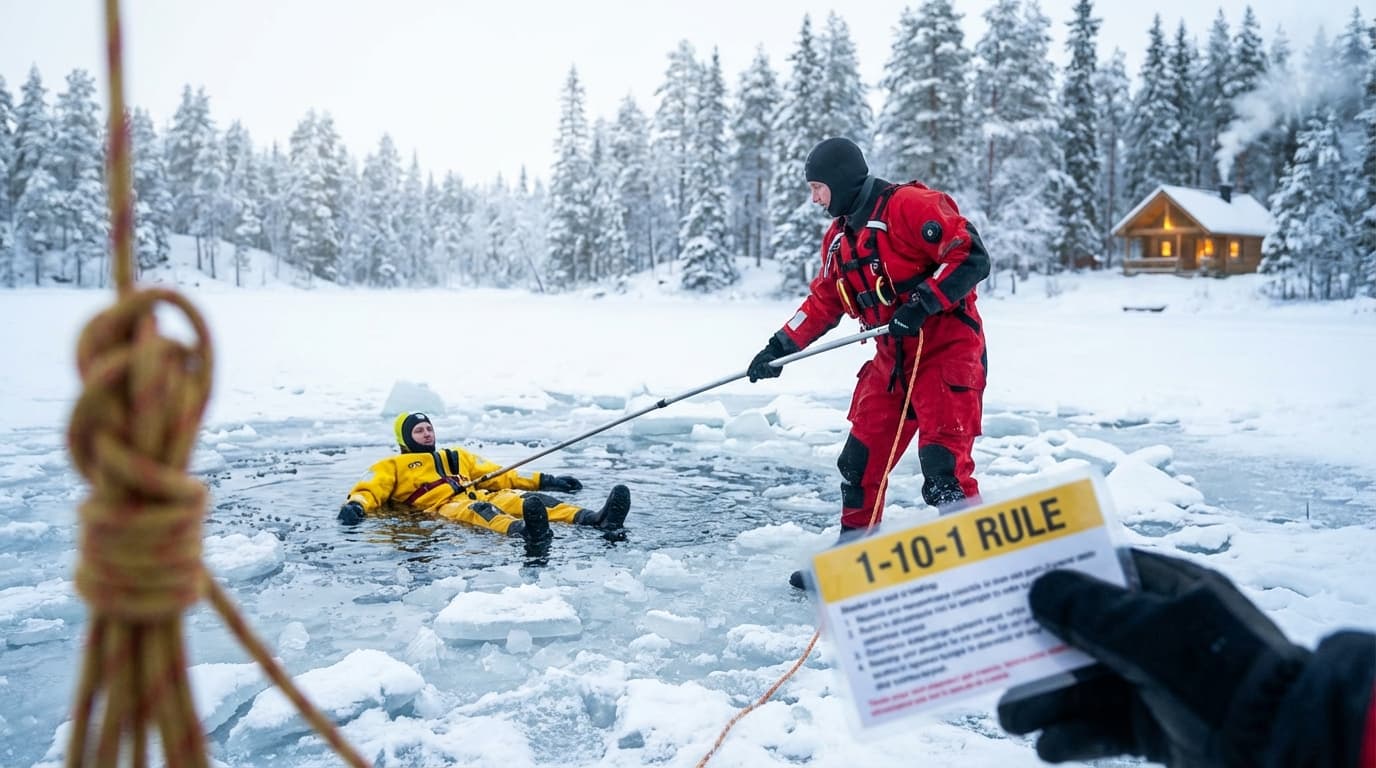
Imagine the shock of hitting water so cold it feels like a physical blow. Most people assume hypothermia is the immediate threat, but the real danger starts the moment you break the surface. To survive, you need a clear plan that accounts for how your body actually reacts to freezing temperatures. This is where the 1-10-1 rule becomes your survival map. It breaks the experience into three distinct windows: one minute to control your breathing, ten minutes of meaningful movement, and one hour before you lose consciousness from the cold. By keeping these numbers in mind, you can stay calm and act with purpose.
This approach works because it forces you to focus on what is happening right now rather than worrying about what might happen in an hour. Water is incredibly efficient at stealing your warmth, cooling you down at least 24 to 30 times faster than the air does. By understanding these three stages, you shift your focus from the long-term fear of freezing to managing the immediate, violent shock to your nervous system. It turns a chaotic life-or-death situation into a series of manageable steps that prioritize your airway and your physical ability to move.
The first sixty seconds are a battle for your breath. When the cold hits your skin, your breathing rate can spike by 600% to 1000% almost instantly. This is the gasp reflex, and if your head is underwater when it happens, you could drown before you even realize what is happening. This is why wearing a life jacket is non-negotiable. It serves as your breathing insurance, keeping your head above the waves while you fight to regain control. A simple trick to stay in control is to breathe out through pursed lips, as if you are blowing out a candle, which helps slow your heart rate and prevents the hyperventilation that leads to panic.
Once you have mastered your breathing, the clock starts on your muscles. You have roughly ten minutes to perform meaningful movement before cold water incapacitation sets in. This stage is where many people make a fatal mistake by overestimating their swimming ability. Even if safety is only 15 meters away, the cold will eventually cause your nerves and muscles to stop responding to your brain. Statistics show that 66% of drowning victims were within that short 15-meter range of safety but could not reach it because their muscles simply stopped working. You must prioritize self-rescue immediately while you still have the grip strength to pull yourself out, because once those ten minutes are gone, your ability to help yourself disappears.
Key insights:
A life jacket is critical for surviving the initial gasp reflex that causes immediate drowning.
Proximity to shore offers a false sense of security, as most cold-water drownings happen within 15 meters of safety.
Meaningful movement ends long before hypothermia sets in, making the first ten minutes the only real window for self-rescue.
The First Minute: Winning the Battle for Your Breath
The moment you hit freezing water, your body reacts with a violent, involuntary gasp. This cold shock response is the most dangerous sixty seconds you will ever face. Your breathing rate can skyrocket by 1000% almost instantly. If your head is underwater during that first gasp, you might drown immediately. This is why the first 1 in the 1-10-1 rule is so vital. You have one minute to steady your breathing before you can even think about a rescue.
Think of your life jacket as breathing insurance. It keeps your face above the waves while your lungs go haywire, allowing you to try pursed-lip breathing. By blowing out slowly through your lips as if you are whistling, you can stop the hyperventilation and regain your rhythm. It feels like a losing battle in the moment, but regaining control is the only way to stay conscious and move to the next step. What does this mean for you? It means you must focus entirely on your breath before trying to swim.
Most people who drown are surprisingly close to safety. In fact, 66% of victims are within 15 meters of the shore. They do not fail because they cannot swim. Instead, they fail because they lose the fight for air. Since water cools you at least 25 times faster than air, you cannot afford to waste a single second of that first minute panicking. Control your breath first, and the rest of the survival process becomes possible.
Key insights:
Hyperventilation during cold shock can increase your breathing rate by 600% to 1000%.
Pursed-lip breathing is a critical technique to regain airway control during the first 60 seconds.
A life jacket is essential for surviving the initial gasp reflex without inhaling water.
Proximity to the shore offers a false sense of security since most drownings happen very close to safety.
The Ten-Minute Window: Why You Need to Move Fast (But Smart)
Once you get your breathing under control during that first minute, the clock starts ticking on your muscles. You have roughly ten minutes of meaningful movement before your body starts to shut down. This has nothing to do with how well you can swim in a heated pool. Because water pulls heat away from you about 30 times faster than air, your nerves and muscles will stop working correctly much sooner than you might expect.
The reality of swim failure is often misunderstood. You might think you can reach the shore if it looks close, but the numbers tell a different story. About 66% of people who drown in cold water are within 15 meters of safety. That is a tiny distance, yet in freezing conditions, it becomes an impossible stretch. Your body prioritizes keeping your core warm, which leaves your limbs heavy, weak, and eventually unresponsive.
This is why you have to prioritize self-rescue immediately while you still have your grip strength. Don't waste those precious minutes on a long, exhausting swim that you might not finish. Instead, focus on getting as much of your body out of the water as possible. Whether it is climbing onto a capsized boat or pulling yourself onto the ice, you need to act before the incapacitation takes over and your arms stop listening to your brain.
Key insights:
Proximity to the shore offers a false sense of security since most accidents happen within 15 meters of safety.
Muscle failure happens long before hypothermia, making self-rescue a race against your own nervous system.
Focus on immediate exit strategies rather than long-distance swimming to avoid cold-water incapacitation.
Why Being Close to Shore is a False Sense of Security
Imagine you are standing on a dock and looking at the water just a few feet away. It looks like a short hop, right? But the numbers tell a much scarier story. About 66% of people who drown in cold water are within 50 feet of safety. Even more startling is that 43% are within just seven feet. That is basically arm's reach. Being close to the shore gives you a false sense of security that can be deadly because it makes you underestimate the water.
So why can’t people just swim those few feet? It is because water steals your body heat up to 30 times faster than air. The second you fall in, your body goes into a state of total panic called cold shock. You might start gasping for air uncontrollably, with your breathing rate spiking up to 1000% higher than normal. If you are not wearing a life jacket, you have to fight just to keep your head up. You might think you have time, but your muscles will start to fail in less than ten minutes.
This is the danger of swim failure. Your brain is screaming at your arms to move, but they just won't listen. This is why you should never assume you can just swim for it without a solid plan. If you fall in, your first and only job for that first minute is to get your breathing under control. Knowing that the shore is much farther away than it looks, at least in terms of what your body can handle, is the first step to actually making it back there safely.
Key insights:
Most cold water drownings happen within 50 feet of safety because of immediate physical incapacitation.
Cold water drains heat up to 30 times faster than air, causing muscles to lock up long before hypothermia sets in.
The cold shock phase can cause a gasping reflex that makes it nearly impossible to swim even very short distances without a life jacket.
The 'H.E.L.P.' Position and Other Ways to Stay Warm
So you have survived the first sixty seconds of gasping and panic. Now what? Your main enemy is the clock because water pulls heat away from your body about twenty five to thirty times faster than air does. If you are alone, you need to get into the Heat Escape Lessening Posture, or the H.E.L.P. position. Think of yourself as a floating ball. Pull your knees up toward your chest and wrap your arms around your legs. This protects the areas where you lose heat fastest like your armpits and groin. Most importantly, keep your head as high out of the water as possible. Your brain starts to slow down once your temperature hits ninety one degrees, so keeping your head dry is a survival priority.
If you are not alone, do not drift apart. Use the huddle method by pulling everyone close together in a circle with your sides touching. This shared body heat creates a small pocket of slightly warmer water between you and buys everyone more time. Even if it is just you and your dog, stay close. Since sixty six percent of victims are within fifteen meters of safety when they struggle, every extra minute of warmth counts toward reaching that nearby shore before your muscles stop working.
There is a common myth that you should kick off your boots and shed your coat the moment you hit the water because they will drag you down. That is actually dangerous advice. Unless your gear is literally pulling you under, keep it on. Wet clothes are only heavy when you try to climb out of the water. While you are floating, those layers actually trap a thin layer of water against your skin that your body can warm up. It acts like a makeshift wetsuit. Wool is especially great at this because it keeps some of its insulating properties even when it is soaked.
Think of your clothes as your first line of defense against the cold. You only want to ditch gear if it is preventing you from staying afloat or if you have reached a boat and need to climb up. Staying dressed and staying still are your best bets for stretching that one hour of consciousness into something longer. It is all about slowing down the heat loss while you wait for help or plan your next move.
Key insights:
Keep your head dry because brain function declines significantly at 91 degrees.
Wet clothes provide insulation and should only be removed if they prevent flotation.
Heat loss in water happens up to 30 times faster than in air.
Wait, Don't Take Off Your Clothes!
Your first instinct after falling into freezing water is probably to strip off your heavy coat and boots. You might think they will pull you down like an anchor, but that is a dangerous myth. Here is the thing: wet clothes are only heavy when you are trying to climb out of the water. While you are submerged, they actually act as a makeshift wetsuit.
Because water pulls heat away from your body 24 to 30 times faster than air, you need every layer you can get. Materials like wool are especially good at trapping a tiny bit of air and water against your skin, which your body heat then warms up. This provides a small but crucial bit of insulation that can buy you more time.
Unless a piece of gear is literally dragging you under or preventing you from floating, keep it on. Those layers are your best defense against the cold while you wait for rescue or try to reach safety.
Key insights:
Wet clothes provide a layer of insulation that slows down heat loss.
Clothing only becomes a weight burden once you are out of the water.
Keep all layers on unless they are actively preventing you from floating.
The Danger Isn't Over Yet: Understanding Post-Rescue Collapse
You finally make it out of the freezing water and think the hard part is over. But for many people, the real danger is just starting. This is known as post-rescue collapse, the fourth and final stage of cold water immersion. Even after you are on dry land, your body is still fighting a massive internal battle. It is common for victims to lose consciousness or even suffer heart failure right after being pulled to safety. This happens because the body is struggling with sudden shifts in blood pressure and a phenomenon called afterdrop.
When you are submerged, the physical pressure of the water actually helps keep your blood moving toward your heart. Once that pressure is gone, your blood can pool in your legs, causing your blood pressure to crash. At the same time, cold blood from your outer limbs starts rushing back to your core. This afterdrop means your internal temperature keeps falling even though you are no longer in the water. Remember that your brain function starts to drop at 91 degrees, and the human heart can actually stop if the core temperature hits 64 degrees.
Because the heart is so fragile at these temperatures, you have to handle a victim with extreme care. Moving someone too roughly or forcing them to stand up can trigger a fatal cardiac arrest. Think of the body like a delicate piece of glass that is ready to crack. Keep the person lying down and let the medical pros handle the warming. Getting someone out of the water is a huge win, but the rescue is not truly finished until their vitals are stable on land.
Key insights:
Post-rescue collapse can happen even after a person seems safe and alert.
The afterdrop causes core temperatures to continue falling after exit.
Keep victims horizontal and move them gently to prevent the heart from stopping.
Treating Hypothermia in the Wild: Do's and Don'ts
Identifying hypothermia in the wild usually starts with what experts call the "Cold-Shiver-Stumble-Bumble" progression. It sounds almost like a nursery rhyme, but it is actually a grim roadmap of the body shutting down. First, you start shivering uncontrollably as your core temperature dips. Then, your movements get clumsy and your speech starts to slur. If you see someone acting like they are drunk when they are actually just freezing, you are looking at a medical emergency. Brain function starts to slip at 91°F, so by the time a person seems confused or sleepy, the situation is already critical.
When you are trying to help, your first instinct might be to rub their arms to create friction or offer a flask of whiskey. Do not do either. Rubbing cold skin can cause serious tissue damage or, even worse, trigger a heart attack by forcing cold blood from the limbs back to the core too quickly. Alcohol is just as dangerous. It makes blood vessels dilate, which gives a temporary feeling of warmth but actually accelerates heat loss. Think of it as opening all the windows in a house during a blizzard just because you like the breeze; it feels okay for a second, but you are losing the heat you desperately need to keep.
So, what actually works? Focus on passive rewarming first. Get the victim out of wet clothes and into dry layers or a sleeping bag immediately. Since water cools the body up to 30 times faster than air, simply getting dry is a massive win. If they are conscious and can swallow, give them warm, sweet liquids - but avoid caffeine. For active rewarming, use heat packs or warm water bottles wrapped in cloth, focusing on the core areas like the armpits, groin, and neck. Be extremely gentle during this process. The human heart can stop at a body temperature of 64°F, and even a rough jolt during a rescue can cause a fatal rhythm.
The danger does not end the moment the person is out of the elements. There is a phenomenon called post-rescue collapse where a person's blood pressure drops or their temperature continues to plummet even after they are technically safe. This is why keeping the victim horizontal and still is vital. You might have heard of the 1-10-1 rule, which gives you about an hour before unconsciousness in cold water, but the recovery phase is just as delicate. Stay vigilant and keep them wrapped up until professional help arrives.
Key insights:
Never use alcohol or massage to warm a victim; these methods actually drop core temperatures faster.
Dry clothing is the best defense because water conducts heat away from the body 25 to 30 times faster than air.
The 'Bumble' and 'Stumble' phases indicate that brain function is already declining as the core hits 91°F.
Keep victims horizontal after rescue to prevent post-rescue collapse and sudden cardiac arrest.
Frequently Asked Questions
You actually have about an hour before hypothermia knocks you out, but that number is pretty misleading. The real threat hits much faster than you might think. Most people do not realize that the first few minutes are actually the most dangerous part of falling into freezing water.
Think of it as the 1-10-1 rule. You get one minute to stop gasping and stay calm, then ten minutes where your arms and legs actually work for self-rescue. After those ten minutes, your muscles get too cold to function. Even if you stay awake for an hour, you will not be able to swim or grab a rescue line without a life jacket to keep you afloat.
It really depends on how close you are to safety. Dr. Gordon Giesbrecht, the expert known as Professor Popsicle, points out that you only have about ten minutes of useful movement before your body shuts down. If you can reach a boat or the shore in just a few minutes, you should try to get there as fast as you can.
But here is the thing. If safety is far away, swimming is a bad move. Moving your limbs pumps warm blood to your skin where the cold water sucks it away 25 times faster than air would. In that case, it is better to stay still in the H.E.L.P. position by hugging your knees to your chest to save every bit of heat you can.
Actually, that is a common myth that can lead to panic. While heavy boots feel like lead weights when you are trying to walk on land, they do not pull you under once you are submerged. In fact, your clothes and boots often trap air pockets that can help you stay afloat for a short time.
The real danger is not the weight of your gear but how the cold affects your movement. Wet clothes only become heavy when you try to climb out of the water. Instead of struggling to kick your boots off, you should keep them on because they provide a layer of insulation that helps protect you from heat loss. Focus your energy on getting to safety rather than undressing in the water.
It is a strange and scary sensation, but feeling a sudden wave of warmth is a major warning sign. This usually happens when your body reaches a state of deep exhaustion and can no longer keep blood restricted to your core. Your blood vessels suddenly open up, sending a rush of warm blood to your skin and making you feel like you are overheating.
This is often called paradoxical undressing because people in the final stages of hypothermia sometimes start taking their clothes off. It is a sign that your brain function is declining and your heart is at risk. If you or someone else starts feeling warm after a long time in the cold, it means the situation is critical and you need medical help right away.
Conclusion
Falling into a frozen lake is a nightmare, but the 1-10-1 rule turns that chaos into a manageable map. It is about realizing that cold shock response is not a death sentence, it is just the first hurdle. When you understand that you have a full minute to get your breath and ten minutes of movement, the water feels a little less like an enemy and more like a challenge you can actually win.
So what does all this mean for your next winter hike? It means you can trade panic for a plan. Knowing how to survive falling through ice is about more than just physical strength. It is about keeping your head above water and respecting the reality of post-rescue collapse. Consider talking through these steps with your hiking partners so everyone knows how to treat hypothermia in the wild before you even hit the trail.
Survival is not about being a hero. It is about staying calm enough to let your brain lead the way back to safety. Stay safe, stay dry, and always respect the ice.
Every WilderReady guide is researched, written, and fact-checked in-house against trusted references such as the American Red Cross, the National Park Service, and the CDC before it goes live. We publish under this shared byline instead of invented personas, so you always know who stands behind the guidance you are reading.