Wet Wood and Winter Nights: Survival Skills That Actually Work When Things Go Wrong
Imagine you are miles from the trailhead when the sky turns dark and the rain starts soaking through your gear. It's a heavy moment that tests your nerves more than...
Wet Wood and Winter Nights: Survival Skills That Actually Work When Things Go Wrong
Imagine you are miles from the trailhead when the sky turns dark and the rain starts soaking through your gear. It's a heavy moment that tests your nerves more than your muscles. True survival isn't about luck or buying the most expensive gear. It's about having a plan and the right mindset to handle whatever the woods throw at you.
The real trick to staying safe is building practical Survival Skills before you find yourself in a pinch. We're going to look at primitive fire making techniques for wet conditions and bushcraft shelter ideas for winter survival that keep you warm when it matters most. Knowing how to work with nature instead of fighting it is what keeps a bad day from becoming a disaster.
We'll also walk through the essential survival knots every backpacker should know and emergency signaling techniques for lost hikers. Plus, we have a solo wilderness survival gear checklist to help you pack smart. Let's get you ready to handle the wild so you can make it through the night in one piece.
The Golden Rule: Why Awareness Beats Gear Every Time
You might have a backpack full of high-tech gadgets, but they won't save you if you’re oblivious to the world around you. JD Alewine often says that awareness is the first step in staying safe, and he’s right. Before you even lace up your boots, you have to realize that the woods don't care about your gear. Survival is a sequence of skills, and the first one is just paying attention. A strategy that keeps you alive in a humid swamp will be useless in a dry mountain range. The season and your specific location change the rules of the game entirely.
It’s easy to rely on a phone, but what happens when the battery hits zero? That’s where traditional skills like using the sun or finding the North Star come in. These aren't just old-school tricks. They are vital backups for when tech fails. If you can read a topographic map to find ridgelines and water, you’re less likely to get turned around. The goal is to move from being a visitor to someone who actually understands the landscape. It's about being present and noticing the small things, much like a curious animal watches its environment, before they become big problems.
Think of it as reading the room, but the room is the great outdoors. You’re looking for shifts in the terrain or the way the clouds are moving. If you see the wind shifting or notice specific plants that provide tinder or food, you’re already ahead of the curve. It’s about terrain association, which means using rivers or ridges to know where you are without staring at a screen. When you understand the plants and animals around you, the wilderness stops being a scary place and starts being a set of resources you can actually use.
Key insights:
Traditional skills like using the sun or North Star are essential backups for when GPS devices lose power.
Survival is a sequence of skills where understanding your environment must happen before using tools.
Paying attention to weather shifts and local plants turns a dangerous environment into a manageable resource.
Reading the Room (The Outdoor Version)
Before you touch your gear, look around. JD Alewine says awareness is the first step for safety. It’s more than just seeing trees. It’s noticing wind shifts or cloud patterns. If birds go quiet, the woods are talking. Staying tuned helps you beat the storm.
Use terrain association to spot ridgelines and find your way without a phone. When you know which plants offer dry tinder, you’re reading the landscape like a map. This awareness makes a tough spot manageable because you understand the world around you.
Fire Without Matches: The Wet Weather Challenge
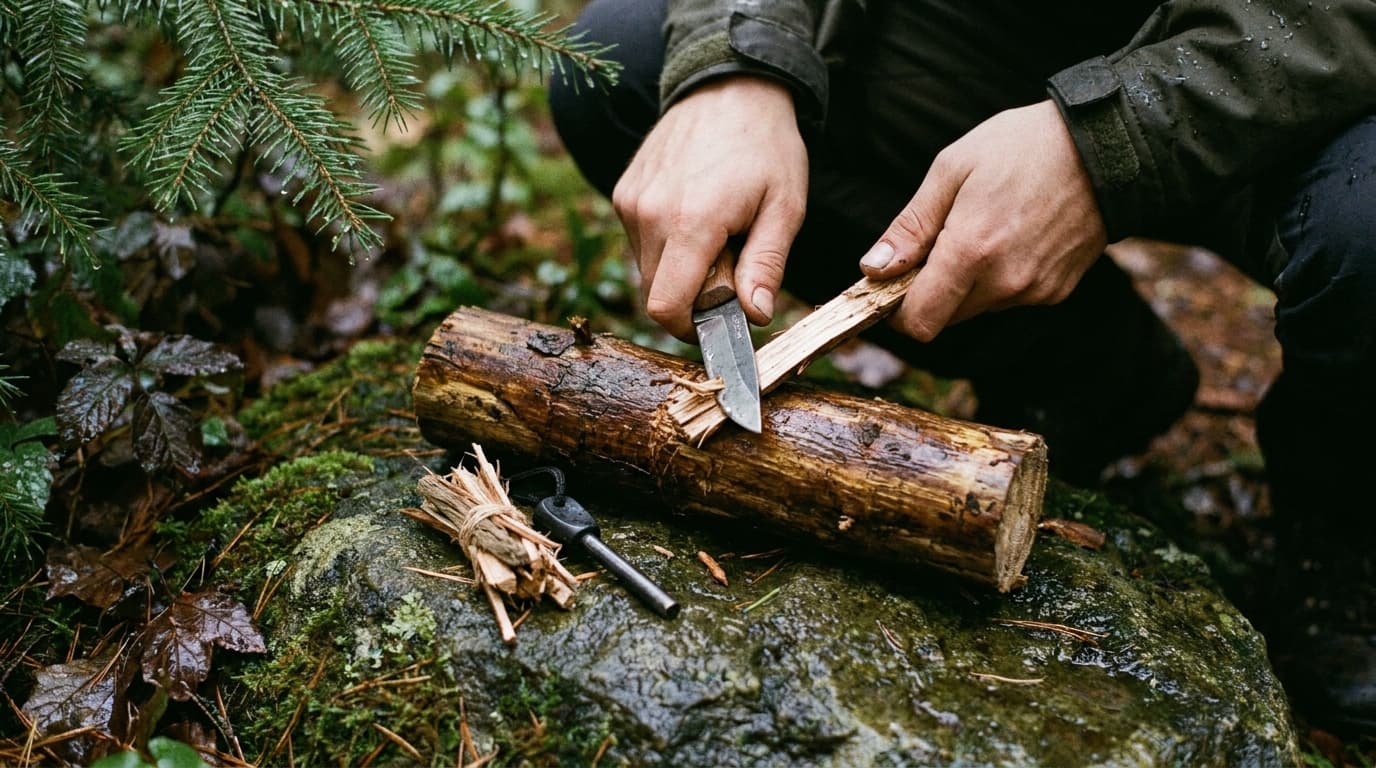
Imagine standing in the woods while the rain comes down in heavy sheets and your matches are nothing but a soggy mess. This is the moment where theory ends and reality begins. Most people think they can just rub two sticks together and get a flame, but wet weather completely changes the rules of the game. Before you even think about a fire drill, you have to find or make a sharp edge. Survival is a sequence of skills, and you cannot create a functional drill board without a cutting tool first. Mark Payton, a seasoned survival expert, always says you need to practice, practice, practice these techniques long before you actually need them to stay alive. It is about building a mindset where you understand the terrain and the weather patterns before the first spark ever flies. JD Alewine points out that awareness is the primary step in staying safe. If you do not know how the dampness affects your specific wood types, you are just spinning your wheels in the mud. You have to be able to look at a soaked forest and see the hidden dry spots that others miss. It takes patience and a deep understanding of how nature hides its resources during a storm.
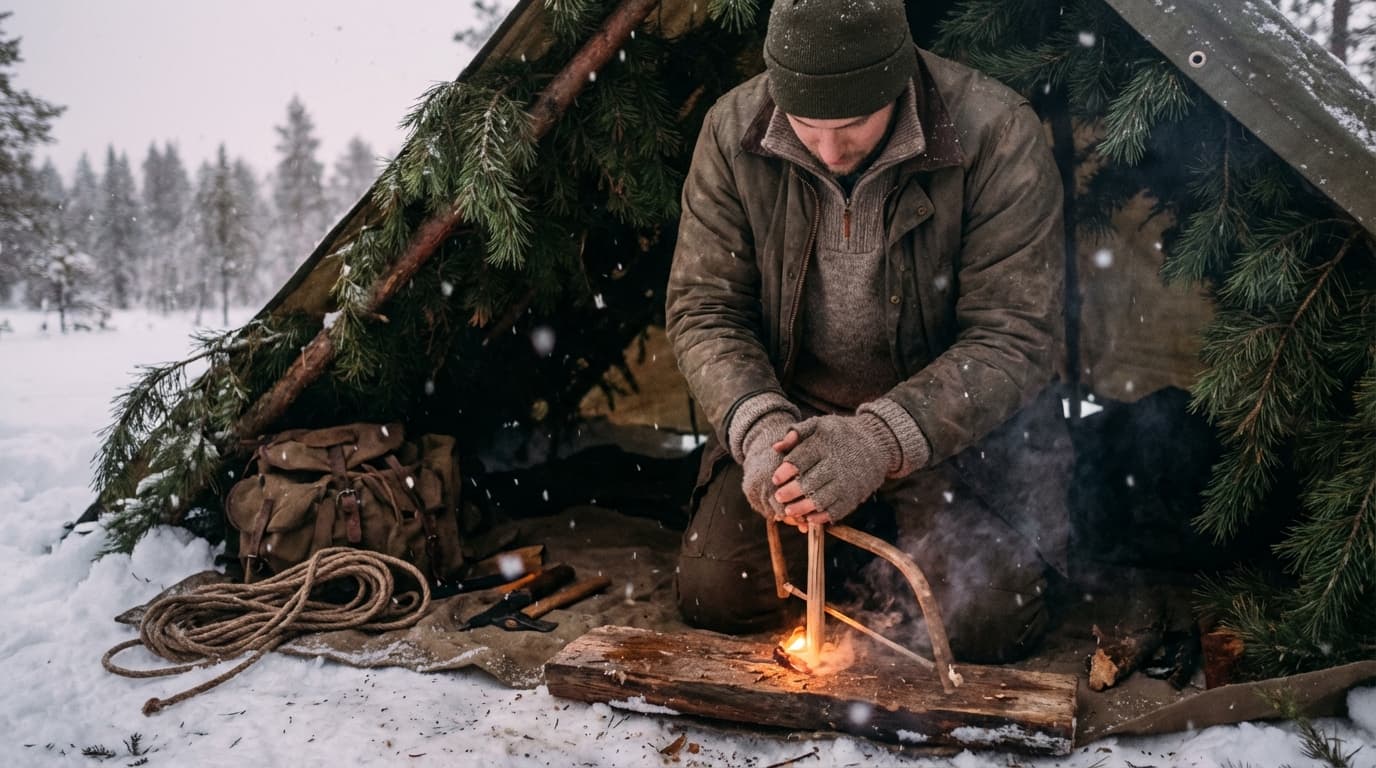
When every branch looks like a soaked sponge, you have to look deeper into the wood. Friction fire works by creating intense heat through speed and pressure, but even a little moisture can kill that heat instantly. The secret is finding dry heartwood inside dead, standing trees or fallen logs that have stayed off the ground. Michael Pewtherer explains in his survival handbook that these primitive skills are almost entirely about the preparation. You are searching for that bone-dry center that the rain simply could not reach. Once you have those dry materials, the bow drill gives you the mechanical advantage needed to beat the humidity and get that ember glowing.
What happens if you do not even have a piece of paracord for your bow? You have to make your own. Extracting fibers from local plants to twist into rope is a total game-changer for building tools in the wild. Without a solid string, your bow drill is just a pile of useless sticks. Learning to find the right plants and strip their stalks for fiber means you are no longer reliant on a backpack full of gear. It makes a desperate situation feel much more manageable because you are finally using what the land provides to solve your own problems and build your own way out.
Key insights:
Survival is a sequence of skills where a cutting tool is often the first requirement for fire making.
Wet weather fire making relies on finding dry heartwood hidden inside soaked logs.
Primitive cordage allows you to build essential tools like the bow drill using only natural plant fibers.
Consistent practice is the only way to ensure these techniques work when conditions are at their worst.
Mastering the Hand and Bow Drill
Getting a fire going when the woods are soaked feels like a losing battle. But even in a downpour, dry wood exists if you know where to look. Primitive techniques like the hand drill or bow drill rely on friction, which is tough when everything is damp.
The secret lies in finding dead standing timber and splitting it open to reach the dry heartwood inside. You will need a solid cutting tool first because these skills follow a specific sequence. Michael Pewtherer notes that survival is built on these logical building blocks.
Like Mark Payton suggests, practice these moves until they are second nature. Muscle memory is what keeps panic at bay when the sun starts to drop.
Key insights:
Dry heartwood remains accessible inside standing dead trees even during heavy rain.
Primitive fire making requires a sequence of tools, starting with a reliable cutting edge.
Consistent practice is the bridge between knowing a skill and actually surviving with it.
Primitive Cordage: Making Your Own Rope
Think of being stuck in the cold with no gear. To build a fire using a bow drill, you first need a string. By extracting fibers from local plants, you can twist a rope that handles the friction of fire making. This helps you build tools from scratch.
Survival skills are a sequence where one success enables the next. Making your own rope means you can build snares or secure a winter shelter when gear fails. It makes the forest feel like a toolbox. It is deeply satisfying.
Key insights:
Primitive cordage is the essential link that connects raw materials to functional survival tools.
Natural fibers provide a reliable backup that ensures you are never truly without gear.
Staying Warm: Bushcraft Shelters for the Cold
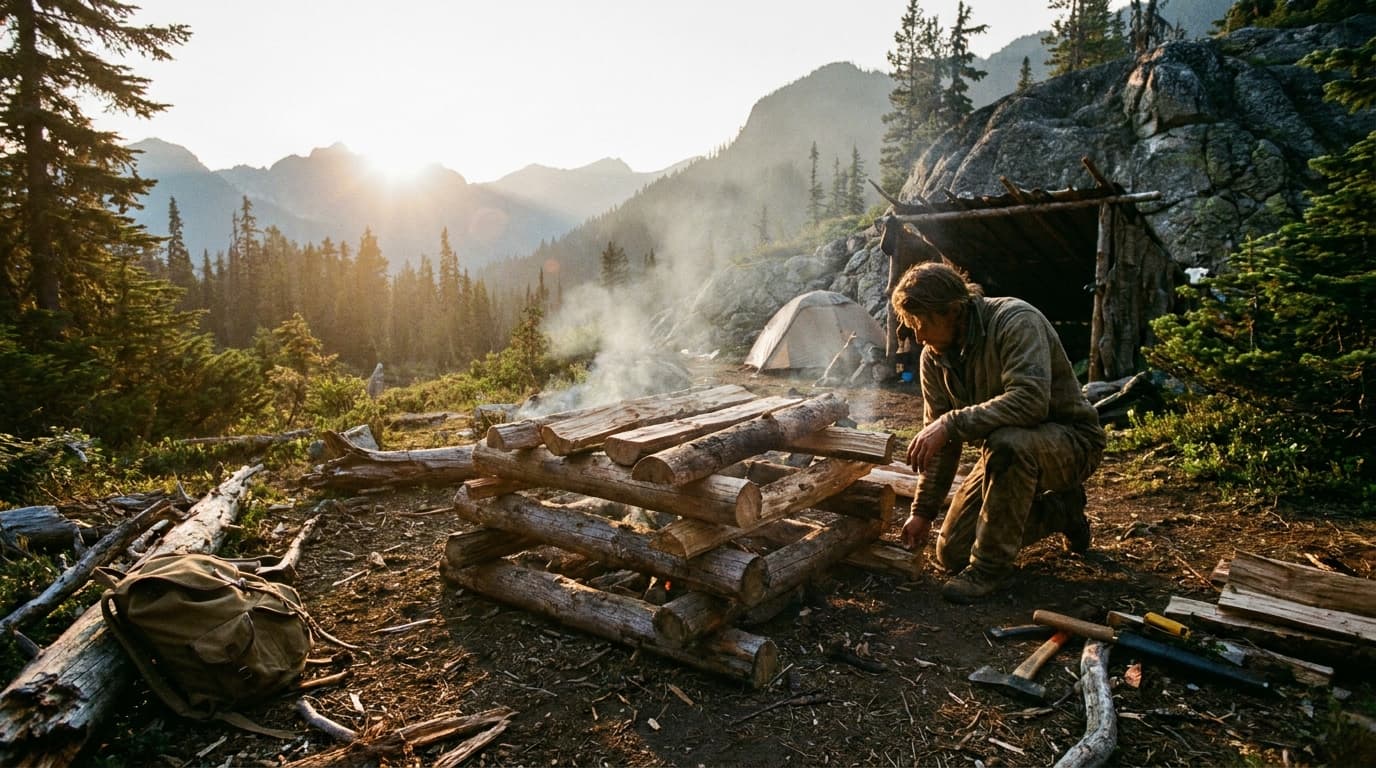
When the temperature drops, your biggest fight isn't actually with the air. It is with the ground. Think about it this way: the earth is a giant heat sink that wants to pull every bit of warmth out of your body. That is why ground insulation is the most important part of any winter build. You need a thick mattress of pine boughs, dry grass, or leaves before you even think about a roof. A classic debris hut works because it uses natural clutter to trap air. You are basically building a human sized bird nest to keep your heat from escaping.
So, which shape should you pick? A lean-to is great if you have a fire because the slanted wall reflects heat back at you, but it is risky in shifting winds. If the breeze changes, you are suddenly sitting in a wind tunnel. An A-frame is much better for trapping your own body heat in a tight space because it encloses you on both sides. It is all about thermal efficiency. You want the smallest space you can comfortably fit in because your body has less air to warm up. If the space is too big, you will stay cold no matter how much debris you pile on top.
Michael Pewtherer, an expert on primitive skills, explains that survival is really a sequence. You cannot just jump to a complex build without understanding the terrain first. Using a topographic map helps you find elevation and ridgelines so you are not stuck in a cold valley where moisture collects. Even if you have a GPS, these traditional navigation skills are vital backups because batteries always seem to die when you need them most. Location and season change everything, so what works in a dry forest might fail in a swamp.
Awareness is the first step in staying safe. As JD Alewine points out, you have to know your surroundings before you even start building. Practice these shelters often when the weather is nice. Mark Payton suggests practicing until you have these skills down solid before you ever try them in a real survival situation. Think of it this way: the middle of a blizzard is the worst time to realize your debris hut walls are too thin. If you can see light through the roof, it is not thick enough to keep you warm.
Key insights:
Ground insulation is more important than the roof for preventing heat loss to the earth.
Small, tight shelters like an A-frame are easier to heat with your own body temperature.
Traditional navigation tools like maps and the North Star are essential backups to electronic devices.
Survival skills are sequential and require understanding the terrain before building a shelter.
The Lean-To vs. The A-Frame
Choosing between a lean-to and an A-frame comes down to how much you trust the wind. A lean-to is a quick win if the breeze is steady, acting as a simple shield for your back. But if you're stuck in a freezing winter storm with shifting gusts, the A-frame is the smarter move. Its enclosed shape traps body heat much better, boosting your thermal efficiency when it matters most.
Think of it as choosing between a porch and a tent. As Michael Pewtherer notes in his survival handbook, these choices are about balancing speed with long-term comfort. Before you start building, check your surroundings. Is the ground damp? Which way is the wind actually blowing? Matching your shelter to the environment is the kind of awareness that experts like JD Alewine say is the first step to staying safe.
Key insights:
A-frames are superior for heat retention in swirling winter conditions.
Lean-tos work best as one-sided windbreaks when the weather is predictable.
Always assess terrain and wind direction before committing to a build.
The Only Knots You Really Need to Know
Ever watched someone struggle with a complex knot while their hands are freezing? It is painful to see. When things go wrong in the woods, you do not need a library of fifty different hitches. You really just need two or three that you can tie in the dark or with numb fingers. These essential survival knots every backpacker should know are far better than fancy ones because they are fast and reliable when it counts. Think of them as the backbone of your camp setup.
Take the Taut-Line Hitch, for example. It is the king of adjustable tension. If your rain fly starts sagging during a midnight downpour, this knot lets you slide the hitch to tighten the line without having to untie the whole setup. Then there is the Bowline. This creates a secure, fixed loop that simply will not let you down. It does not slip under a heavy load, yet it stays easy to untie even after the rope gets wet and tight. Without these, even the best gear is just a pile of loose fabric.
Getting these right helps with everything from shelter stability to quick gear repairs. A solid knot is the difference between a dry night and a collapsed tarp. If a pack strap snaps or a guy line breaks, knowing how to lash things back together keeps you moving. As JD Alewine says, awareness is the first step in safety, but having the physical skills to respond to a problem is what actually keeps you comfortable when the weather turns.
But here is the catch: you have to practice until it is muscle memory. Mark Payton encourages this kind of repetition because you should not be trying to learn on the fly during a storm. Try tying them while you are distracted or in low light. Once your hands know the moves without you thinking about them, you are truly ready for the trail. It is not about how many knots you know, but how well you know the ones that matter.
Key insights:
Simple, reliable knots are superior to complex ones in high-stress or cold environments.
The Taut-Line Hitch and Bowline provide the necessary tension and security for almost any backcountry task.
Mastery comes from repetitive practice until the motions become automatic muscle memory.
Physical skills like knot-tying are the practical application of wilderness awareness.
Tying it All Together
How do you turn a pile of sticks into a reliable home? It comes down to the essential survival knots every backpacker should know. These ties are the glue for your shelter and the quick fix for snapped gear. But knowing the steps is only half the battle.
You need to practice until the movements become muscle memory. As Mark Payton says, you have to practice if you don't have these mastered. If you can't tie them in the dark, they won't help much in a storm.
Key insights:
Practice knots until they are automatic to ensure they work under pressure.
Reliable knots are essential for both building shelter and repairing gear.
Hey, Over Here! Getting Found When You Are Lost
Imagine the moment you realize the trail has vanished. Your heart beats faster and your mind starts to race, but the best thing you can do right now is actually nothing. Staying put is almost always the smartest move because search teams begin their work at your last known location. Moving only makes you a harder target to find and wastes precious calories. As JD Alewine says, awareness is the first step in staying safe. Once you have calmed down, start using the Rule of Three. Since nature does not usually create patterns of three, three loud whistle blasts or three distinct piles of rocks act as a universal signal for help. It is a simple way to tell rescuers where you are without burning through your limited energy.
Visual signals are all about breaking the natural patterns of the woods to grab someone's attention. A signal mirror is one of your best tools because a tiny flash of sunlight can travel for miles to reach a pilot or a distant hiker. If you do not have a mirror, look for anything reflective in your gear like a gum wrapper or a compass face. On the ground, build high-contrast markers that do not look like part of the landscape. A large X made of dark logs on light grass or white rocks on dark dirt is easy to spot from above. If you have a fire, toss on green boughs or damp wood to create heavy white smoke. This creates a visual flag that stands out against the trees. Mark Payton suggests practicing these skills often so you can act with confidence when things go wrong.
Key insights:
Rescuers look for patterns of three because they do not occur naturally in the wilderness.
Staying in one place prevents the search area from expanding and keeps you near your last known point.
Contrast is more important than size when creating ground signals for aircraft.
White smoke from wet wood is more visible against dark forest canopies than black smoke.
Visual Signals That Actually Work
You have to stand out to get found. Waving your arms usually won't cut it when rescuers are searching from a distance. A signal mirror is a lifesaver because it flashes light for miles, even on hazy days. If you lack a mirror, use a shiny tin lid or even a credit card. It’s all about catching a pilot's eye with that sudden glint of light.
On the ground, aim for high contrast. In the snow, use dark branches or rocks to make markers. In thick woods, clear a spot to show the dark earth below. For fires, add green boughs or damp leaves to produce thick, white smoke. This stands out perfectly against a dark treeline, making sure you don't just blend into the scenery.
Key insights:
Signal mirrors are effective even in low light by reflecting ambient brightness toward the horizon.
Contrast with your surroundings is more important for visibility than the actual size of your ground markers.
Smoky fires are most effective during the day, while bright flames work best for night signaling.
Navigation Secrets: When Your GPS Dies
You are miles from the trailhead when your GPS screen flickers and goes dark. It is a sinking feeling, but it does not have to be a disaster. Long before satellites, people found their way using nothing but the sky and the ground. Think of traditional skills as your vital backup plan. This matters because technology is a tool, not a guarantee. As JD Alewine says, awareness is the first step in staying safe. This means looking at the landscape, not just your screen, to understand the world around you and prepare for when batteries eventually fail.
During the day, the sun is your basic guide, rising in the east and setting in the west. When night falls in the northern hemisphere, Polaris - the North Star - becomes your fixed point for finding north. You can also use terrain association to match what you see, like a specific ridge or a winding river, to your position. If you also track your direction and distance from a known spot, a method called dead reckoning, you can find your way back even when the tech fails. Michael Pewtherer, a survival expert, notes that these skills are part of a sequence. Mastering one enables the next, much like how knowing primitive fire making techniques for wet conditions is essential before you can worry about long-term comfort.
A topographic map is more than just paper; it is a 3D picture of the land. By looking at those contour lines, you can spot ridgelines, steep valleys, and water sources before you even see them. This is vital when visibility drops or the weather turns. When you cannot see the horizon, your compass becomes your best friend. It keeps you on a straight line so you do not end up walking in circles. Mark Payton suggests practicing these skills until they are second nature. If you do not have them down yet, keep at it. Learning to read the map together with the terrain ensures you are never truly lost, even in the deepest woods.
Key insights:
Traditional skills like using the sun and stars provide a fail-safe when electronic devices run out of power.
Terrain association allows you to use physical landmarks like ridges and valleys to confirm your location on a map.
Dead reckoning is a simple but effective way to estimate your position by tracking your distance and direction from a known start point.
Reading a Topographic Map
Ever felt like a map was just a bunch of messy squiggles? Those lines are actually your best guide. Topographic maps show you the shape of the land by highlighting ridgelines, valleys, and elevation. Instead of seeing a flat path, you can spot water sources or steep hills before you even get there. This is called terrain association - using the earth's features to find your way.
While a GPS is great, batteries die and signals fade. A physical map and a compass are your most reliable backups, especially when visibility is low. As JD Alewine points out, awareness is the first step to staying safe. Practice using these tools before you actually need them so you don't get turned around when the weather turns sour.
Key insights:
Traditional tools like maps and compasses are vital backups because electronic devices often fail in remote areas.
Terrain association allows you to navigate by identifying prominent landscape features like valleys and ridges.
Packing Smart: Your Solo Survival Checklist
Ever felt the urge to grab a knife and just walk into the woods? It sounds like a rugged adventure, but no-supply challenges are usually a recipe for trouble. JD Alewine says awareness is the first step in staying safe. Before going gear-free, you must understand the terrain and the weather patterns of your location. A solid checklist balances the weight you carry with the tools that keep you breathing when things go wrong.
Packing light is great until your GPS dies. This is why topographic maps are essential because they show ridgelines and water sources a phone screen might miss. If you are in the northern hemisphere, spotting the North Star provides a reliable backup for orientation. As John F. Dean notes, it is better to learn from the mistakes of others than to become a cautionary tale. Traditional navigation is your safety net when technology fails.
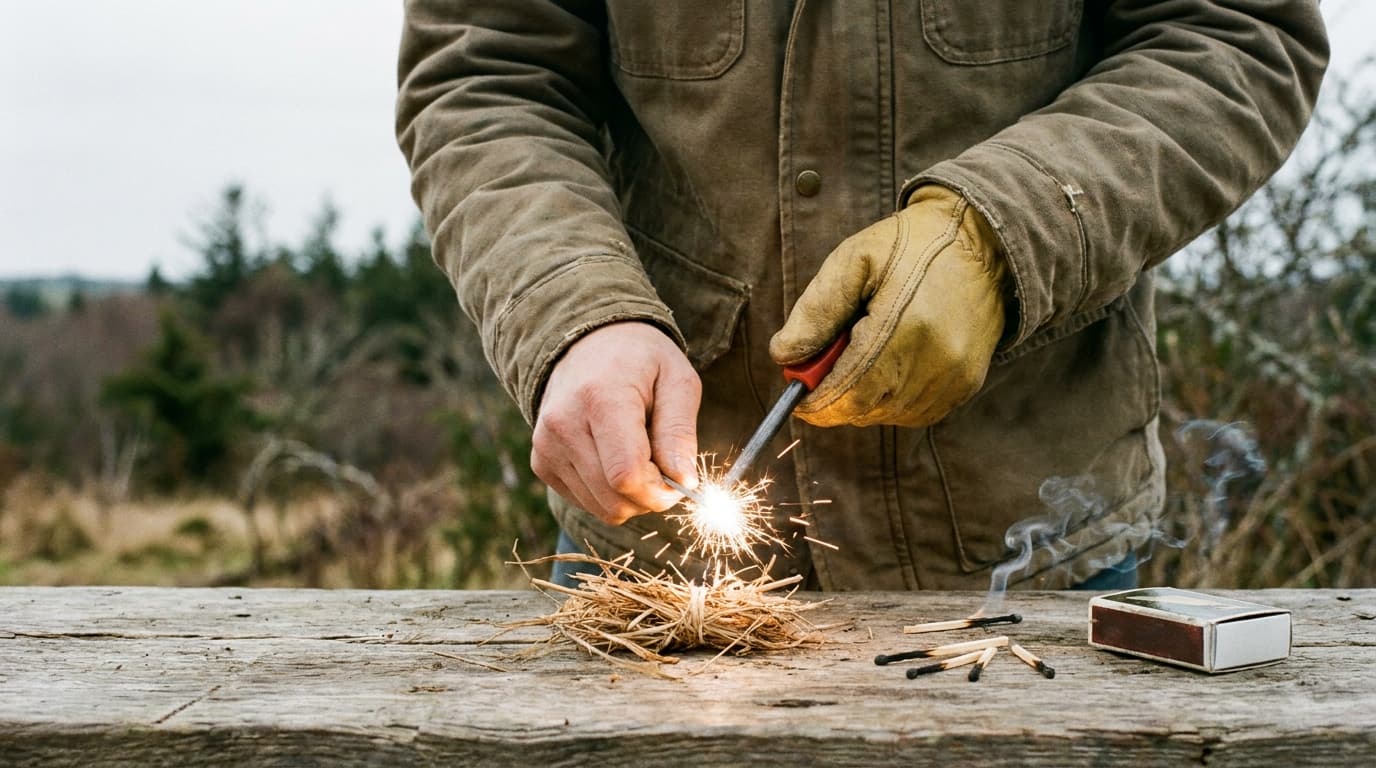
Survival is a sequence of skills. You cannot build a warm shelter or a fire without the right foundation. Primitive fire making is impressive but it requires constant practice. Mark Payton suggests not trading a reliable lighter for a hand drill unless you have spent hours honing the craft. Keep your pack smart, stay aware of your surroundings, and remember that your gear is only as good as your ability to use it.
Key insights:
Traditional navigation tools like maps and the North Star are vital backups for failing GPS devices.
Survival is a sequential process where basic skills must be practiced to enable more complex tasks.
Safety in the wilderness starts with awareness of terrain and weather before you even pack your bag.
Frequently Asked Questions
The very first thing you should do is just stop moving and take a deep breath. It sounds simple, but keeping your cool is actually your best tool. As JD Alewine says, being aware of what is happening around you is the biggest part of staying safe.
Before you take another step, look at the land, the plants, and the weather. This is called wilderness awareness. It is much better to sit still for a minute and get a handle on the terrain than to keep walking and potentially get even more turned around.
It is possible, but it is definitely a tough job. Since primitive fire making is a sequence of skills, you usually have to find a way to get to the dry wood hidden inside a wet log first. You will likely need to use a cutting tool to split things open and find the wood that is still dry on the inside.
Here is the thing: where you are and what season it is will play a huge role in whether this works. It takes a lot of practice to get this right when conditions are damp. Mark Payton always suggests practicing these skills over and over before you actually need them, because trying to learn a bow drill for the first time in the rain is a real challenge.
If you're just starting out, the Bowline is the one you want to learn first. It creates a fixed loop at the end of a rope that won't slip or bind up, which is why people often call it the king of knots. It’s incredibly reliable for everything from securing a shelter line to helping in a rescue.
The trick is to practice it until it’s second nature. You want to be able to tie it even if your hands are cold or you're feeling a bit tired. Once you have this one in your toolkit, you'll find that other knots like the Clove Hitch or Taut-line Hitch become much easier to pick up.
Also, remember that knowing the knot is only half the battle. You should also look into primitive cordage, which is how you make your own string from local plants. Tying a Bowline with handmade rope is a great way to test your skills.
Don't worry if you're missing the usual gear because you can still make a lot of noise or a big visual mess to get noticed. The classic move is to use the 'Rule of Three' - three fires in a triangle, three loud shouts, or three piles of rocks. It's a universal sign that says you need help.
Fire is probably your best bet during the day. If you can get a fire going using a hand drill or bow drill, add green leaves or pine boughs to create thick, white smoke that stands out against the trees. If you're in an open area, you can also stomp out a big 'X' or 'SOS' in the snow or dirt.
As JD Alewine says, awareness is the first step in staying safe. Keep an eye on your surroundings to find the highest ground or the clearest opening so your signals are actually visible to search teams or pilots flying overhead.
Conclusion
So what is the big takeaway here? Survival skills are less about having a fancy bag of gear and more about how you think when things get messy. Whether you are trying to get a fire going with wet wood or tying a bowline to keep your shelter from blowing away, these skills work together to keep you calm. It is about being aware of your surroundings long before the sun goes down.
The best way to stay safe is to practice these skills when you do not actually need them. You do not want to be learning how to signal for help for the first time while you are lost. Instead, try building a bushcraft shelter in your backyard or practicing your survival knots while you watch a movie. It makes these movements second nature so you can focus on making good choices in the wild.
Your next move is simple: grab a piece of rope and get those basic knots down until you can tie them with your eyes closed. Respect the woods, stay prepared, and keep your head on straight. After all, the whole point of knowing how to survive a cold night is making sure you get back home safe.
Every WilderReady guide is researched, written, and fact-checked in-house against trusted references such as the American Red Cross, the National Park Service, and the CDC before it goes live. We publish under this shared byline instead of invented personas, so you always know who stands behind the guidance you are reading.