Staying Safe in the Wild: What to Actually Do When You Meet a Bear or Cougar
Imagine you are hiking through a quiet forest when a massive grizzly suddenly steps onto the trail ahead. Your heart hammers against your ribs and your brain screams for you...
Staying Safe in the Wild: What to Actually Do When You Meet a Bear or Cougar
Imagine you are hiking through a quiet forest when a massive grizzly suddenly steps onto the trail ahead. Your heart hammers against your ribs and your brain screams for you to bolt. But did you know a bear can sprint as fast as a racehorse? In these high-stakes Survival Scenarios, your natural instincts can actually put you in more danger than the animal itself.
Staying safe in the wild is about preparation rather than luck. Whether you need to know how to survive a bear attack or you are looking for cougar encounter tips, understanding animal behavior is the key. It is not just about being brave. It is about knowing how to talk to a predator and when to stand your ground so you can get back to the trailhead safely.
This guide covers wolf safety in the wild and the best ways of using bear spray effectively before you even step foot in the woods. We will look at how to read animal body language and why your backpack is a life-saving shield. Let's get you ready for your next big adventure with total confidence and zero panic.
Why Your First Instinct to Run Is Probably Wrong
Imagine you’re out on a beautiful trail and a bear suddenly appears from the brush. Your heart starts hammering against your ribs, and every nerve in your body screams at you to bolt. It is the most natural human reaction in the world, but in the wild, it is almost always the wrong move. The reality is that you simply cannot outrun a bear. These animals might look heavy or even a bit clumsy, but they can sprint as fast as a racehorse, whether they are heading uphill or down. If you run, you aren't escaping; you are just starting a race you are guaranteed to lose.
Beyond the speed difference, there is the predator’s psychology to consider. When you turn and sprint, you trigger a deep-seated chase instinct. To a bear, a fleeing figure looks exactly like prey. The better strategy is to stand your ground or move sideways. This sideways shuffle is a smart choice because it is non-threatening and allows you to keep the bear in sight without tripping over roots. Also, keep your pack on your back. It provides a layer of protection and ensures the bear doesn't get a reward of food.
What about climbing a tree? It is a common survival myth, but both grizzlies and black bears are actually excellent climbers. Scrambling up a trunk rarely works because they can follow you up much faster than you can climb. Vertical escapes are almost never the best option because you are just moving the encounter into a space where the bear still has the physical advantage. Instead of going vertical, your best bet is to stay on the ground where you can manage the situation while looking as big and calm as possible.
Instead of looking for a branch, focus on using your voice. Talking in a calm, firm tone helps the bear identify you as a human rather than a prey animal. While it is terrifying to stay put when your brain says bolt, staying calm is your best defense. Remember that a standing bear is often just curious and trying to catch your scent, not preparing for an attack. Most of these encounters actually end peacefully if you manage to keep your brain in control and avoid triggering that predatory chase response. It is all about showing the bear you are a human, not a snack.
Key insights:
Running triggers a predatory chase response.
Bears can reach racehorse speeds on both uphill and downhill terrain.
Both grizzly and black bears are skilled climbers, making trees an unsafe escape.
Sideways movement is non-threatening and helps you keep eyes on the animal.
Human vocalization helps bears distinguish you from typical prey animals.
Bears Can Climb Better Than You Think
If you see a bear, just climb a tree. That’s the classic advice we’ve all heard, but it’s actually one of the most dangerous things you can do in a survival scenario. The reality is that both grizzly and black bears are incredible climbers. They can scramble up a trunk much faster than you can find a sturdy branch. Think of it this way: a bear can run as fast as a racehorse, whether they are headed uphill or down. Trying to outclimb them is a losing game.
Vertical escapes are rarely your best bet because running or climbing can trigger a bear's instinct to chase, much like a dog after a ball. Instead, try moving sideways. This keeps the bear in your sight and shows you aren't a threat. Most encounters end without any injuries if you stay calm and use your voice to identify yourself as a human rather than prey. It's about de-escalation, not a race to the top.
Key insights:
Bears are expert climbers, making trees a poor choice for escape.
Running or climbing triggers predatory chase instincts in bears.
Moving sideways is a non-threatening way to maintain visual contact while retreating.
Reading the Room: Understanding Bear Body Language
You are hiking through the brush when a bear suddenly stands up on its hind legs. It is a heart-stopping moment, but here is a bit of good news: a standing bear is usually just curious. It is trying to get a better scent or a clearer view of what you are. It is not necessarily an aggressive move. However, you need to watch for the real red flags. If the bear starts woofing, snapping its jaws, or pinning its ears back against its head, it is feeling stressed or threatened. These are the bear's ways of telling you that you have crossed a line.
Sometimes, a bear might even charge at you. It feels like a nightmare, but many times this is just a bluff charge where they stop or turn away at the last second. The most important rule is to not run. It sounds wild, but bears can run as fast as a racehorse, whether they are going uphill or downhill. If you run, you look like prey, and that triggers their instinct to chase. Most of these encounters actually end without anyone getting hurt, as long as you stay calm and do not act like a frightened animal.
So, how do you handle the bear chat? Start talking to the bear in a calm, low-pitched voice. You are not trying to scare it away with noise; you are simply identifying yourself as a human. This is crucial because it helps the bear realize you are not a deer or an elk. Avoid the urge to scream or make high-pitched squeals. While it feels natural to yell when you are scared, those sharp sounds can actually make things worse by mimicking the sound of a wounded animal. A steady, 'Hey bear, I am just passing through,' works wonders to de-escalate the tension. It is a simple tool that distinguishes you from anything else in the woods.
While you are talking, start making your exit using the sideways shuffle. Moving sideways is great because it is not seen as a threat by the bear, and it allows you to keep your eyes on the animal without making direct, aggressive eye contact. Staring a bear down can feel like a challenge to them, so keep your gaze slightly averted but stay aware of their movement. Also, whatever happens, keep your pack on your back. It acts as a shield for your spine and ensures the bear does not get a reward like your lunch. Stepping sideways also helps you avoid tripping over roots or rocks, which is the last thing you want to do when a grizzly is watching you.
Think of it this way: you are a guest in their living room. By understanding their body language and responding with calm movements, you are showing the bear that you are just a person who took a wrong turn. Most bears really just want to be left alone. When you act predictably and give them space, you turn a potentially scary story into a successful lesson in wilderness co-existence. Remember that even though both black and grizzly bears can climb trees, your best bet is staying on the ground and showing you are not a threat.
Key insights:
A standing bear is usually trying to identify you, not preparing to attack.
Running is dangerous because bears can match the speed of a racehorse in any direction.
Low-pitched talking identifies you as a human and avoids triggering predatory instincts.
Moving sideways allows you to keep the bear in sight without appearing confrontational.
Keeping your backpack on provides physical protection and prevents the bear from getting food.
The Art of the 'Bear Chat'
Imagine you are on a trail and a bear suddenly appears. Your heart is probably racing, but now is the time to start a conversation. Talking in a calm, low tone isn't just about staying brave; it is a specific tool that identifies you as a human. While you might feel like screaming, those high-pitched noises can actually trigger a bear's predatory instincts. You want to sound boring, not like a wounded animal.
Bears are incredibly fast. They can run as fast as a racehorse both uphill and downhill, and they are excellent climbers too. Since you cannot outrun them, your voice is your best defense. If the bear stands up, try not to panic. According to the National Park Service, a standing bear is usually just curious and trying to get a better look at you.
As you chat, start moving sideways slowly. This non-threatening move lets you give the bear space without tripping or turning your back. Most encounters end peacefully, so just keep your cool and keep the conversation going.
Key insights:
Talking calmly helps the bear identify you as a human rather than a prey animal.
Bears can run as fast as racehorses, making vocal de-escalation safer than running.
A standing bear is typically showing curiosity rather than aggression.
The Sideways Shuffle
Imagine you are standing still while a bear watches you from a distance. Your first instinct might be to turn and bolt, but that is a huge mistake. Bears can run as fast as a racehorse both uphill and downhill, so you simply will not win that race. Instead, you should use the sideways shuffle. This move is a total game changer because it shows the bear you are not a threat and are not acting like prey.
By stepping sideways, you are making a polite exit. This specific movement lets you keep your eyes on the bear without making scary eye contact. In the wild, a direct stare can feel like a challenge or a threat, which is the last thing you want. Moving this way also helps you stay balanced. It is much harder to trip over a stray root or rock when you are shuffling sideways rather than backing up blindly.
Here is the thing: most of these encounters actually end without anyone getting hurt. The goal is to stay calm and keep your gear. Keep your pack on because it protects your back and keeps your snacks away from the wildlife. Just keep talking in a low, steady voice to identify yourself as a human. It might feel a bit silly to shuffle like a crab through the woods, but it is the safest way to put distance between you and a curious bear.
Key insights:
Moving sideways is non-threatening and prevents accidental tripping.
Bears can run at racehorse speeds, making running a dangerous choice.
A standing bear is usually just curious about what you are.
Keeping your backpack on provides a physical shield for your back.
Mountain Lions: A Different Kind of Encounter
If you spot a mountain lion on the trail, your first instinct might be to do exactly what you would do for a bear. But here is the thing: cougars require a completely different strategy. While most bear encounters end peacefully and without injury, mountain lions are ambush hunters that respond to different cues. You are not trying to be non-threatening here. In this scenario, you need to be the scariest thing in the woods.
The most important rule is to never run. Instead, you have to stand your ground and look like a giant. Open your jacket wide and raise your arms high above your head. This is not just for show. It changes how the lion perceives your size. You want to look like a predator that is far too much trouble to hunt, rather than a small prey animal.
Then comes the stare-down. Maintaining direct eye contact is vital because it tells the animal you are fully aware of its presence. In the wild, these animals rely on the element of surprise to succeed. By staring them down, you take that advantage away. Use your voice too. Speak loudly and firmly to identify yourself as a human. This helps de-escalate the situation because humans are not their natural food source, and vocalizing can trigger their desire to avoid a fight.
While you are standing your ground, make sure you keep your pack on. It might be tempting to drop your heavy gear so you can move better, but that bag is actually a piece of armor. If a struggle happens, the pack provides a thick layer of protection for your back and neck. Also, dropping your gear often leads to the animal getting what experts call a food reward. We want to avoid teaching wildlife that hikers carry snacks. Keeping your gear attached ensures you stay protected and the lion does not get a prize for its aggression.
Key insights:
Mountain lions are ambush predators, so taking away the element of surprise is your best defense.
Vocalizing in a deep, firm tone helps distinguish you from prey animals that usually scream or squeal.
Backpacks serve as a physical barrier that can prevent serious injury during an animal struggle.
Keep Your Pack On
If a bear approaches, your instinct might be to drop your bag and bolt. Don't. Your pack is a literal shield. If things get physical, that bulk protects your spine and vital organs. It is much safer to have a layer of gear between you and a predator.
Plus, dropping your bag often gives the animal a "food reward." Once a bear gets your snacks, it learns to see hikers as a walking vending machine. This makes the woods more dangerous for everyone. Since bears can run as fast as racehorses, you won't outrun them anyway. Keep your pack on, stay calm, and protect both yourself and the wildlife.
Key insights:
A backpack serves as a protective barrier for your vital organs during a struggle.
Retaining your gear prevents animals from associating humans with easy food sources.
Bear Spray: You Have It, But Can You Reach It?
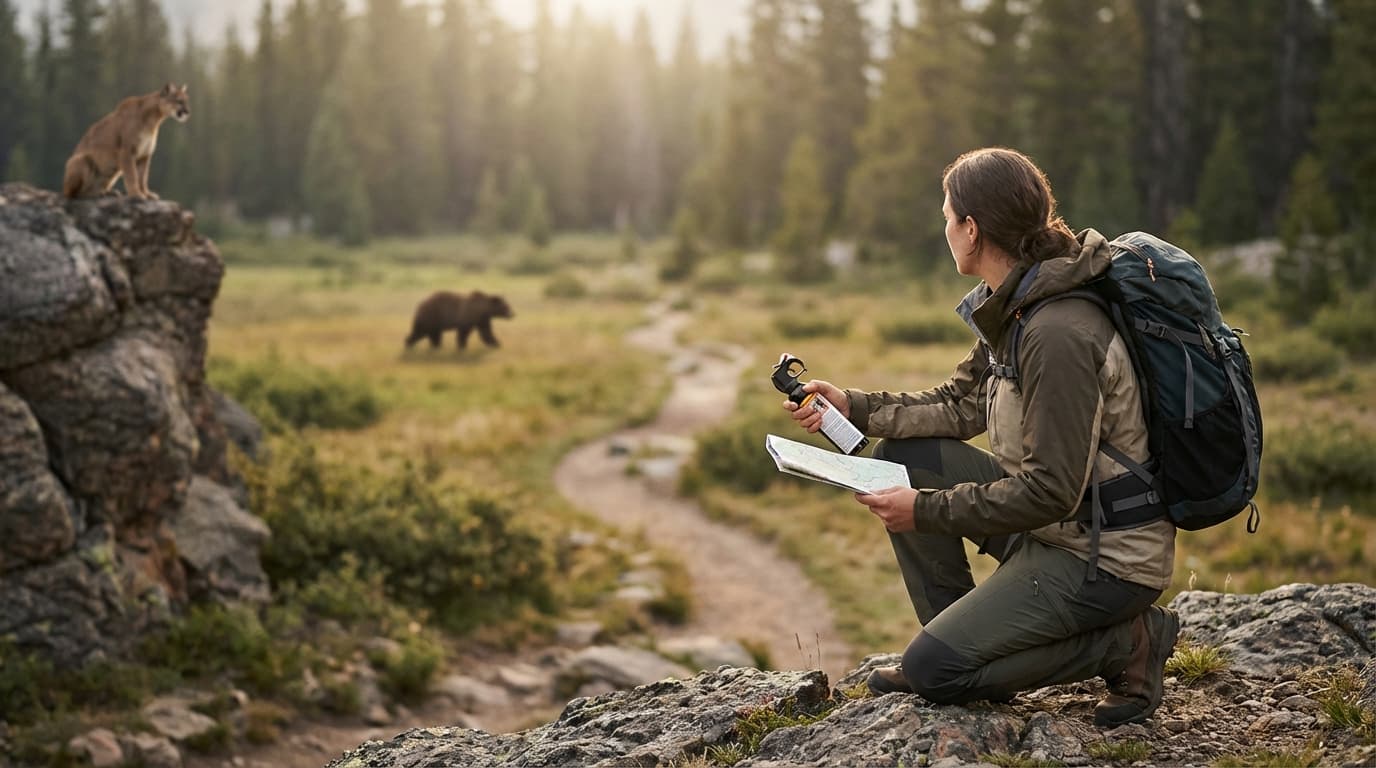
Think about this: a bear can run as fast as a racehorse, whether it is charging uphill or booking it down a slope. If you find yourself in a surprise encounter, you will not have time to dig through your backpack for that canister of bear spray buried under your extra socks. Most encounters actually end without anyone getting hurt, but that is usually because the humans stayed calm and prepared. Your spray is your best friend out there, but it is only useful if you can grab it and have it ready to fire in about two seconds flat.
So, how do you keep it handy? Experts recommend four specific ways to carry your spray to ensure it is always within reach: a hip holster, a chest harness, a backpack strap attachment, or a specialized waistband. The goal is to avoid fumbling when it counts. While you are at it, practice the cloud technique. You are not trying to hit a bullseye; you are creating a wall of deterrent between you and the animal. It is a great idea to buy a practice canister filled with water so you can get used to pulling the safety clip before you are actually staring down a grizzly.
The reality is that bear behavior can be confusing. For instance, a standing bear is usually just curious, not threatening. However, if you see it woofing, yawning, or snapping its jaws, it is feeling agitated. Whatever you do, do not run. Running triggers a chase instinct in bears, and you cannot outrun them. Instead, move sideways. This is a non-threatening way to leave the area while keeping your eyes on the bear so you do not trip. Keep your pack on, too, as it provides a layer of protection for your back and keeps your gear out of the animal's reach.
Key insights:
Carrying spray on your body rather than in a pack is the only way to ensure a two-second draw.
Moving sideways is the safest way to retreat because it is non-threatening and helps you keep your footing.
Most bear encounters end peacefully if you avoid triggering their predatory chase instinct by running.
The Power of the Pack: Why Hiking in Groups Works
Have you ever noticed how much noise a group of friends makes on the trail? While it might feel like you are ruining the quiet, you are actually building a safety shield. Bears are naturally cautious. When they hear a group chatting or smell the collective scent of several people, they usually decide it is not worth the trouble. It is the smelly and noisy advantage. Most bear encounters end without any injuries because the animals choose to avoid us when they know we are coming.
Think of it as visual intimidation. To a bear, a single hiker looks like a manageable target, but a group looks like a large, confusing entity. This matters because bears can run as fast as a racehorse, so you cannot outrun them anyway. By staying together, you look bigger and more formidable. If you do see one, remember that a standing bear is usually just curious, not threatening. It is trying to get a better look at the pack that just entered its space.
Here is the thing: traveling in a pack mimics the survival strategies of wolves. There is safety in numbers. If an encounter happens, you have more eyes to spot defensive signals like jaw snapping or woofing. You also have more hands ready to use bear spray. Just do not drop your packs if things get tense. Those bags provide protection for your back and keep your food away from the animal. Staying grouped up is your best defense.
Key insights:
Groups look like a single large predator to a bear, which acts as a natural deterrent.
Collective noise and scent serve as an early warning system that keeps wildlife at a distance.
Keeping your pack on during an encounter protects your spine and prevents animals from accessing food.
Common Questions About Wild Animal Safety
What happens if you are deep on the trail and suddenly see a bear? It is the 'what-if' that keeps hikers awake in their tents at night. Most people worry about being hunted, but the reality is a bit different. National Park Service data shows that most bear encounters actually end without any injuries to humans. Usually, if a bear stands up, it is not trying to be scary. It is just curious and trying to get a better look at you. Think of it as the bear checking its own surroundings, much like you are.
But how do you tell the difference between a curious bear and one that is agitated? You have to watch for the signals. If a bear starts woofing, snapping its jaws, or laying its ears back, it is feeling stressed. This is where your response matters. For a black bear, you want to stand your ground and look large. For a grizzly, you might need to be more passive if things get physical. But no matter the species, never run. Bears can run as fast as a racehorse, both uphill and downhill, and they can climb trees too. Running just triggers their instinct to chase you like a dog chasing a ball.
Instead of sprinting, try moving sideways. This is a non-threatening way to keep your eyes on the animal without tripping over a root. Also, keep your pack on. It protects your back and prevents the animal from getting to your food. If you are with a group, stay together. Groups are naturally louder and smellier, which usually keeps animals at a distance. If things get tense, use your voice. Talking calmly helps the animal realize you are a human and not a prey animal. Remember, a bear might bluff charge and turn away at the last second. It is a terrifying moment, but staying calm and having your bear spray ready in an easy-to-reach spot is your best defense.
You might wonder about mountain lions too. Mark Hart from AZGFD Tucson often asks hikers if they would know what to do if a cougar appeared. The rules are similar: do not run, look big, and fight back if necessary. The key is to be prepared before you even step on the trail. Whether it is knowing the four ways to carry bear spray or simply traveling in a pack, being proactive reduces the fear significantly. Most of the time, the animal is just as surprised to see you as you are to see them.
Key insights:
Group travel reduces risk because the combined size and noise of a crowd is intimidating to wildlife.
A standing bear is usually trying to gather information rather than preparing for an attack.
Running is the worst response because it triggers a predatory chase instinct in both bears and cougars.
Keeping your backpack on during an encounter provides a physical shield for your spine and protects your supplies.
Ready for the Trail
Stepping into the woods shouldn't feel like a scary movie. Even though a bear can outrun a racehorse, most meetings end without anyone getting a scratch. The secret isn't just being fearless. It is about being ready. When you know how to carry your spray and move sideways, that nervous energy turns into real confidence.
Before you head out, check official state websites for the scoop. Look for.gov domains for reliable updates on local wildlife. These resources keep you and the animals safe. So grab your pack right now, keep talking, and enjoy the views. You have the tools to handle whatever the trail throws your way.
Key insights:
Preparation turns nervous energy into trail confidence.
Official.gov websites are the best sources for local animal activity.
Most wildlife encounters end safely when you follow basic protocols.
Frequently Asked Questions
It really depends on the type of bear you are facing. If a grizzly bear makes contact, then playing dead is the right move for survival scenarios on how to survive a bear attack. You want to lie flat on your stomach and clasp your hands behind your neck. But if a black bear attacks, you should never play dead. In that case, you need to try to escape or fight back with everything you have. Remember that bears can run as fast as a racehorse, so do not try to outrun them. Even climbing a tree isn't a perfect fix since both black bears and grizzlies are good at climbing.
Here is the thing that many people miss about how to survive a bear attack. A charging bear is often just bluffing. They might run at you at high speed and then stop or turn away at the last second. If that happens, stay calm and keep talking in a low voice. This helps the bear realize you are a human and not a prey animal. If the bear is just standing there, it is usually just curious and trying to see you better. Also, keep your backpack on during the encounter because it can protect your back and keeps the bear away from your food.
Yes, bear spray is a very effective tool for more than just bears. It creates a huge cloud of pepper spray that irritates the eyes and nose of any animal that gets too close. It is a great choice for wild animal defense, providing safety during a cougar encounter or when considering wolf safety in the wild. Since there are four different ways to carry the spray, you have plenty of options for using bear spray effectively.
The most important part is how you carry it. You should have your spray in a holster on your belt or chest where you can grab it in a second. If you keep it tucked away in your bag, you probably won't be able to get to it fast enough if a cougar surprises you. Also, remember that walking in a group is a huge help. Groups are naturally louder and smellier, which usually keeps wild animals from wanting to come near you in the first place.
You'll want to keep your bear spray right where your hand can find it without you even looking. When you're wearing a big backpack, the best spots are usually a chest holster or a clip on the pack's waist belt. There are actually four main ways to carry it, but the key is making sure it isn't buried inside your bag or clipped somewhere you can't reach in a split second.
Also, remember to keep your pack on during an encounter. It acts like a shield for your back and keeps the bear away from your food. If you have to move, do it slowly and sideways. This is a non-threatening move that lets you keep an eye on the bear without tripping over your own feet.
The short answer is no. You definitely cannot outrun a bear, even on a steep downhill slope. Bears are incredibly fast and can keep up with a racehorse no matter the terrain. If you turn and run, you might accidentally trigger their instinct to chase you like a piece of prey, which is the last thing you want.
Instead of sprinting, try talking to the bear in a normal, calm voice. This helps them realize you are a human and not a snack. You can also move away slowly and at an angle. This is much better because it shows the bear you aren't a threat and it keeps you from falling while you watch what the animal is doing.
Conclusion
So what is the takeaway for your next trek? It comes down to staying calm when your brain wants to panic. Whether you are facing a curious bear or a cougar, your goal is to show them you are a human, not a snack. Standing your ground and keeping your bear spray ready changes the dynamic of these survival scenarios.
You do not have to be a pro to stay safe. You just need to respect the animals and know their triggers. Understanding that a bluff charge is just a bear being a bear, or that a cougar is simply a wild predator following instinct, helps you feel like a guest. Knowing cougar encounter tips and wild animal defense basics leaves less room for fear.
Before you head out, practice pulling your bear spray so you are ready for a quick draw. It is also a great excuse to bring friends along since groups are much safer. Respect the wild, stay aware, and enjoy the trail. The woods are much better when you know you can handle whatever walks across your path.
Every WilderReady guide is researched, written, and fact-checked in-house against trusted references such as the American Red Cross, the National Park Service, and the CDC before it goes live. We publish under this shared byline instead of invented personas, so you always know who stands behind the guidance you are reading.