Lost in the Snow? Why Your Gut Is Your Worst Enemy in a Whiteout
Imagine being trapped inside a giant ping-pong ball where the sky, the ground, and the horizon all vanish into a single, blinding blur. It is a terrifying reality for anyone...

Cole Mercer
Wilderness Guide & Navigation Specialist
Lost in the Snow? Why Your Gut Is Your Worst Enemy in a Whiteout
Imagine being trapped inside a giant ping-pong ball where the sky, the ground, and the horizon all vanish into a single, blinding blur. It is a terrifying reality for anyone caught in a mountain blizzard, and once you lose your bearings, your own brain becomes your biggest enemy. In these high-stakes survival scenarios, your internal sense of direction fails almost instantly, often leading you in circles while you're convinced you're walking a straight line.
Relying on your gut during a whiteout is a recipe for disaster because humans simply aren't built to navigate without visual cues. We're going to dive into survival tips for zero visibility and explain why your smartphone is often the first thing to quit when the temperature drops. You will learn why analog backups are non-negotiable and how something as simple as using a compass in snow can literally save your life.
We will also cover blizzard pathfinding techniques like the leapfrog method and how to avoid common mountain navigation errors that trap even experienced hikers. By the time you finish reading, you'll know exactly how to keep your cool and find your way back when the world turns white.
Imagine stepping into a giant ping-pong ball where the sky and ground melt into one blinding shade of white. This is a whiteout, and it is a psychological trap. When you lose visual cues, your brain starts making things up. You might feel like you are walking straight, but without a fixed point to look at, humans almost always wander in circles. Your intuition is your biggest liability when visibility hits zero.
Technology often fails first. Cold weather drains phone batteries fast and wet screens stop responding when you need them most. As Backpacker Magazine says, "Trust your map, not your gut." Carry a paper map and remember that your usual pace count can triple in deep snow. Distances will feel much longer than they actually are, which can lead to panic if you are not prepared for the slow progress.
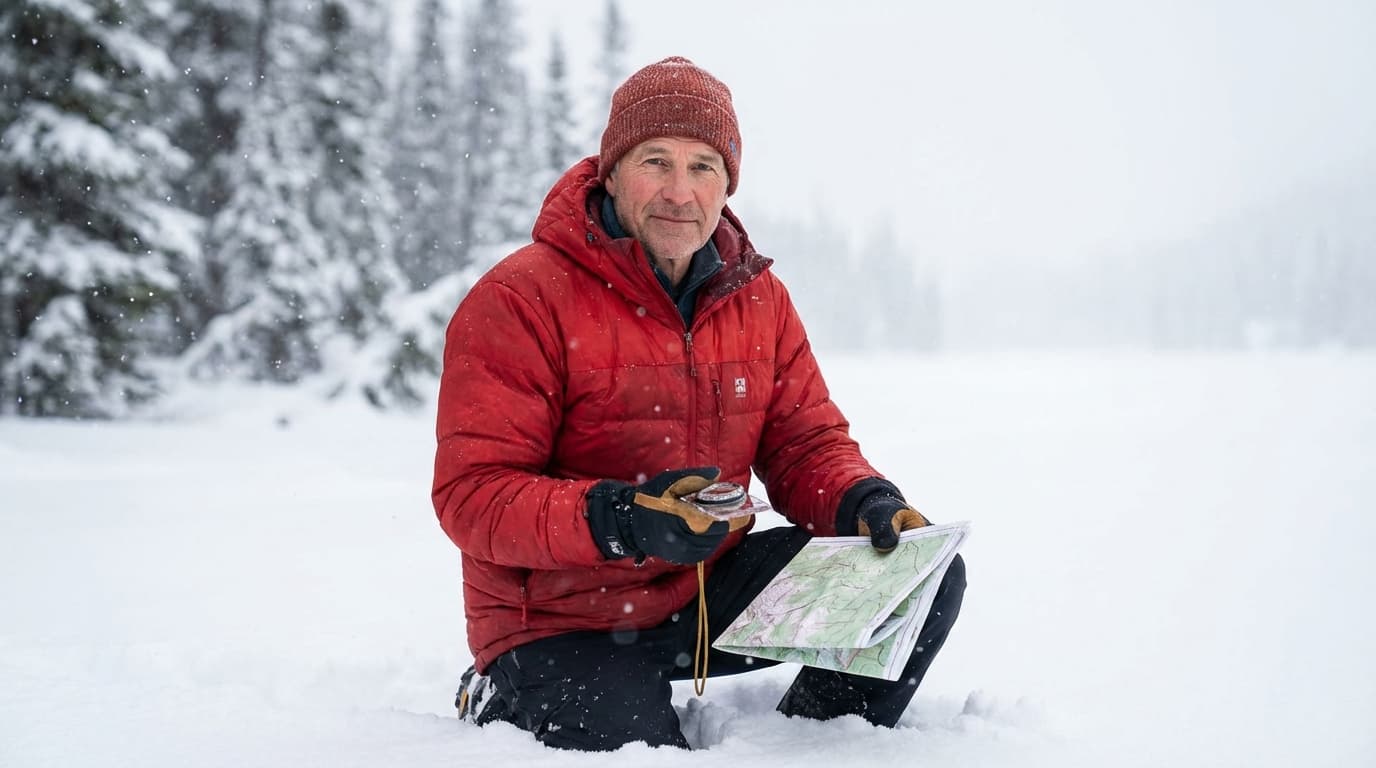
Survival depends on a plan made before the weather turns. Use digital tools but keep an analog compass attached to your jacket so you do not lose it in the wind. Use handrails like ridgelines to stay on track. If you are with a partner, try the leapfrog method where one person stays on a bearing while the other moves to the edge of visibility. It is about trusting the process, not your feelings.
Key insights:
- Human intuition is unreliable in zero visibility, often causing people to walk in circles.
- Cold weather quickly drains phone batteries, making analog maps and compasses essential backups.
- Deep snow can triple the time and effort required to cover a standard distance.
Inside the Ping-Pong Ball: The Reality of Whiteout Conditions
Imagine stepping into a giant, glowing ping-pong ball. That is how mountaineers describe the reality of a total whiteout. When the sky and the snow become the exact same shade of flat white, the horizon just disappears. This is more than just a visibility issue because your brain actually needs that horizon line to understand movement and balance. Without it, you might feel like you are tilting or sliding even when you are standing perfectly still. It is a disorienting experience that makes your mind create false movements out of thin air.
Navigating this environment is physically draining too. You cannot see the depth of the snow or the slope of the ground, so every step is a guessing game. Because of this, your usual 100m pace counts can double or even triple. You might think you have walked half a mile when you have actually only moved a few hundred yards. It is easy to see why people get exhausted and lost so quickly when they cannot trust their own eyes to judge distance or direction.
Here is a reality check: you cannot trust your inner compass either. Science shows that when humans lose their visual cues, they naturally start walking in circles. You might feel 100 percent sure you are going straight, but you are likely looping back on your own tracks. Backpacker Magazine puts it simply: trust your map, not your gut. It is hard to ignore that voice in your head telling you which way to go, but you have to rely on your tools to survive the urge to panic.
This is why having the right gear matters. Phones are great, but their batteries die fast in the cold and touch screens often fail when they get wet. Experts suggest carrying 1:40,000 or 1:50,000 scale maps because they show larger terrain features that do not get buried under fresh snow. If you do get turned around, you can calculate a back bearing by finding the 180-degree opposite of your path. It takes focus to stay calm when landmarks vanish, but sticking to the data is what gets you home.
Key insights:
- Humans naturally walk in circles when they lose sight of the horizon and visual landmarks.
- Physical effort increases drastically, often tripling the time it takes to cover the same distance in deep snow.
- Analog tools like paper maps are more reliable than smartphones in cold, wet survival situations.
- Trusting your navigation tools over your intuition is the only way to avoid disorientation.
Why You Can't Trust Your 'Inner Compass'
Have you ever felt like you were walking in a straight line, only to find your own tracks circling back toward you? In a whiteout, mountaineers often say they are stuck inside a ping-pong ball. Without a horizon or trees to guide you, your brain loses its sense of direction almost immediately. Science shows that when we are blind to landmarks, our bodies naturally drift into loops rather than the straight path we imagine.
This is where your intuition becomes your biggest liability. You might feel certain that the trail is just over the next rise, but your gut is usually lying to you. Backpacker Magazine gives the best advice for this situation: trust your map, not your gut. When landmarks vanish and the world turns into a featureless void of white, your internal compass breaks. The urge to follow a feeling is often just a byproduct of rising panic.
To stay safe, you have to override that survival instinct with hard data. It feels strange to stare at a compass needle when your brain wants to turn left, but that needle is the only thing that knows the truth. Overcoming this mental hurdle is the hardest part of winter travel. If you can stop, breathe, and rely on your tools instead of your instincts, you will stay on track.
Key insights:
- Human biology naturally causes us to walk in circles when we lack a visual horizon or landmarks.
- Panic often mimics intuition, making you feel like you know the way when you are actually lost.
- The most reliable way to navigate zero visibility is to ignore your feelings and follow your compass bearings exactly.
The Tech Trap: Why Your Smartphone Might Quit First
Imagine standing inside what mountaineers call a ping-pong ball. In a total whiteout, the sky and ground blend into a single, featureless void where you can't tell up from down. Your first instinct is probably to grab your phone for a GPS fix, but that is a dangerous trap. The reality is that smartphone batteries drain way faster in the cold, often dying in just a few minutes. Even if the power holds, trying to swipe a wet touch screen with freezing fingers is nearly impossible. Digital tools are great for convenience, but they are secondary to old-school backups when the weather turns mean.
The danger of relying on your phone isn't just the battery; it's the fact that humans are terrible at walking in a straight line without visual cues. Without a horizon, we naturally wander in circles. This is why the pros at Backpacker Magazine say to trust your map, not your gut. You need to have a whiteout plan ready before the visibility drops. This includes knowing your back bearings and realizing that your usual pace count can double or even triple when you are fighting through deep snow and wind. If you wait until you are lost to check your tools, you are already in trouble.
For winter navigation, a 1:40,000 scale paper map is your best friend. These are better for snowy terrain because they highlight larger features that stay visible even when the small stuff is buried. But a map is only useful if you can keep hold of it. A sudden gust of wind can snatch a loose map and vanish it into the white forever. As mountain guide Alan Halewood points out, this would not be the time to lose your gear. Keeping your map and compass physically tied to your body with lanyards is a simple step that saves lives.
When you're actually moving in zero visibility, use handrails like ridgelines or frozen creeks to stay on track. You can also try the leapfrog method, where one partner stays on a bearing while the other moves to the very edge of visibility. This keeps you moving in a straight line instead of veering off-course. Think of it this way: your phone is a luxury that might quit when it gets cold, but a laminated map and a compass don't have batteries to fail. In the mountains, redundancy isn't just a good idea - it is the standard for getting back home safely.
Key insights:
- Cold weather can kill a fully charged smartphone battery in minutes, making digital-only navigation a high-risk strategy.
- Standard 1:40,000 scale maps are preferred for winter because they emphasize large-scale terrain features that snow won't easily hide.
- Human intuition is unreliable in whiteouts; without visual landmarks, people almost always walk in circles.
- Physical attachment is vital; lanyards prevent wind from blowing away essential tools like maps and compasses during a storm.
The Case for Paper Maps and Lanyards
Imagine pulling out your phone in a blizzard only to find the screen frozen or the battery dead from the cold. It happens way faster than you would think. This is why old-school paper maps are still the gold standard for winter. Specifically, a 1:40,000 scale map is usually better than the standard 1:25,000 because it shows larger terrain features that are not easily buried under deep snow. When everything looks like the inside of a ping-pong ball, you need those big landmarks to find your way.
But here is the thing: a paper map is only helpful if you actually have it in your hands. In high winds, a single gust can turn your map into a kite. Think of it this way: if it is not physically attached to you, you do not really own it. Using a lanyard or clipping your map case to your jacket is non-negotiable. As expert Alan Halewood puts it, a whiteout is definitely not the time to lose your gear to the wind.
Why take the risk? When your touch screen fails in the wet or your GPS glitches, that physical map is the only thing standing between you and a long night out in the cold. It does not need a charge, and it will not crash. Just make sure it is tethered to your body so it stays exactly where you need it when the visibility drops to zero. It is a simple fix that keeps a bad situation from becoming a disaster.
Key insights:
- 1:40,000 scale maps are ideal for winter because they highlight large features that snow cannot easily hide.
- Cold weather significantly drains phone batteries and can cause touch screens to fail when you need them most.
- Lanyards are essential safety gear to prevent the wind from blowing your map or compass away in a storm.
Technical Tricks to Keep You on the Right Path
When you are stuck inside what mountaineers call the ping-pong ball, your senses start to lie to you. Everything is white, there is no horizon, and you might not even know if you are standing on a slope or a flat field. This is where technical tricks save you from walking in circles. One of the biggest shocks is how much your pace changes. In deep snow and zero visibility, a standard 100 meter walk can feel like a mile. Your usual pace count might double or even triple because of the physical effort and the constant stopping to check your gear. Think of it as moving through a world where your eyes no longer provide the truth.
If you are with a partner, use the leapfrog method to stay on a straight path. It is simple but keeps you from drifting. One person stays put while the other walks forward until they are right at the edge of visibility. The person in the back uses a compass to make sure the lead person is still on the right bearing and signals them to move left or right. Once the leader is in the right spot, the person in the back catches up and they repeat the process. This stops small errors from turning into a massive detour over long distances. It is much better than trying to guess where you are going while walking.
When the light is so flat that you cannot see the ground, try throwing snowballs. This creates a temporary visual reference so you can see the slope gradient and direction. You should also look for handrails. These are linear features like ridgelines, valley bottoms, or creeks that you can follow to stay on track. Another smart move is the bearing off trick. You intentionally aim to one side of your target, like a trailhead. When you finally hit a road or a fence, you will know exactly which direction to turn because you planned to miss on purpose. It takes the guesswork out of finding a small point in a big landscape.
Technology is great until it fails. Phone batteries die much faster in the cold and touch screens often stop working when they get wet. This is why having a paper map is a life saver. For winter trips, 1:40,000 or 1:50,000 scale maps are usually better. They show larger features that are less likely to be buried under deep snow. Always remember to calculate your back bearing by adding or subtracting 180 degrees from your forward bearing. It is the best way to make sure you can get back exactly the way you came if the weather gets even worse.
Key insights:
- Human intuition fails in whiteouts, leading people to walk in circles without visual cues.
- Deep snow can triple the number of steps needed to cover the same distance compared to clear ground.
- Aiming to miss your target on purpose is often safer than trying to hit a single point in zero visibility.
- Paper maps at 1:40,000 scale are more reliable than digital tools when features are obscured by snow.
The Leapfrog Method: Using a Partner as a Landmark
Ever feel like you are trapped inside a giant ping-pong ball? That is exactly how mountaineers describe a total whiteout. When the world turns into a featureless white void, your internal compass starts lying to you. You might think you are walking straight, but without a solid landmark, you will almost certainly end up walking in circles. This is where your climbing partner becomes your most valuable piece of navigation equipment.
The leapfrog method turns your partner into a human landmark. One of you stays put while the other walks ahead to the very edge of visibility. Before the lead person disappears into the mist, the navigator standing behind uses their compass to signal them left or right until they are perfectly on the bearing. It sounds slow, but it is the only reliable way to stop small mistakes from turning into a massive detour over long distances.
The reality is that everything feels harder when you cannot see. Deep snow can make a standard 100 meter pace count double or even triple, which messes with your head. As expert Alan Halewood points out, this is definitely not the time to lose your gear or your cool. Keep your compass tethered to your jacket and trust the math. By leapfrogging, you reduce the risk of drifting off course and keep each other moving toward safety even when your gut tells you to turn the wrong way.
Snowball Sighting and Handrails
Ever felt like you were trapped inside a white ping-pong ball? That is exactly how hikers describe a total whiteout. When the sky and ground blend into a single wall of white, you lose your sense of what is up or down. To find the slope in this flat light, try throwing a snowball. If you can, rub a bit of dirt on it first. As it rolls, it creates a quick visual reference that reveals the drop-off or the angle of the ground that you simply could not see before.
Since you cannot trust your eyes, you have to trust the shape of the land. This is where handrails come in. You look for a steady feature like a ridgeline or a creek that you can follow safely. It acts like a physical guide to keep you on track. But remember that your speed will change. In deep snow, your usual pace counts can double or even triple, so do not assume you have reached your destination just because your legs feel tired.
There is also a clever trick called bearing off. Instead of aiming directly for a tiny target like a trailhead, you intentionally aim a little to the left or right. Think of it this way: if you aim straight and miss, you will have no idea which way to turn when you hit the road. But if you aim left on purpose, you know for a fact that your target is to the right once you reach that path. it takes the scary guesswork out of a high-stakes situation.
Key insights:
- Snowball sighting helps identify slope gradients when flat light erases shadows.
- Linear terrain features like creeks or ridges serve as reliable physical handrails.
- Intentional offset navigation, or bearing off, ensures you know which direction to turn when reaching a road or trail.
- Pace counts often triple in deep snow, making distance estimation difficult without a map.
Common Mountain Navigation Errors and How to Avoid Them
Have you ever looked at a blurry shape in the distance and convinced yourself it is the trail marker you have been searching for? In a whiteout, your brain desperately tries to make sense of nothingness, a state mountaineers call being inside the ping-pong ball. It is easy to fall into the trap of wishful thinking, but your intuition is a liar when visibility hits zero. Research shows that without visual landmarks, humans naturally wander in circles. You have to trust your tools, not your gut.
A common mistake is putting all your faith in a smartphone. Cold weather drains batteries incredibly fast, and wet touchscreens often fail when you need them most. This is where the math of the back bearing becomes your lifeline. To stay on a straight line, you need to know your 180-degree opposite. If your forward bearing is 198 degrees, you subtract 180 to get a back bearing of 18 degrees. It sounds easy now, but doing subtraction while shivering in a storm is a different story. Redundancy is the only way to stay safe.
You also need to realize that your physical progress changes in the snow. Your usual 100m pace count can double or even triple when you are trudging through deep drifts. You might feel like you have covered a mile when you have actually only moved a few hundred meters. If you lose your way, remember that waiting it out is often the smartest choice. Sometimes the best navigation strategy is to stop, find shelter, and wait for the light to change rather than walking deeper into a dangerous situation.
Key insights:
- Trust your compass over your intuition because humans naturally walk in circles without visual cues.
- Always carry a paper map and compass as backup since phone batteries and screens fail in freezing, wet conditions.
- Practice back bearing math before you need it so you can stay on a straight line during high-stress moments.
- Adjust your expectations for distance because deep snow can triple the time it takes to cover 100 meters.
Frequently Asked Questions
Conclusion
So what does all this mean? Surviving a whiteout is less about physical strength and more about mental discipline. When you are stuck inside that ping-pong ball of clouds and snow, your brain will try to convince you that you are walking straight when you are actually spinning in circles. The secret to making it home is realizing that your gut is a liar in these survival scenarios and your compass is your only honest friend.
It is also a good reminder that your gadgets are only as good as their battery life. Cold weather is a battery killer, so having a paper map and a physical compass is essential. Before your next winter trip, try practicing the leapfrog method with a friend. Getting these skills into your muscle memory now means you won't have to scramble when the visibility drops to zero.
Respecting the mountain means knowing when to trust your tools and when to hunker down. If you stay calm and stick to your plan, you can turn a scary situation into a story you live to tell. Stay warm, stay smart, and always have a backup.
Send it to someone who should read it next.
About the author

Cole Mercer
Wilderness Guide & Navigation Specialist
Covers map reading, route planning, land navigation, and lost-person response with a focus on staying calm and moving smart outdoors.
View all articles