Lost in a Whiteout? Why Your Gut is Your Worst Enemy (and How to Get Home Safely)
Imagine stepping inside a giant ping-pong ball where the ground and sky look exactly the same. In a blizzard, your eyes lose every point of reference and your inner ear...
Lost in a Whiteout? Why Your Gut is Your Worst Enemy (and How to Get Home Safely)
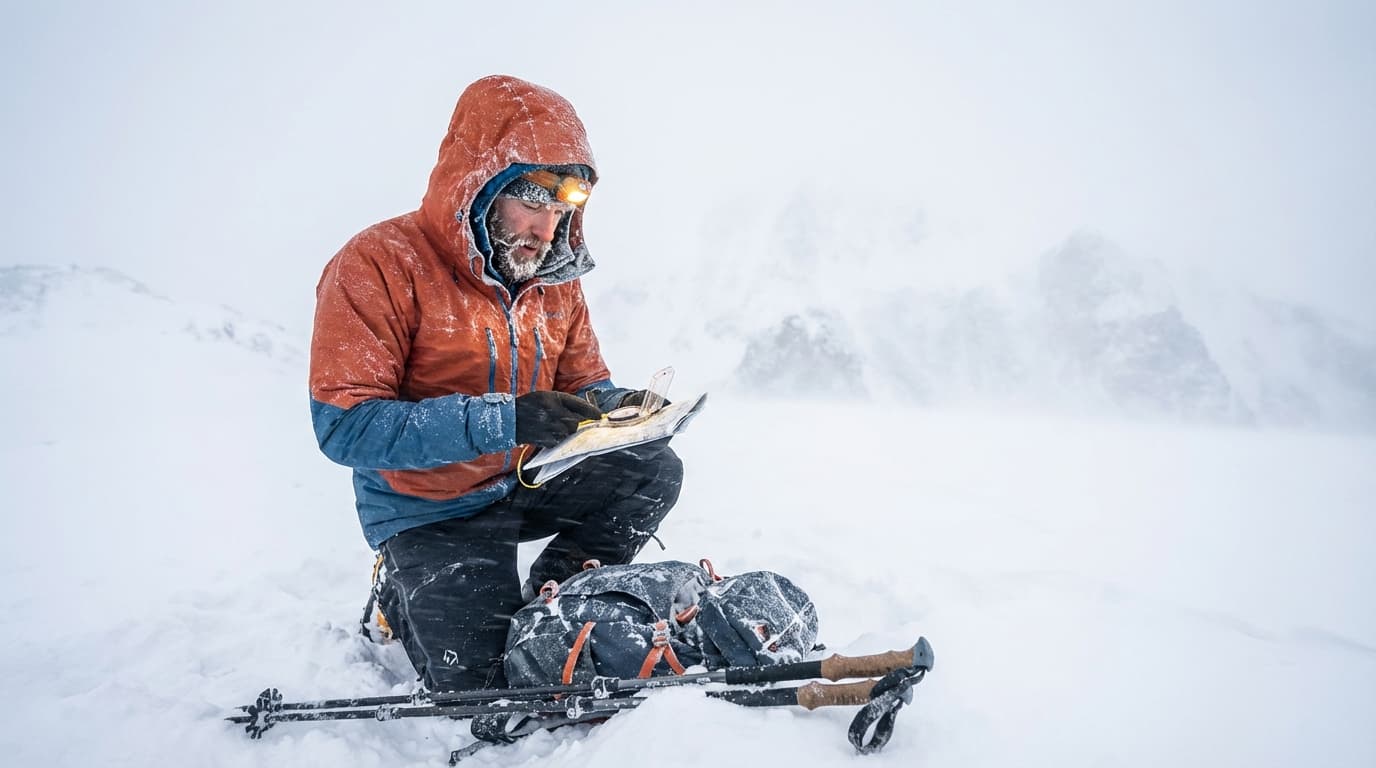
Imagine stepping inside a giant ping-pong ball where the ground and sky look exactly the same. In a blizzard, your eyes lose every point of reference and your inner ear starts playing tricks on you. When facing survival scenarios: how to navigate in a whiteout is the most important skill you can have. It depends entirely on ignoring your instincts and trusting your gear instead.
Even if you are naturally sure-footed. Most people naturally wander in circles when they cannot see the horizon, leading to dangerous mountain navigation errors. We will look at survival tips for zero visibility that work, including blizzard pathfinding tricks and why your phone battery might fail when the temperature drops.
We will cover everything from using a compass in snow to the leapfrog method for staying on a straight line. You will also find out why a paper map is your most reliable backup and how to calculate back bearings. By the time you are done, you will know how to find your way home safely even when the world goes white.
Surviving the Storm: How to Find Your Way When the World Goes White
Ever felt like you were trapped inside a giant ping-pong ball? That is exactly how a whiteout feels. You lose the sky, the ground, and your balance in seconds. It is terrifying because your brain is actually your worst enemy in a storm. It tries to make sense of the nothingness, but it usually just leads you in circles.
The reality is that your intuition is useless when you cannot see the horizon. This is why you must trust your map, not your gut. Even if you feel like you are walking the wrong way, look at your tools. Apps like Gaia GPS work on satellites even in airplane mode, which is vital since cold air kills phone batteries fast.
Keep in mind that moving through deep snow is exhausting and slow. Your usual 100m pace count might double or even triple when visibility vanishes. If you ignore your panicking feelings and follow your compass instead, you can make it back to safety. Trust the gear and you will get home.
Key insights:
Human intuition is unreliable in whiteouts and often leads to walking in circles.
Digital tools like Gaia GPS are effective but require offline maps and external power due to cold weather battery drain.
Technical navigation methods like tracking pace counts must be adjusted for deep snow conditions.
Inside the Ping-Pong Ball: Why Your Brain Lies to You
Imagine stepping into a world where up, down, left, and right all look exactly the same. Mountain guides call this being inside the ping-pong ball because you lose all sense of perspective. Without a horizon or a single rock to look at, your brain starts making things up to fill the void. You might feel like you are tilting or even falling when you are standing perfectly still. It is a strange psychological disorientation that can turn a familiar trail into a trap in seconds.
Why do we naturally wander in circles when the clouds roll in? It comes down to your inner ear. Without visual cues to reset your balance, tiny physical differences in your legs or the weight of your pack cause you to drift. Even the best hikers make this mistake. Research shows that people who think they are walking straight in a whiteout often end up back where they started. This is why the golden rule of survival is to trust your map, not your gut. Your feelings will lie to you, but a compass will not.
Navigating through this featureless white world also changes how you move physically. If you are trudging through deep snow with no visibility, your standard 100m pace count can double or even triple. You are working harder and moving slower than you think. Also, do not rely only on your phone. Even if you have maps downloaded for offline use, cold weather drains batteries much faster than usual. You need a real plan, like using a partner to leapfrog ahead so you can maintain a straight line on a specific bearing.
The smartest move is to stay ahead of the weather. Successful survival happens because someone recorded their bearings or back-bearings before the storm hit. Using handrails like a ridge or a creek can guide you home without you needing to stare at a screen every few seconds. Think of it this way: your tools are your eyes when the world goes white. If you ignore them because you feel like the trail is to the left, you are choosing a dangerous gamble over a proven science.
Key insights:
Trusting technical instruments is more reliable than human intuition during total disorientation.
Redundancy in navigation tools is essential for winter safety because digital devices often fail in the cold.
Proactive planning and pre-loading waypoints are the primary factors in successful whiteout extraction.
The Science of Wandering in Circles
Ever felt like you were trapped inside a giant ping-pong ball? That is exactly what a whiteout feels like. When the ground and sky match perfectly, your inner ear gets totally confused. Without a horizon to look at, your brain loses its sense of balance and just guesses where straight is. Most of the time, those guesses are completely wrong.
Here is the thing about walking in the snow. Without a clear path, humans naturally drift and start walking in big circles. You might feel totally confident that you are heading the right way, but your gut is basically a broken GPS. Also, do not forget that walking in deep snow is exhausting. Your normal 100 meter pace count can double or even triple when you are struggling through the white stuff.
So, what do you do? You trust your tools, not your feelings. Apps like Gaia GPS are lifesavers because they work in airplane mode, but cold air drains phone batteries faster than you would think. Always have a compass as a backup. Calculating a back bearing might feel like a chore, but it is the only way to make sure you are moving toward safety and not just spinning in circles.
Key insights:
The inner ear requires a visible horizon to maintain a straight line of travel.
Human intuition is unreliable in zero visibility, often leading to walking in circles.
Pace counts change drastically in snow, making distance estimation difficult without tools.
Cold weather significantly reduces phone battery life, making analog backups essential.
Phones vs. Paper: Building a Navigation System That Won't Die
Imagine you are standing inside what mountain guides call a ping-pong ball where the sky and ground look exactly the same. You reach for your phone to check your position, but the screen is black because the freezing air killed your battery. This happens more often than people think. While digital tools like Gaia GPS are amazing because they work in airplane mode, they are fragile in the cold. You need a backup that is unhackable and battery-free. A paper map and a compass are the only tools that will never let you down when the weather gets nasty. Trusting these instruments is vital because the reality is that without them, humans naturally start walking in circles.
Keeping your tech running in the cold requires a bit of strategy. External power banks and airplane mode are non-negotiable if you want to stay safe. But if the screen does go dark, do not panic yet. You can often bring a dead phone back to life by putting it inside your jacket against your skin. That burst of body heat can give you just enough power to check your coordinates one last time. It is also worth remembering that your physical effort changes in the snow. A standard 100m pace count might double or even triple when you are trudging through deep drifts, so do not assume you have traveled as far as it feels.
Many mountain pros are now switching to 1:40,000 scale maps for winter trips. It sounds strange to use a map with less detail, but it actually makes sense. When a heavy blanket of snow covers the landscape, small features like tiny streams or narrow paths are buried. You cannot use them for finding your way. A 1:40,000 map highlights the big terrain features like massive ridges and deep valleys. These act as handrails that you can follow even when visibility is poor. By focusing on the big picture, you are less likely to get confused by the small stuff that is hidden under the frost.
Key insights:
Body heat can often revive a frozen phone battery for emergency use.
Pace counts can triple in deep snow, making distance estimation difficult.
Larger scale maps help identify major terrain features when small details are buried.
Keeping Your Tech Alive in the Cold
Ever notice how your phone battery acts like a total drama queen the second it gets chilly? One minute you have a decent charge, and the next, you are staring at a black screen. In a whiteout, this is more than just annoying, it is a real safety problem. To keep things running, flip your phone into airplane mode immediately. Mapping apps like Gaia GPS still work perfectly with satellites if you pre-downloaded your maps. This saves a massive amount of juice because your phone stops hunting for a cell signal that does not exist in the storm.
Also, keep a power bank tucked inside your jacket layers where it stays warm. If your phone still takes an unexpected nap, try the body-heat trick. Shove the device into an inner pocket right against your skin. Often, a bit of your own warmth is all it needs to wake back up for a quick check of your bearings. It is a simple move that keeps you on the right path when the world turns featureless and white.
Key insights:
Cold weather significantly accelerates battery drain, making external power sources a necessity.
Airplane mode preserves battery life while allowing GPS tools to function using offline maps.
Direct body heat is a reliable way to temporarily revive a phone that has shut down due to cold.
The 1:40,000 Map Trend
Have you ever looked at a map during a storm and realized you can't see anything it describes? It happens because deep snow buries the tiny details we usually use to find our way. This is why more mountain travelers are switching to 1:40,000 scale maps. They are becoming the new standard for a simple reason: they help you see the big stuff.
While standard maps show every little bump, those small features vanish in a blizzard. A 1:40,000 map focuses on massive landmarks like ridges or valley bottoms. These act as handrails you can actually follow when everything else is white. Since phone batteries die so fast in the cold, having a paper map that highlights these huge features makes it much easier to stay on track when your gut tells you you're lost.
Key insights:
Large-scale maps highlight major terrain features that remain visible even when small landmarks are buried in deep snow.
Relying on big 'handrails' like ridges is safer than trying to spot tiny details during a whiteout.
Smart Tricks for Moving in a Straight Line
When you are stuck inside what mountain guides call the "ping-pong ball," your brain starts playing tricks on you. Without a horizon or shadows, you lose all sense of perspective. You might feel like you are walking straight, but the reality is that humans naturally wander in circles when they have no visual cues to follow. This is where you have to stop trusting your gut and start trusting your tools. As Backpacker Magazine suggests, you have to trust your map and not your gut because your internal compass is simply not built for a world without contrast. One simple trick to create your own landmarks is "snowballing." If the ground is just a flat sheet of white, throw a snowball ahead of you. Sometimes people even rub a little dirt on it to make it stand out. This gives you a temporary target to walk toward so you do not drift.
If you are hiking with a partner, the leapfrog method is your best bet for staying on course. You stay put while your partner walks forward into the whiteout. You use your compass to make sure they stay exactly on the bearing. Once they reach the edge of visibility, you signal them to stop. They are now your landmark. You walk up to join them and repeat the process. It feels slow, but it keeps you from drifting. Remember that in deep snow, your normal 100m pace count might double or even triple. Do not get frustrated if you feel like you are barely moving. It is much better to move slowly in the right direction than quickly in the wrong one.
Another way to lower stress is to use "handrails." These are linear features like ridge lines, valley bottoms, or creeks. Instead of constant compass checks, you just follow the physical feature to stay on track. This is where aiming off comes in. If you are looking for a specific spot on a road, aim slightly to the left or right of it. When you hit the road, you will know exactly which way to turn. Also, keep your phone warm. Cold weather kills batteries fast. If you use an app like Gaia GPS, download your maps ahead of time and keep the device close to your body. For a safe return, remember that a back bearing is just your forward bearing plus or minus 180 degrees. Technical instruments are always more reliable than human intuition during total disorientation.
Key insights:
Human intuition fails in whiteouts, making technical methods like back bearings and compass checks essential.
Snowballing and leapfrogging create artificial landmarks in featureless terrain to prevent circular wandering.
Aiming off removes the 50/50 guesswork when trying to find a specific point along a linear feature like a road or creek.
The Leapfrog Method Explained
Ever feel like you are trapped inside a ping-pong ball? In a whiteout, your intuition is your worst enemy. People often wander in circles without visual cues, so you have to trust your tools over your gut. The leapfrog method is a simple team tactic that keeps you on a straight line when visibility vanishes.
Here is the process. One partner stays at a fixed point while the other moves forward to the edge of visibility. The person in the back watches the compass and signals the leader to stay on the bearing. Once the leader reaches the limit of sight, they stop and wait for the partner to catch up. This keeps you from drifting off course into dangerous terrain.
This creates a reliable chain of human breadcrumbs. To double-check your path, use a back-bearing by adding or subtracting 180 degrees from your forward heading. You can also throw snowballs ahead to create visual contrast. Since phone batteries drain fast in the cold, these manual techniques are often the only way to get home safely.
Key insights:
Trust technical instruments over human intuition during total disorientation.
Use back-bearings to verify your path and prevent drifting.
Manual navigation is essential because cold weather kills phone batteries quickly.
Using 'Handrails' to Stay on Track
Ever feel like you are trapped inside a giant ping-pong ball? That is exactly how it feels when the sky and ground merge into one big white blur. In these moments, staring at a compass every few seconds is honestly exhausting and adds to the panic. This is why smart travelers look for handrails. A handrail is just a natural line in the landscape, like a ridge, a creek, or a valley bottom. Instead of obsessing over a tiny needle, you just follow the physical shape of the land.
Think of it as a guide for your feet. If you keep a rising ridge on your right side, you know you are still on track without needing to stop. You can also use a clever trick called aiming off. This means you intentionally aim to one side of your goal. When you finally hit a handrail like a road or a fence, you will know exactly which way to turn. It removes that scary guesswork that often leads people to wander in circles.
Key insights:
Handrails reduce the mental fatigue of constant instrument checks by using terrain features.
The aiming off technique provides certainty when you finally encounter a linear landmark.
Using physical features helps prevent the natural human tendency to walk in circles when visibility is zero.
The Math of Snow: Why Your Pacing Changes
Think of it this way: walking in a whiteout is like being trapped inside a giant ping-pong ball. You lose all sense of up, down, or distance almost instantly. Because you lack visual landmarks, your brain loses its internal compass, and you will likely start wandering in circles without even realizing it. This is where your intuition becomes your biggest liability. You have to stop trusting your gut and start trusting the cold, hard numbers on your gear to find your way back to safety.
The math of a trail changes the moment the snow gets deep. In normal conditions, 100 meters is a predictable distance you can cover in a minute. In a whiteout, that same stretch can take three times as much effort and twice as many steps because of the terrain. Since your phone battery will likely plummet in the cold, you cannot rely on a screen alone. You need to know your pace count and realize that every meter in the powder is a completely different beast than a meter on dirt.
Doing the math for a back bearing is your literal lifeline when visibility drops to zero. It is a simple plus or minus 180-degree rule: if your original heading was 30 degrees, add 180 to get a return bearing of 210. If you were at 250, subtract 180 to find 70. This calculation needs to be second nature because when your hands are freezing and the wind is biting, complex thinking gets hard. Keep your compass on a lanyard tucked inside your jacket to keep the housing warm and prevent you from dropping your only way home into a deep snowdrift.
Key insights:
Your pace count can double or triple in deep snow, making distance estimation difficult.
Phone batteries fail quickly in the cold, making analog compass skills essential backups.
The back bearing rule is the most reliable way to reverse a course when you lose all visual cues.
Doing the Math: The Back Bearing Rule
Imagine being stuck inside a giant ping-pong ball where the sky and ground look exactly the same. In that moment, your intuition is a liar. You need the back bearing rule to find your way home. The math is easy: just add or subtract 180 degrees from your forward bearing to reverse your path. If your heading is under 180, add; if it's over, subtract.
But doing math is hard when your fingers are numb. Since phone batteries die fast in the cold, your compass is your lifeline. Keep it on a long string so you can read it without fumbling with thick gloves. Trusting these numbers keeps you from walking in circles when you can't see your own feet.
Key insights:
Add 180 if your bearing is 0-180; subtract 180 if it is 180-360.
Keep your compass on a long lanyard so you can use it without removing winter mitts.
Planning Ahead: The Secret to a Stress-Free Exit
Imagine stepping into what Baker Mountain Guides calls a ping-pong ball. Everything is white, and you can't tell up from down or where the snowy ground meets the sky. This is where your intuition fails you because humans naturally start walking in circles when they lose sight of the horizon. To avoid this, the real work starts before you even pull on your boots. You need to pre-load waypoints into your phone or GPS while you are still sitting on your couch. Mapping apps like Gaia GPS or Caltopo are great because they rely on satellites and work perfectly in airplane mode, but only if you remember to download the maps ahead of time.
Here is the catch. Cold weather is a total battery killer. Your phone might show eighty percent, but ten minutes in a freezing wind can drop it to zero instantly. Always carry a portable power source and keep your device tucked against your body for warmth. While you still have some visibility, start using the breadcrumb technique. This involves recording your exact path as you move forward. If the clouds drop and you can't see your own hand, you have a digital trail to follow back. It is much easier to follow a line you just made than to guess where the trail used to be when everything looks the same.
Why does this matter so much? Because in a blizzard, your brain will try to convince you that left feels right even when it is wrong. Backpacker Magazine says it best when they tell you to trust your map and not your gut. Proactive planning is the single biggest factor in getting home safely. By setting your bearings and recording waypoints early, you remove the panic and guesswork. When the world turns white, you won't be desperately searching for a path. Instead, you will simply be following a plan you already made when your head was clear and you could still see the horizon.
Key insights:
Digital maps only work in whiteouts if they are downloaded for offline use before you lose cell service.
Cold weather causes rapid battery drain, making a physical power bank a mandatory safety item.
The breadcrumb technique provides a recorded trail that overrides the human tendency to walk in circles.
Final Thoughts: Trust the Process, Not the Feeling
Ever feel like you’re trapped inside a giant ping-pong ball? That’s the disorienting reality of a mountain whiteout. When the world turns into a featureless void, your inner compass will lie to you. Most people end up walking in circles because they trust their gut instead of their gear. Getting home safely isn't about bravery; it's about being technical and staying calm.
You need a mix of digital tools and analog skills. Mapping apps are great, but cold weather drains phone batteries fast. Always carry a paper map and compass as a backup. The math doesn't lie. Keep in mind that a standard 100m pace count can double or even triple in deep snow. It is harder work, but those numbers are your most reliable friend.
Technical skill is your best defense against panic. Whether you are using snowballing to find the ground or following a ridge as a handrail, these methods keep you moving straight. If you need to turn around, add or subtract 180 degrees for a back bearing. It feels strange to ignore your instincts, but the process is what gets you home.
Key insights:
Digital redundancy is vital because batteries fail in the cold.
Trusting instruments over human intuition prevents wandering in circles.
Pre-planned waypoints and back-bearings are a reliable safety net.
Frequently Asked Questions
The very first thing you should do is stop moving right where you are. When you are stuck in what mountain guides call a ping-pong ball, your brain loses its sense of perspective and direction. If you keep walking without a clear plan, you will likely end up wandering in circles.
Once you have stopped, check your phone. Cold weather drains batteries fast, so keep your electronics tucked away and warm. This is the time to rely on the waypoints you saved earlier rather than trying to guess which way is home.
Since you do not have any landmarks to aim for, you should use the leapfrog method. This is where one person stays at a known spot while the other walks forward to the edge of visibility on a specific bearing. It is a great way to make sure you are still moving in a straight line even when you cannot see the horizon.
You can also try throwing snowballs ahead of you to create a tiny visual mark in the featureless white landscape. It is a bit like playing a very serious game of fetch with yourself to stay on track. Just remember to trust your compass even if your gut tells you it is wrong, because your internal sense of direction is not as reliable as the tools in your hand.
It's mostly because of the cold. Low temperatures slow down the chemical reactions inside lithium-ion batteries, which makes them way less efficient. You might notice your phone showing 40% one minute and then just shutting off the next because the battery can't provide enough power to keep the device running.
To stop this from happening, try to keep your phone in an inner pocket close to your body heat. It also helps to carry a portable power bank as a backup. You really can't rely on a cold phone when things get tough in the mountains, so keeping it warm is just as important as keeping yourself warm.
Snowballing is a clever trick for when you're stuck in what mountain guides call a ping-pong ball. This happens when the sky and ground look exactly the same and you lose all sense of where you are. You just pack a snowball, maybe rub a little dirt on it to make it darker, and throw it ahead of you along the direction you need to go.
Since whiteouts take away all your visual cues, throwing that snowball gives you a temporary marker to walk toward. It helps you stay in a straight line instead of accidentally wandering in circles. It's a simple way to create your own landmarks when the world around you disappears.
Conclusion
When the world turns into a featureless white bowl, your senses will try to convince you of things that simply are not true. We have seen how your inner ear fails and why your brain naturally wants to walk in circles when you lose the horizon. Survival scenarios: how to navigate in a whiteout is not really about being brave. It is about being disciplined enough to ignore your gut and listen to your compass instead.
Technology is a great partner until the cold kills your battery, so having analog skills like leapfrogging or using back bearings is what actually gets you home. Before your next trip into the snow, take a few minutes to practice with your map in a place where the stakes are low. It is much easier to learn the math of snow when your fingers are not already freezing.
Getting back safely comes down to trusting the tools and the techniques you have prepared in advance. Stay calm, keep your head, and let the logic of your map lead you out of the storm. You have the skills to find your way even when you cannot see your own feet.
Every WilderReady guide is researched, written, and fact-checked in-house against trusted references such as the American Red Cross, the National Park Service, and the CDC before it goes live. We publish under this shared byline instead of invented personas, so you always know who stands behind the guidance you are reading.