Is Your Water Filter Actually Working? What Hikers Need to Know
You're three days into the backcountry, miles from the nearest tap, and staring at a sparkling alpine stream. It looks perfect, but looks can be incredibly deceiving when it comes...
Is Your Water Filter Actually Working? What Hikers Need to Know
You're three days into the backcountry, miles from the nearest tap, and staring at a sparkling alpine stream. It looks perfect, but looks can be incredibly deceiving when it comes to what's actually floating in your drink. Finding the best backpacking water filter isn't just about convenience; it's about making sure you don't spend the rest of your trip feeling miserable because of a tiny parasite.
Whether you're looking for a gravity water filter review to help hydrate a group or weighing a UV water purifier vs filter for solo trips, your choice of gear determines your mood by day three. We're going to break down how these systems work and why even the clearest water can be risky if you don't have the right tools to treat it.
We also cover survival water purification gear for emergencies and the best portable water filter for hiking when you want to move fast. From avoiding common maintenance mistakes to picking the right setup for your next adventure, here is what you need to know to stay healthy on the trail.
Why You Can't Always Trust a 'Clean' Mountain Stream
You have probably seen those pictures of water so clear it looks like it came from a glass bottle. But that high-alpine spring is not always as safe as it looks. Just because you can see every pebble on the bottom does not mean the water is pure. In fact, some of the most dangerous sources are the ones that look the most inviting.
Most things that will actually ruin your trip are invisible to the eye. We are talking about Giardia and Cryptosporidium, tiny hitchhikers that do not care how clean the stream looks. A good backpacking water filter does more than just strain out the dirt. It is your primary defense against a week of stomach cramps and dehydration. You are filtering for what you cannot see, not just the silt.
Now consider your mood on day three. If your filter is slow or your gear is a hassle to use, your trip starts to feel like a chore. Choosing the right survival water purification gear is not just a safety check. It is about making sure you actually enjoy the hike instead of dreading the next time you have to stop and pump for twenty minutes.
Key insights:
Visual clarity is never a reliable indicator of water safety in the wild.
Filters must target invisible protozoa and bacteria rather than just sediment.
The weight and speed of your filtration gear directly impact your morale during long trips.
The Big Debate: UV Light vs. Traditional Filters
You’re standing by a crystal-clear mountain stream, parched after a long climb. You reach for your gear, but here is the big question: do you squeeze that water through a physical mesh or zap it with a high-tech light? This is the heart of the UV water purifier vs filter debate. While standard filters are the workhorses of the trail, they have a blind spot. They are great at catching bacteria like E. coli, but viruses are often small enough to slip right through the tiny pores. UV purifiers work differently by using light to scramble the DNA of those tiny hitchhikers, making them harmless before they can ruin your trip.
But there is a catch that might make you think twice before ditching your traditional setup. Think of it as the 'floaties' problem. If you’re pulling water from a murky puddle or a silty river, a UV light won't do a thing to clear it up. You’ll end up with safe, neutralized germs floating in a glass of crunchy, brown water. Filters, on the other hand, actually scrub the grit and grime out. There is also the matter of how much work you want to do. Squeezing a filter for every liter of water can get tiring on your hands, but relying on a UV pen means you’re one dead battery away from a very thirsty hike.
Knowing when a purifier is non-negotiable usually comes down to where you are heading. If you are traveling internationally or hiking in areas with heavy human traffic, a simple filter might leave you vulnerable. This is the fundamental difference: a filter removes the big stuff like protozoa and bacteria, but a purifier is designed to neutralize everything, including those nasty viruses. In popular campsites or developing countries, that extra layer of protection is worth the weight. It’s not just about getting the dirt out; it’s about making sure the water won't send you to the emergency room.
Think about your own hiking style before choosing. If you mostly stick to pristine alpine lakes, a lightweight filter is probably your best friend. But if you're the type to wander through regions where the water quality is a total mystery, the peace of mind that comes with a purifier is hard to beat. Sometimes the best gear isn't the most expensive one, but the one that matches the specific risks of your next adventure. Whether you prefer the physical reliability of a filter or the high-tech speed of UV, knowing the limits of your gear is what keeps you safe.
Key insights:
UV light kills viruses that pass through standard filters.
Filters remove physical debris and silt that UV lights cannot.
Purifiers are essential for international travel and high-use areas.
UV systems require battery management while filters require physical effort.
When a Purifier is Non-Negotiable
Think about your next big trip. If you are heading to a remote village or a crowded trail where people aren't careful with waste, a standard filter might not cut it. Most hikers use hollow fiber tubes to stop bacteria, which works great in the backcountry. But these often miss microscopic viruses that thrive in areas with high human traffic.
Here is the real difference. A filter acts like a fine mesh screen for large contaminants like Giardia. A purifier goes further, using chemicals or UV light to kill viruses too. When you travel internationally, this extra step is vital. It is the difference between a great adventure and a miserable week stuck in a hotel bathroom because of a bug you didn't see coming.
Does this mean you always need a purifier? Not necessarily. In pristine mountain streams, a filter is usually enough. But in heavy-use zones or when traveling abroad, that extra protection is non-negotiable. It is all about matching your gear to the risk level of the water you are facing.
Key insights:
Filters stop bacteria and protozoa but often miss smaller viruses.
Purifiers are essential for international travel and areas with poor sanitation.
Match your protection level to the human impact on the water source.
Gravity Filters: Why We Love Being Lazy at Camp
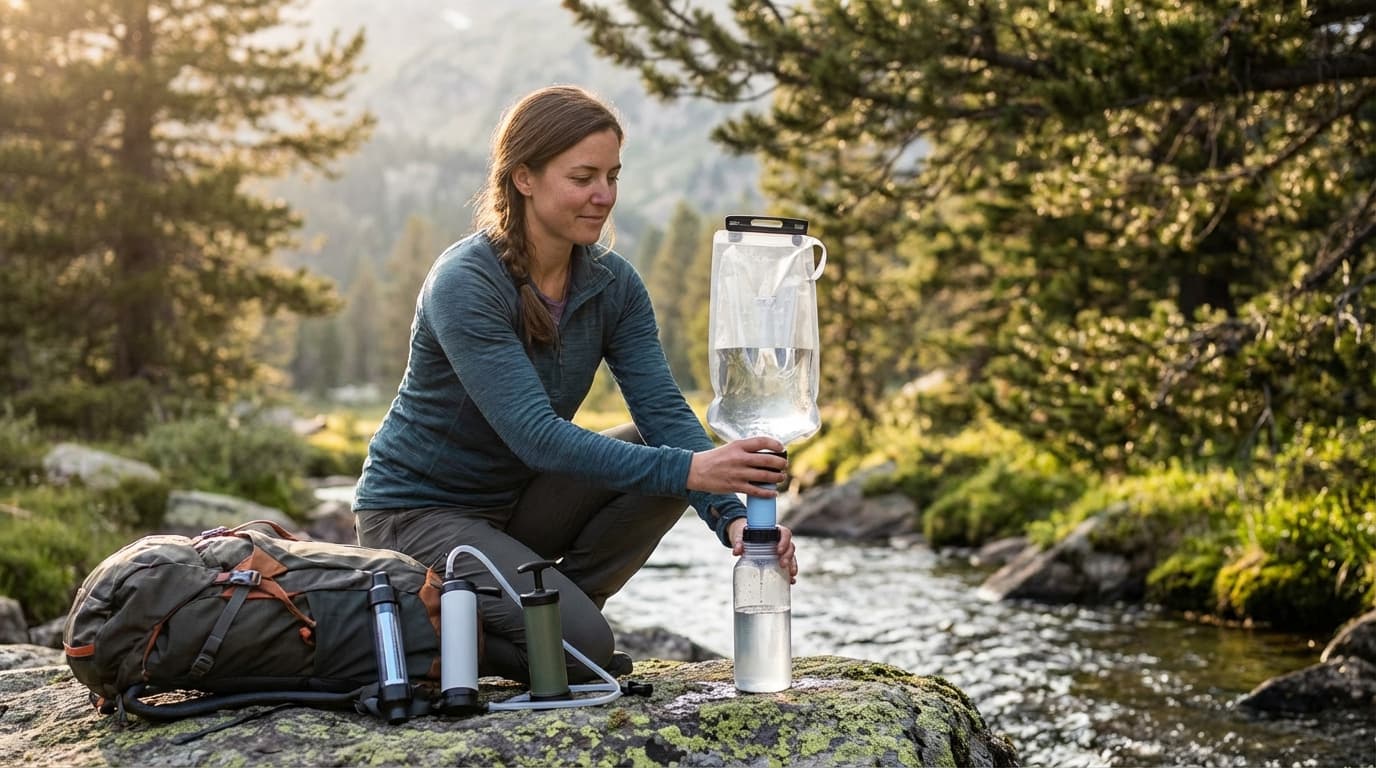
After a long day on the trail, your body is tired and your energy is low. The idea of sitting by a creek and manually pumping water for twenty minutes sounds like a nightmare. This is why gravity filters are so popular among hikers who value their downtime. You just fill a bag with water, hang it from a tree branch, and let physics do the work for you. It is a simple system that lets you focus on setting up your tent or making a meal while your water cleans itself. This hands-off approach is a huge relief when you are exhausted and just want to relax.
If you are traveling with a group, a gravity system is easily the best backpacking water filter choice. Instead of everyone struggling with their own small filters, one person can set up a large bag that provides enough water for the whole camp. It makes everything from morning coffee to cleaning up after dinner much faster. You do have to deal with a bit more weight and bulk in your pack compared to a tiny squeeze filter because of the extra bags and hoses. Still, most people find that the convenience of having several liters of water ready at once is worth the extra few ounces in their pack.
Our gravity water filter review found that speed is one of the most important factors to consider, but it is not always consistent. Manufacturers often claim their filters can process a liter in a minute, but real-world results are usually a bit slower. During our tests, we found that the height of the bag makes a big difference. The higher you hang the dirty water bag, the more pressure is created, which forces the water through the filter much faster. We also noticed that the type of water matters just as much as the gear. If you are pulling from a clear alpine lake, the filter stays fast for days, but silty river water will slow it down almost immediately.
Maintenance is another area where these filters can be tricky for the average hiker. Many people skip the cleaning process because it feels like an extra chore at the end of the day. To keep the flow rate high, you need to backflush the filter by pushing clean water back through it. This clears out the sediment and minerals that naturally build up in the tiny pores. Think of it this way: the filter is like a screen that catches everything you do not want to drink. Eventually, that screen gets full and the water cannot get through. We recommend backflushing at least once a day to ensure you are not stuck waiting an hour for a single liter of water the next morning.
Key insights:
Gravity filters save your energy by doing the work while you rest at camp.
They are the most efficient option for groups who need large volumes of water for cooking and drinking.
Hanging the bag higher creates more pressure and significantly speeds up the filtration process.
Regular backflushing is the only way to prevent the system from slowing down to a drip over time.
Our Honest Gravity Water Filter Review
Imagine you just finished a ten-mile climb with a heavy pack. Your legs are shaky, your throat is dry, and the last thing you want to do is squat by a muddy creek pumping a manual handle for twenty minutes. This is why gravity systems are so popular. They promise to do the heavy lifting while you set up your tent or finally take off your boots. But do they actually deliver when you are tired and thirsty?
We ran some speed tests to see how fast these things actually flow in the wild. While the packaging often promises a liter per minute, the trail tells a different story. With clear mountain water, they are impressively fast. But add a little silt or organic gunk, and that flow rate drops quickly. In our experience, you can expect a three-liter bag to finish in about five to seven minutes. It is not instant, but it is hands-free, which is the real win here.
The real deal-breaker is the cleaning process, which most hikers conveniently skip. To keep that flow moving, you have to backflush the filter regularly. It feels like a chore when you are exhausted, but ignoring it is exactly how a great filter turns into a slow, frustrating drip. Think of it as basic gear insurance. If you take thirty seconds to flush it out after a murky fill, it stays reliable for the whole trek.
What does this mean for you? If you are a solo hiker who moves fast and light, a squeeze filter might be a better fit. But for groups or long-distance hikers who value their downtime at camp, a gravity setup is hard to beat. Just remember that a little maintenance goes a long way in keeping your water flowing fast.
Key insights:
Flow rates vary wildly based on water clarity, not just the filter's rating.
Backflushing is the single most important habit for maintaining a gravity system.
The primary benefit of gravity filters is the hands-free operation during camp setup.
Portable Filters for the Fast and Light Hiker
When you are trying to crush twenty miles before sunset, every ounce in your pack starts to feel like a brick. You definitely do not want a heavy pump filter that takes ten minutes to set up. This is where squeeze filters and straw designs save the day for the fast-and-light crowd. Squeeze filters usually involve a soft bottle you fill and then push through a filter, while straws are even simpler - you just lean down and drink. Both are light, but they handle the trail differently.
Most trail runners prefer squeeze filters because they give you options. You can fill a bag, screw on the filter, and keep moving while you hydrate. It beats lying face-down in the dirt with a straw. These designs also let you fill up your main bottles for the long stretches between streams. Being able to drink directly from the source without waiting for tablets to dissolve makes a huge difference when you are trying to maintain your pace. It turns a ten-minute chore into a sixty-second pit stop.
However, these lightweight tools have a major weakness: they are surprisingly fragile. If you drop a hollow fiber filter onto a sharp rock, you might create tiny internal cracks you cannot even see. Suddenly, you are drinking contaminated water without a clue. Then there is the freezing trap. If water stays inside the filter and freezes overnight, the ice expands and breaks the membrane. If it freezes once, it is effectively broken. You actually have to sleep with your filter in your sleeping bag on cold nights to keep it functional. It is a bit of a hassle, but it is the only way to make sure your gear still works the next morning.
Key insights:
Squeeze filters allow you to carry water for later, while straws generally require drinking directly at the source.
A single drop onto a hard surface can compromise the internal membrane without showing any outward signs of damage.
Always store your filter in a pocket close to your body or inside your sleeping bag if temperatures might dip below freezing.
The Durability Test
Imagine you’re miles into the woods and your filter slips, hitting a jagged rock with a dull thud. Even if the outer shell looks fine, the danger is hidden. Those tiny hollow fibers are fragile, and a single microscopic crack lets bacteria swim right into your drinking water. You can't see this damage, which makes a simple drop a serious safety risk.
Watch out for the silent gear killer: freezing temperatures. If water stays inside the filter during a cold night, it expands and snaps the internal membranes. This turns your tool into a useless straw. If you suspect it froze, try blowing air through the outlet. If it flows easily, the seal is broken. Keep your filter in your sleeping bag to stay safe.
Key insights:
Invisible internal cracks can compromise filtration after a fall.
Freezing water physically ruptures the filtration membranes.
Keep filters in your sleeping bag to prevent ice damage.
Survival Gear: Stuff You Hope You Never Use
You’re miles from the trailhead, your main filter just cracked after a freezing night, and the sun is starting to dip. This is where your backup plan saves the day. Survival water gear isn't about what you use every day; it’s about having a plan B that works when your fancy gear fails. Think of it as the spare tire for your hydration. You hope you never have to pull it out of your pack, but you’ll be glad it’s there when the alternative is drinking from a sketchy puddle. This changes everything.
Chemical tablets are the go-to backup for a reason. They’re tiny, cheap, and they don't have moving parts that can break or freeze. Sure, they might make your mountain water taste a bit like a public swimming pool, but they kill the tiny bugs that a standard filter might miss. Then there are the emergency straws. These are great for a quick fix, but let's be real: nobody wants to lay on their stomach to drink from a creek for three days straight. A full-service pump or a gravity bag is way better for camp life, but keeping tablets in your first aid kit gives you that extra layer of security.
So, how do you build a system that won't quit? It’s all about redundancy. You might love your gravity filter for easy chores, but try tucking a few Chlorine Dioxide tabs into your hip belt pocket just in case. If your main filter freezes overnight or gets dropped on a sharp rock, you aren't stuck. It’s not about being paranoid; it’s just about being smart. This way, a small gear hiccup stays a minor annoyance instead of turning into a full-blown emergency. It is always better to carry a few extra grams than to spend your hike worrying about every sip.
Key insights:
Chemical tablets serve as a weightless, fail-proof secondary purification method.
Emergency straws are excellent for survival but impractical for long-term camp use.
A fail-safe system relies on redundancy, combining mechanical filters with chemical backups.
3 Mistakes Most Hikers Make with Their Water Setup
You have finally reached that perfect alpine lake after a six-mile climb. You are parched, you pull out your gear, and nothing happens. The water barely drips through the nozzle. This is the moment most hikers realize they have neglected the one piece of gear their safety depends on. It is easy to blame the equipment, but usually, the breakdown happens because of a few common habits we all pick up on the trail.
The biggest culprit is often the forgotten backflush. We tend to treat a portable water filter like a kitchen faucet - something that just works until it does not. But every liter of silty stream water you push through that membrane leaves behind microscopic debris. If you wait until the flow slows to a crawl before cleaning it, you have waited too long. Think of it like changing the oil in your car. You do it to prevent a stall, not because the engine already stopped. A quick rinse at home or a field backflush after a muddy source keeps the fibers open and your frustration low.
Then there is the dirty hand problem. It sounds simple, but cross-contamination is how most people actually get sick. You spend ten minutes submerged in a murky pond filling your dirty bag, get your hands soaked in raw water, and then immediately use those same hands to screw on the clean cap or hold your water bottle. It only takes one stray drop of bad water to ruin your week. Keeping a strict clean hand, dirty hand policy is just as important as the filter itself. Also, make sure your dirty bags and clean bottles never touch in your pack.
Finally, many of us fall into the trap of buying gear because a thru-hiker on a screen swore by it. A lightweight squeeze filter is amazing for a solo trek, but it might be a nightmare if you are trying to hydrate a group of four in the desert. Or maybe you bought a gravity water filter because of a review, but your destination has no trees to hang it from. Your destination should dictate your gear, not an algorithm. Check if you will be dealing with clear mountain runoff or silty cow ponds before you pack.
What does this mean for your next trip? It means checking your flow rate at home, practicing your clean hand technique, and matching your tech to the actual terrain. Staying hydrated should not be a struggle. When you respect the process, you spend less time hovering over a filter and more time actually enjoying the view. It is about working with your gear instead of against it.
Key insights:
Clean your filter frequently to prevent permanent clogs from sediment.
Maintain a strict separation between hands that touch raw water and hands that touch clean gear.
Research your water sources to choose between a squeeze, gravity, or UV system.
Making the Right Choice for Your Next Trip
Picking the right gear isn't just about what's on sale. It's about where you're going. Are you dipping your bottle into crystal-clear mountain springs or scooping from a muddy puddle in the desert? A portable water filter for hiking works wonders in clear water, but silty sources will choke it fast. Think about your group size too. If you're solo, a lightweight squeeze filter is perfect. But for a group, a gravity water filter review will tell you that hanging a bag and letting physics do the work saves everyone’s forearms from a workout.
Then there's the stuff nobody likes to talk about: the chores. Every filter has a lifespan, and some are much shorter than others. You have to consider the reality of maintenance and how much you're willing to do in the field. If you hate backflushing your gear every night at camp, you might want to spend more upfront for a system with a higher flow rate. Survival water purification gear often looks rugged, but if the replacement filters cost as much as a new unit, it is a bad investment in the long run.
So, what is the best all-rounder for most people? While a UV water purifier vs filter debate usually comes down to speed versus sediment, most of us need something that handles both. A high-quality hollow-fiber squeeze filter remains the gold standard for most trips. It is light, relatively cheap, and keeps you safe without the bulk. Just remember to keep it from freezing at night, or you will be looking for a replacement much sooner than you planned.
Key insights:
Match your filter style to the clarity of your expected water source to avoid clogs.
Calculate the long-term cost by checking the price and lifespan of replacement cartridges.
Squeeze filters offer the best balance of weight and reliability for most solo backpackers.
Frequently Asked Questions
Honestly, yes. Clear water is a bit of a trap because the stuff that actually makes you sick is way too small to see. We are talking about tiny bugs like Giardia that do not care how sparkly or cold the stream looks.
Think of it like this: even the most beautiful mountain spring could have a dead animal or some runoff just around the bend. It only takes one bad sip to ruin your entire trip, so it is best to just use your filter every single time and stay safe.
Most of the standard filters you see on the trail will not touch chemicals or metals. They are mainly built to stop bacteria and tiny parasites. If you are worried about pesticides or lead, you usually need a filter that has an extra layer of activated carbon or a specific purifier.
Here is the thing: if you are hiking deep in the woods, you probably do not need to worry about heavy metals. But if you are filtering water near old mines or farm fields, you should check if your gear is rated for it because most basic filters are not designed for that job.
It really depends on where you are getting your water, but a good rule of thumb is to backflush it every time you notice the flow slowing down. If you are filtering clear mountain stream water, you might only need to do it every few days. But if you are dealing with silty lake water, you will probably find yourself cleaning it once or twice a day to keep things moving.
Here is the thing: do not wait until the water is barely dripping to act. A quick five-second backflush every morning keeps the membrane happy and saves you from standing around for twenty minutes waiting for your dinner water to filter. It is much easier to maintain a clean filter than it is to scrub a totally clogged one.
The short answer is no, not effectively. UV purifiers rely on light reaching every single microbe to neutralize it. When the water is muddy or cloudy, those tiny bits of dirt and sediment act like shields, giving bacteria and viruses a place to hide from the rays.
If you are stuck with murky water, you will want to pre-filter it through a bandana or a coffee filter first to get the big stuff out. Even then, if the water looks like chocolate milk, a UV light just is not the right tool for the job. In those cases, a physical squeeze or gravity filter is a much safer bet because it actually removes the gunk instead of just trying to shine a light through it.
Conclusion
Picking the best backpacking water filter is less about finding a perfect gadget and more about knowing your specific trail. Whether you love the hands-off ease of a gravity water filter or prefer a portable water filter for hiking fast, the goal is staying hydrated without the risk of a ruined trip. When weighing a UV water purifier vs filter, the right choice usually comes down to the water sources you expect to find and how much effort you want to spend at the shoreline.
It is easy to get caught up in technical specs, but the most reliable gear is the stuff you actually know how to maintain. Even the best survival water purification gear can fail if it freezes overnight or gets clogged with silt. The real shift in thinking happens when you stop seeing your filter as a magic wand and start treating it like a piece of essential equipment that needs a little care and attention before every hike.
Before your next big adventure, give your setup a quick test run in the kitchen sink. It is much better to find a slow flow or a dead battery now than when you are miles from the trailhead. Check your gear, pack a backup, and get back out there with the confidence that your water is truly safe to drink. Happy trails.
Every WilderReady guide is researched, written, and fact-checked in-house against trusted references such as the American Red Cross, the National Park Service, and the CDC before it goes live. We publish under this shared byline instead of invented personas, so you always know who stands behind the guidance you are reading.