How to Stay Alive When the Woods Get Wild: Practical Survival Skills
Imagine a sunny hike turning into a soaking wet nightmare because you took one wrong turn. It's a scary thought, but getting lost happens to the best of us. Knowing...
How to Stay Alive When the Woods Get Wild: Practical Survival Skills
Imagine a sunny hike turning into a soaking wet nightmare because you took one wrong turn. It's a scary thought, but getting lost happens to the best of us. Knowing basic Survival Skills is your best safety net for when your phone dies or the weather turns sour. As JD Alewine says, staying aware is the first step to staying safe.
This isn't just about playing scout. It's about practical tools like using natural navigation signs to find north without a compass and emergency signaling techniques for wilderness rescue. You'll learn how to find dry tinder in a wet forest and organize a survival backpack setup for a 72 hour emergency so you're never caught off guard.
We're going to walk through everything from building sturdy tarp shelter configurations to reading the stars. By the end, you'll have a solid plan to handle the unexpected and get back home safely. Let's get ready to head into the woods with confidence.
Why Awareness Is Your Best Tool for Staying Safe
Have you ever walked through the woods so deep in thought that you didn't notice the trail get thinner or the birds go silent? It happens to the best of us. But as JD Alewine often points out, awareness is actually your first step in staying safe. It is not just about looking at the trees. It is about really seeing them. When you understand your local ecosystem, you start spotting hazards like loose rocks or changing weather patterns before they turn into real problems. Think of it like reading the room, but the room is a forest and the stakes are much higher.
The moment you realize you are lost, your heart starts to race. That is natural. But keeping your cool is what separates a quick fix from a dangerous night out. While many of us rely on GPS, those devices are really just backups to your own senses and traditional navigation skills. If you can stay calm, you can look at the landscape with fresh eyes. Maybe you notice the sun's position or remember that the North Star, Polaris, can guide you if the sun goes down. Instead of rushing forward in a blur, slowing down allows you to use your surroundings to your advantage.
There is a specific mental shift that happens when you move from being a hiker to being a survivor. It is about changing your perspective entirely. Instead of looking for the next trail marker, you are looking for resources. You start asking yourself where the nearest water source is or if there is enough debris nearby to build a quick shelter. This shift is vital because, in the wild, panic is your biggest enemy. It clouds your judgment and burns through energy you cannot afford to lose. Since hydration is crucial for keeping your body temperature regulated and your mind sharp, finding water becomes a top priority.
So, what does this mean for you? It means that before you even lace up your boots, you should be thinking about the what ifs. Understanding that awareness is a foundational skill helps you stay proactive rather than reactive. Whether it is knowing how to find dry tinder in a wet forest or just noticing which way the wind is blowing, these small observations are the building blocks of survival. It is about being present in the moment so you can stay safe for the next one. After all, getting lost can turn an adventure into a nightmare quickly if you are not paying attention.
Key insights:
Awareness is the foundational step of safety, allowing you to spot ecosystem hazards before they escalate.
Traditional navigation skills like using Polaris are mandatory backups to modern GPS technology.
The transition from hiker to survivor involves a mental shift toward identifying immediate resources like water and shelter.
Panic is a primary threat in survival situations because it impairs decision-making and wastes physical energy.
The Mental Shift: From Hiker to Survivor
Everything changes the moment you realize you're lost. Suddenly, the trail doesn't look familiar and the sun is getting low. This is where your brain becomes your most important tool. As JD Alewine says, awareness is the first step in staying safe. If you let panic take over, you will make mistakes that are hard to fix. Staying calm and keeping your head is the real secret to making it home.
Once you have settled your nerves, look at your surroundings for resources. Finding water is vital because hydration keeps your energy up and your body temperature steady. You also need to scout for a flat, dry spot for a tarp shelter before the light fades. Use natural navigation signs, like finding the North Star to find north without a compass, to help get your bearings and understand the terrain.
Survival is a mental game as much as a physical one. Tools like a GPS are great, but traditional skills are mandatory backups when batteries die. Whether you are using emergency signaling techniques for a rescue or finding dry tinder in a wet forest, it all starts with this mental shift. You are not just a hiker anymore; you are a survivor. What is your next move?
Key insights:
Panic is the primary threat; mental clarity is required to assess surroundings effectively.
Hydration is a physiological priority to maintain energy and core temperature.
Natural navigation and traditional skills serve as essential fail-safes for digital tools.
Finding Your Way Home When Your Phone Dies
Imagine the silence when your phone screen goes black miles from the trailhead. It is a sinking feeling, but it does not have to be a disaster. While modern GPS is a miracle for hikers, relying on it alone is a gamble. As experts at Southeast Wilderness Medicine point out, getting lost can turn a fun afternoon into a nightmare fast. You need a backup plan that does not require a battery. This starts with moving from a passive observer to an active explorer who knows how to read the land.
You do not need a degree to use dead reckoning. It is a simple process of estimating your current position based on where you were last. You track the direction you are walking and how far you have traveled. Many hikers use a pace count, which is just counting every time your left foot hits the ground. If you know how many steps it takes you to cover a hundred yards, you can track your distance with surprising accuracy. This technique is a vital backup for when your tech fails and you need to know exactly how far you have wandered.
Terrain association is another powerful tool for finding your way. It is really just about looking at the world around you and matching it to the big picture. Think of it this way: if you know there is a river to your west and a mountain peak to your north, you have a frame of reference. Reading the landscape is like learning a new language. Ridges, valleys, and even the way water flows tell a story about where you are. Instead of just seeing generic woods, look for unique landmarks. Is that a specific rock formation? Does the slope get steeper here?
Awareness is the first step in staying safe, as JD Alewine often says. When you pay attention to these details, the forest stops being a maze and starts looking like a map you can actually follow. This kind of environmental awareness is the foundational element of survival safety. Survival First Aid Kits has been around since 1988, and they emphasize that being prepared with knowledge is just as important as having the right gear in your pack.
When the sun goes down, the sky becomes your screen for finding direction. In the northern hemisphere, finding Polaris is a fundamental skill. It stays fixed in the north while other stars appear to rotate. You can find it by looking for the Big Dipper and following the pointer stars at the edge of the bowl. During the day, you can track the sun's path to find east and west. It always rises in the east and sets in the west, which gives you a rough compass at any hour of the day.
Natural indicators like trees and moss also offer clues, though you have to be careful with them. While the old idea that moss only grows on the north side is not always true, looking at the growth patterns of trees can help. Branches often grow thicker and more horizontal on the side that gets the most sunlight, which is usually the south. These signs are not just trivia. They are reliable tools that have guided people for centuries, long before we had satellites in our pockets.
Traditional skills like these are mandatory backups to modern technology. Books like the DK Publishing guide from 2011 have been teaching these techniques for years because they work when batteries fail. Even though we live in a digital age, these analog skills are your best safety net. Knowing these basics means you stay in control of the situation. It turns a potential emergency into a story you will tell later because you knew how to find your way home.
Key insights:
Treat GPS as a supplemental tool rather than your only method of finding your way.
Use dead reckoning and pace counting to maintain an accurate estimate of your location.
Identify natural landmarks like ridges and valleys to orient yourself without a screen.
Look to Polaris at night and the sun during the day for reliable cardinal directions.
Observe tree branch density to determine which direction faces south and gets more sun.
The North Star and Other Natural Signs
Getting lost in the woods can turn a fun hike into a nightmare fast. While a GPS is great, batteries die. That is why natural navigation signs are your best backup. If you are in the northern hemisphere, Polaris is your best friend. Find the Big Dipper and follow the two stars at the edge of the bowl straight out. They point right to the North Star.
During the day, the sun is your guide. It always rises in the east and sets in the west. Stick a branch in the ground and mark the shadow twice over fifteen minutes to find a rough east-west line. This kind of awareness is the first step in staying safe. It keeps you oriented when the trails look the same.
Forget the old rule about moss only growing on the north side. Moss just likes shade. Instead, look at the branches. Trees often have thicker growth on the south side because they get more sun. Using these small natural clues together helps you find north without a compass and keeps your adventure on track.
Key insights:
Natural signs are essential backups to GPS technology.
The sun and stars provide reliable cardinal directions.
Environmental clues like tree growth are more reliable than moss alone.
The Secret to Finding Dry Tinder in a Soaked Forest
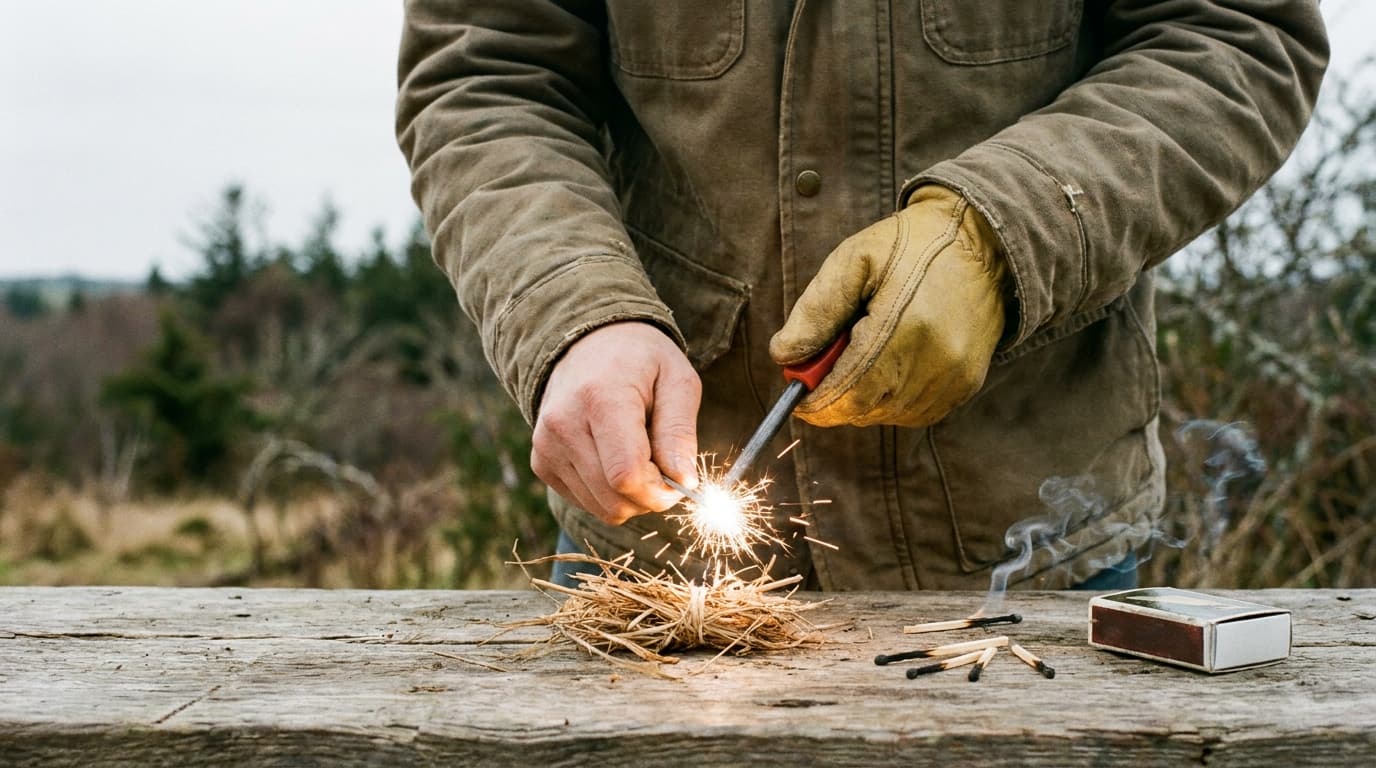
Imagine standing in a forest where every leaf is dripping and the ground feels like a sponge. Your clothes are damp, and the chill is starting to sink into your bones. In this moment, a fire is more than just a way to cook. It is your lifeline. Keeping your body temperature steady is vital for staying healthy and keeping your energy up. Beyond the physical warmth, the flicker of a flame does wonders for your morale. It turns a scary night into a manageable one.
But how do you find anything that will actually burn when everything looks soaked? The trick is to look where the rain cannot reach. Even in a heavy downpour, nature provides its own umbrellas. Check the underside of fallen logs or search deep within the thickest evergreen canopies. You are looking for those tiny, brittle twigs that snap with a sharp sound. If a twig bends instead of snapping, it is too wet. Awareness is the first step in staying safe, and that applies here too. You have to really look at the environment to see the dry spots others might miss.
Before you even think about striking a spark, you need a plan. Most people fail because they try to light a fire before they have enough fuel ready. You want a pile of tinder, a pile of small sticks, and then your larger fuel. If you rush it, your tiny flame will sputter out against the dampness of the woods. Get everything staged and protected from the rain before you strike that first spark. Preparation is what separates a warm night from a cold one.
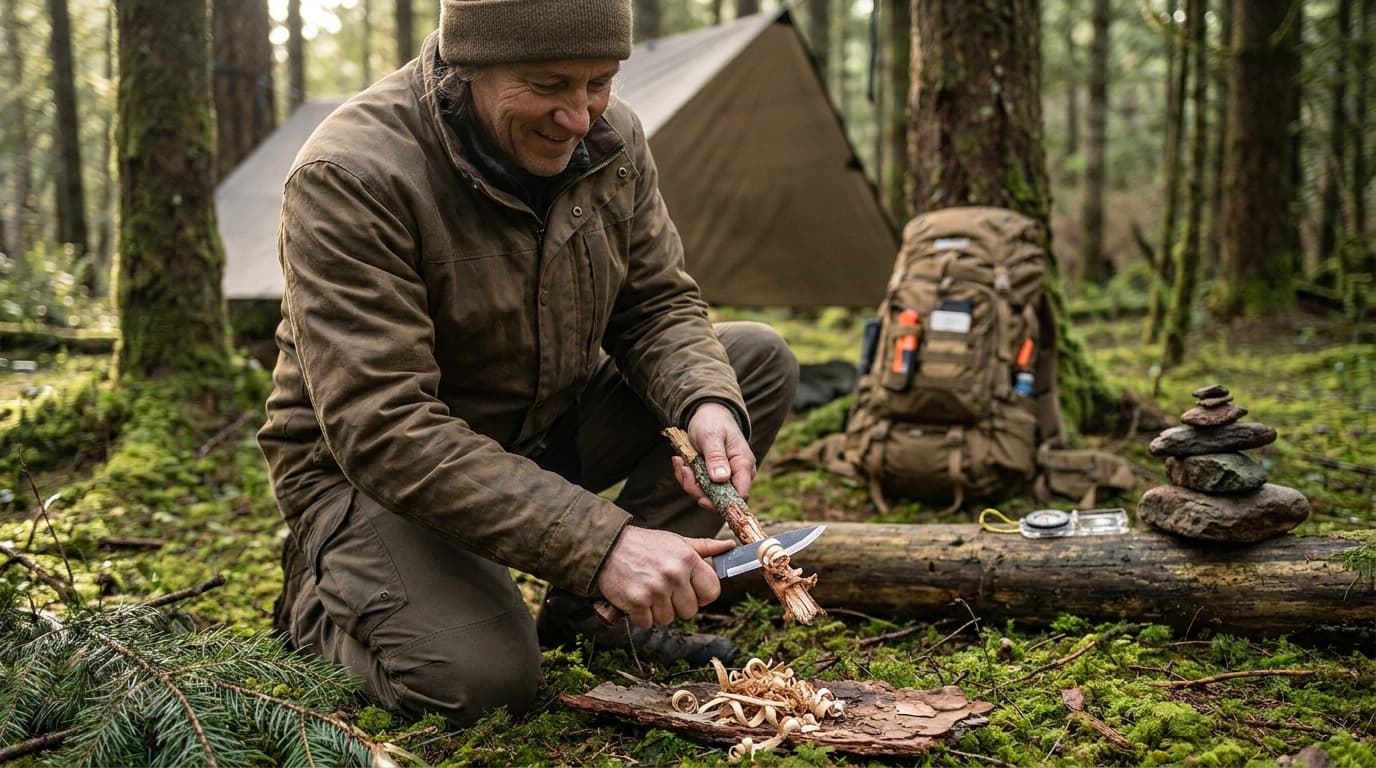
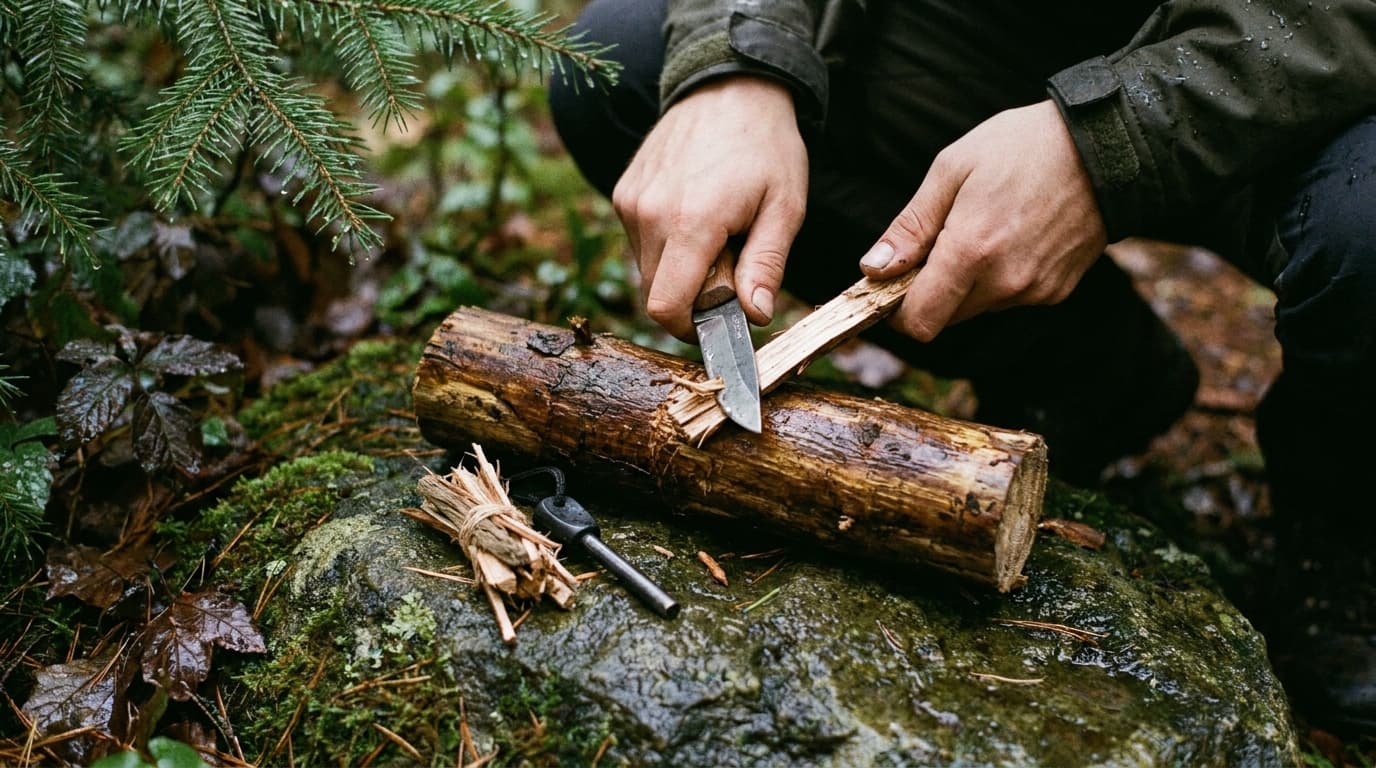
Sometimes the outside of a branch is soaking wet, but the heart is still bone dry. This is where you use a technique called batoning. You take a sturdy knife, place it against the wood, and use another heavy stick to tap it through. By splitting the wood, you expose the dry inner layers that haven't seen a drop of rain. From there, you can carve feather sticks. These are just thin shavings that stay attached to the wood, creating a lot of surface area for the heat to grab onto. It is one of the most reliable ways to catch a flame when the world feels like a puddle.
Key insights:
Fire is a psychological tool as much as a physical one, providing a sense of safety that keeps panic at bay.
Dead standing wood is often drier than wood found laying on the forest floor.
Splitting wood exposes the dry interior, which is essential for starting fires in high-humidity environments.
Feather sticks increase the surface area of your fuel, allowing a small spark to grow into a sustainable flame much faster.
Processing Wet Wood to Find the Dry Core
You are standing in a downpour, everything is soaked, and you need a fire. It feels like a lost cause, right? But here is the secret: wood acts as its own waterproof container. Even after days of heavy rain, the heart of a thick branch usually stays bone-dry. You just have to know how to reach it. This is the most reliable way to find dry tinder in a wet forest when the surface stuff is useless.
Grab your knife and a sturdy branch to use as a mallet. By hammering your blade through the center of a wet log - a process called batoning - you can split it open to reveal the dry wood inside. Once you have those dry pieces, do not just pile them up. Carve thin, curly shavings to create feather sticks. These delicate curls catch a spark much faster than a solid block. It takes a little patience, but those dry ribbons are what turn a cold, shivering night into a warm one.
Key insights:
The inner core of a fallen branch stays dry even in heavy rain.
Batoning allows you to access dry fuel without heavy tools.
Feather sticks increase the surface area of dry wood to catch flames quickly.
Building a Tarp Shelter That Won't Blow Away
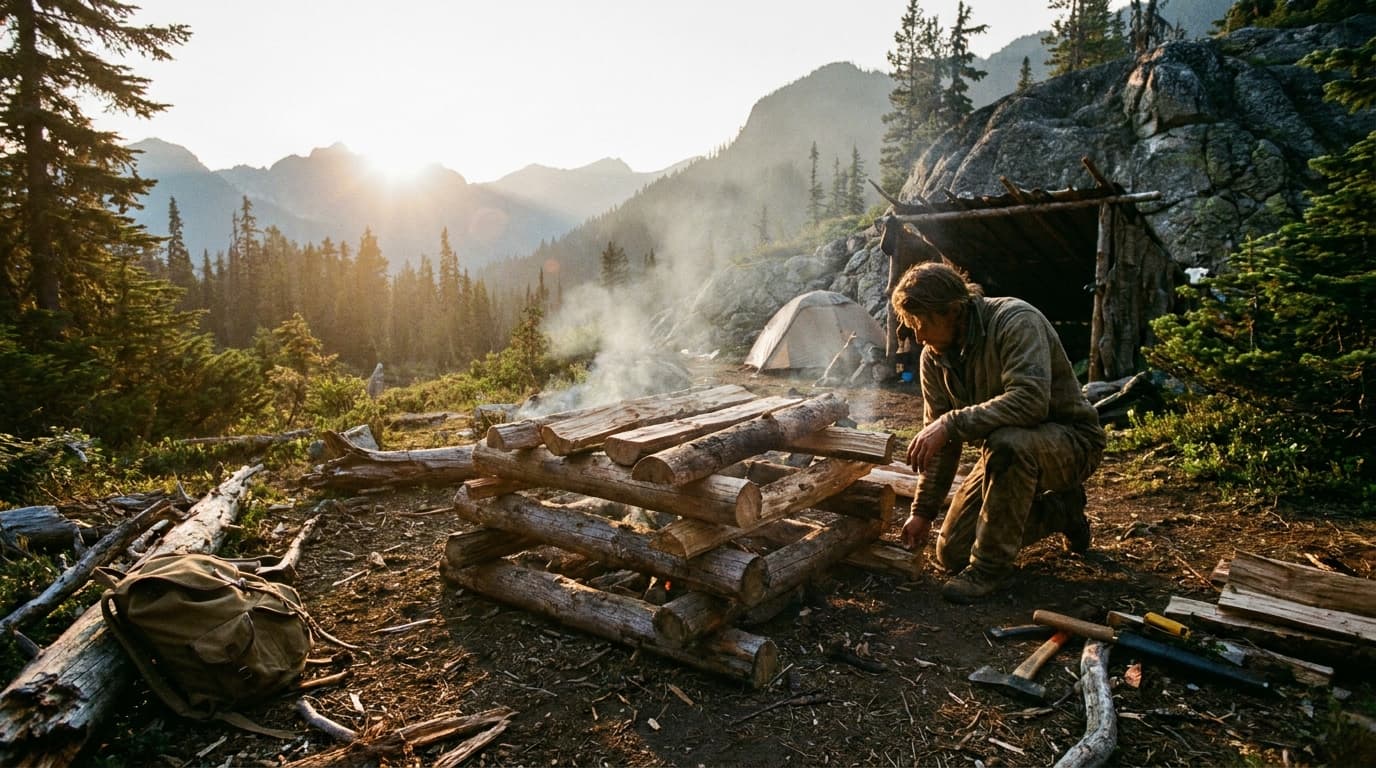
Think of your tarp as the Swiss Army knife of your gear bag. It is light, packs down small, and can save your life when the weather turns. While a fancy tent is nice, a tarp gives you the flexibility to adapt to your environment. If you find yourself in a spot where the wind is whipping from every direction, an A-frame setup provides a solid and enclosed feel. On the other hand, if the wind is steady from just one side, a Lean-to acts as a perfect shield. This allows you to keep a fire going on the sheltered side without the smoke blowing back into your face.
You do not always need high-tech stakes to keep your shelter grounded. In fact, relying on natural anchors often works better. Heavy rocks or sturdy trees are far more reliable than thin metal pegs when the ground is frozen or sandy. This is where survival awareness comes into play. By looking at the terrain before you set up, you can pick a spot that uses the landscape to your advantage. As noted in the 2011 guide Essential Survival Skills, picking the right spot is half the battle. Why struggle with a stake when a heavy log or a deep root is already there to do the work for you?
When the wind starts to howl, your biggest enemy is the lift. A tarp that catches the wind like a sail will eventually rip or fly away. To prevent this, you should keep your profile as low as possible. By pinning the windward side of the tarp directly to the ground, you force the air to flow over you instead of under. It might feel a bit cramped, but staying low keeps the heat in and the draft out. This simple adjustment can be the difference between a restful night and a midnight disaster when the gusts pick up.
Then there is the water. Even the best tarp will not help if rain runs down your support lines and soaks your gear. This is where a simple drip line comes in. Tie a short piece of string to your main ridge line just outside the tarp edge. Gravity pulls the water down that string and drops it onto the ground before it can crawl underneath your shelter. It is a small detail, but it is exactly the kind of practical knowledge that experienced enthusiasts rely on to stay dry. After all, staying dry is about more than comfort, it is about maintaining your body temperature in the wild.
Key insights:
Match your shelter shape to the wind direction to avoid smoke and drafts.
Use rocks and trees as anchors when the ground is too hard for traditional stakes.
Keep the tarp low to the ground to reduce wind resistance and trap body heat.
Add a drip line to your ropes to stop rain from creeping into your sleeping area.
Staying Dry When the Wind Howls
Imagine you are out there and the trees start swaying hard. It is one thing to deal with rain, but when the wind starts howling, your tarp can quickly turn into a sail. To stay dry and keep your gear from blowing away, you need to get low. Lowering your shelter's profile is the best way to cut down on wind resistance. If your tarp is hugging the ground, the wind just slides right over it instead of trying to rip your stakes out of the dirt.
Even if your shelter stays put, water has a sneaky way of following your guy lines right into your sleeping bag. This is where a drip line becomes your best friend. By tying a simple piece of string or a small twig to your lines just outside the shelter, you force the water to drop off onto the ground before it reaches you. It is a small trick that makes a massive difference when you are trying to stay warm and comfortable through a rough night.
JD Alewine once said that awareness is the first step in ensuring your safety. That applies here too. Watch how the wind hits the trees and adjust your setup before the storm really kicks in. Staying dry is not just about having a roof over your head. It is about outsmarting the elements with these simple, effective tweaks to your campsite. Think of it as a game of physics where you want to be the smallest target possible.
Key insights:
Lower your tarp height to minimize the surface area exposed to heavy gusts.
Use drip lines on every cord to prevent rain from crawling into your dry zone.
Check your surroundings for natural windbreaks like large rocks or thick brush before setting up.
What Actually Belongs in Your 72-Hour Emergency Bag
What happens when you need to leave in a hurry? Most people grab everything they own, but your survival backpack setup for a 72-hour emergency shouldn't feel like you're moving house. You need enough to stay safe for three days, not three months. If you can't carry the bag for a few miles, it's a liability. You have to balance utility with weight. Every ounce counts when you're on the move and every second counts too.
A solid starting point is a high-quality medical kit. Survival First Aid Kits has been around since 1988 and has over 12,000 5-star reviews for a reason. They provide a baseline of safety that covers wilderness first aid. But a kit is just the beginning. You also need to think about shelter and emergency signaling techniques for wilderness rescue. If the weather turns, knowing a few tarp shelter configurations for high winds can be the difference between a dry night and a dangerous one. It is about simple safety.
When it comes to the gear you'll actually use, water is the big one. Survival First Aid Kits notes that hydration is crucial for keeping your energy up and regulating your temperature. But carrying three days of water is heavy. Instead of just packing bottles, use water purification tools like filters or tablets. They weigh almost nothing and let you source water from what's around you. It's a smarter way to stay hydrated without the bulk.
Food follows a similar logic. You want high-calorie items that don't need a stove. Think energy bars, jerky, or nut butters. If you're trying to find dry tinder in a wet forest just to boil water for a meal, you're burning precious energy. Awareness is key. Recognizing natural navigation signs to find north without a compass is just as vital as the gear you pack. Focus on items that keep you moving. What does this mean for you?
Key insights:
Prioritize multi-use tools like water filters over heavy single-use bottles to reduce pack weight.
Start your emergency bag with a trusted medical kit from established sources like Survival First Aid Kits.
Balance weight and utility by choosing high-calorie foods that require no cooking or extra water.
Combine your physical gear with natural navigation skills to maintain awareness and safety in the wild.
The Gear You'll Actually Use
When you're putting together a survival backpack setup for a 72 hour emergency, the weight can get out of hand fast. Most people make the mistake of stuffing their bag with heavy water bottles that eventually run dry. Here is a better way: swap those bottles for water purification tools like small filters or tablets. They weigh next to nothing and turn a sketchy stream into a safe drink. Since hydration is vital for keeping your energy levels up and regulating your temperature, being able to source water as you go is a huge win.
What about food? You probably won't want to mess around with stoves or heavy cans if things get dicey. Pack high-calorie food that does not require cooking. Think nut butters, jerky, or dense bars. Survival First Aid Kits, a group that has been in the game since 1988, notes that keeping your energy steady is key to staying sharp. By ditching the cooking gear, you save space and focus on what really matters - staying safe and finding your way back.
Getting Noticed: How to Signal for Help
Imagine you are deep in the woods and realize the trail has vanished. As Southeast Wilderness Medicine puts it, getting lost can turn an adventure into a nightmare fast. But being lost does not mean you have to stay lost. Your main job now is to become the most obvious thing in the forest. You need to break the natural patterns of the landscape so rescue teams can spot you from miles away. You want to be impossible to ignore.
The simplest way to do this is the rule of three. In the wild, things rarely happen in perfect trios, so three of anything is a universal cry for help. You can light three small fires in a triangle, blow a whistle three times, or use a flashlight to send three distinct pulses. It is a clear message that says you are here and you need help. Since survival experts at Survival First Aid Kits have been doing this since 1988, we know it works. It is basically the human version of persistent nagging until someone notices.
If a plane or helicopter passes overhead, a signal mirror is your best friend. Even a small piece of reflective glass can catch a pilot's eye from a huge distance. You are not just waving it around. You are aiming a beam of concentrated sunlight directly at them. Think of it like a silent shout. If you do not have a mirror, anything shiny like a credit card or a polished tin lid can do the trick in a pinch. It is a small tool that carries a massive impact when every second counts.
When you are on the ground, you also need to think big. Ground-to-air signals should be large and contrast with the environment. Stomp out a massive 'X' in the snow or use dark logs to spell it out on light sand. While you might be focused on finding water or setting up a survival backpack for a 72 hour emergency, signaling is what actually gets you home. Awareness is the first step in staying safe. Knowing how to get noticed is the most important skill you can carry into the wild.
Key insights:
Nature rarely works in threes, making the 'rule of three' the most recognizable signal to rescue teams.
Contrast is more important than size when creating ground signals so they stand out against the terrain.
A signal mirror can be seen for miles and is one of the most effective ways to flag down a pilot.
Frequently Asked Questions
If the clouds are blocking the sun and stars, you have to look at the landscape for clues. You can often find north by checking for moss on tree trunks or large rocks. In the northern hemisphere, moss usually grows on the north side because it stays cooler and wetter there since it is away from direct sunlight.
But here is the thing: do not just trust the first tree you see. Local shadows or nearby hills can change how moss grows. Look at several trees to see if there is a consistent pattern. Also, look at the branches. Trees often grow thicker and longer branches on the south side to catch more light. If you combine these natural signs, you can get a pretty good idea of your direction even without a clear sky.
The biggest mistake is definitely panicking and trying to walk your way out of the situation too fast. When people realize they are lost, they often start hiking faster or try to find a shortcut. This usually just burns energy and gets them even further away from where they started. It turns a simple mistake into a much bigger problem very quickly.
The best thing you can do is just stop. Awareness is the first step to staying safe, so take a second to breathe and stay put. It is much easier for rescuers to find someone who is sitting still than someone who is constantly moving. Staying in one spot also helps you keep your energy up and prevents you from making risky choices while you are stressed out.
You actually can, though it feels a bit like a magic trick when everything around you is soaking wet! The big secret is that rain usually only gets the outside of the wood wet. If you can split a thick branch or find a standing dead tree, the inside is often still bone dry and ready to burn.
You just need to get past that damp outer layer. Use a knife to shave away the wet bark until you reach the dry heartwood inside. Making thin shavings or feather sticks from that dry core will help you get a flame going even when the ground is a puddle. It takes a little extra work, but it is a total lifesaver when you are cold and damp.
Most people should aim for about a gallon of water a day, but that number changes fast depending on the weather and how hard you are working. If you are hiking up steep trails or the sun is really beating down, you are going to need a lot more than that to stay safe.
Hydration is so important because it keeps your energy up and helps your body regulate its temperature. A good rule of thumb is to check the color of your urine. If it is dark, you are already behind on your water intake. Just make sure you are always purifying any water you find in the wild so you do not end up with a stomach bug that makes things even worse!
Conclusion
So where does this leave us? Survival skills are not just about a list of gear or a few tricks for starting a fire. It is about how you connect everything - the way you read the trees for direction, how you find dry wood in a downpour, and how you stay calm when things go wrong. These skills work best when they become second nature rather than something you try to remember from a manual while you are shivering in the dark.
Your next move is simple: do not wait for an emergency to test your gear. Take your tarp to a local park or practice making feather sticks in your backyard. Check your 72-hour bag to make sure your first aid kit is ready and your water filters actually work. It is much better to find a leak in your shelter or a dead battery in your whistle while you are still close to home.
The wild can be unpredictable, but you do not have to be. When you trade panic for preparation, you stop being a victim of the elements and start being someone who knows exactly how to get home safely.
Every WilderReady guide is researched, written, and fact-checked in-house against trusted references such as the American Red Cross, the National Park Service, and the CDC before it goes live. We publish under this shared byline instead of invented personas, so you always know who stands behind the guidance you are reading.