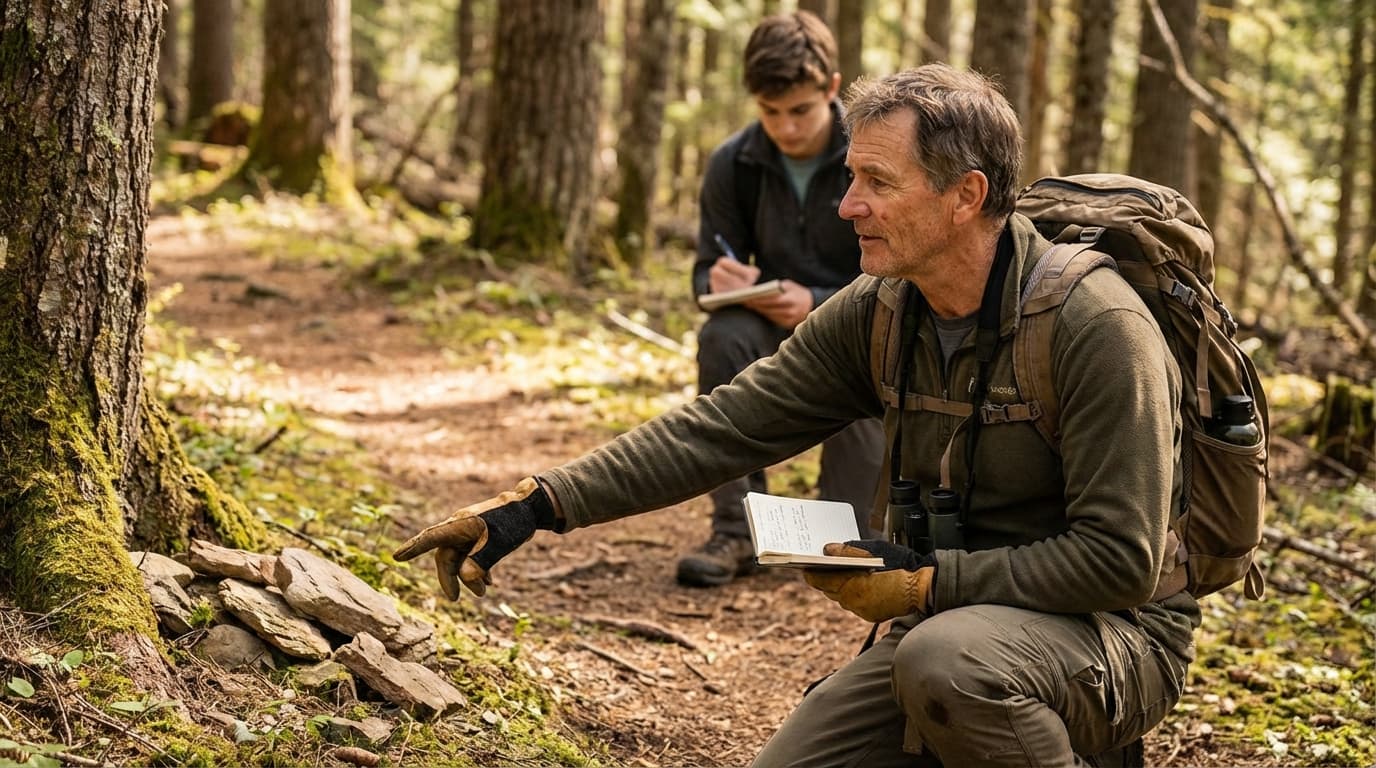
How to Spot Trouble Before It Starts: Training Your Brain for the Wild
Have you ever felt like you were being watched while hiking, only to realize your brain picked up on a sound you didn't even consciously hear? Most of us walk...
How to Spot Trouble Before It Starts: Training Your Brain for the Wild
Have you ever felt like you were being watched while hiking, only to realize your brain picked up on a sound you didn't even consciously hear? Most of us walk through nature with our eyes open but our minds closed to the small details that actually matter. Developing a strong Mindset and Preparedness isn't a gift you're born with, it's a skill you build by choice.
This article explains how to move past basic scanning and start truly seeing the world around you. We'll look at how your brain filters information and why learning to spot natural hazards early can save your life. You'll also find practical situational awareness exercises and survival observation games that make training your eyes for the wild feel like a fun challenge rather than a chore.
We're covering everything from biological hacking for stress to reading the silence of the forest. You'll learn how to stay calm under pressure and recognize when the environment shifts away from its normal baseline. It's time to turn your mind into your most reliable survival tool.
Introduction: Why Seeing the World Differently Saves Lives
Ever walk into a room and realize five minutes later you didn't even notice where the exits were? Most of us move through life just looking without actually seeing what is right in front of us. Real situational awareness isn't a superpower reserved for experts. It is a conscious choice to scan your environment for danger or opportunities while going about your normal routine.
The catch is your brain is literally wired to ignore the world. Your Reticular Activating System (RAS) acts like a filter, tossing out data it thinks you don't need to save energy. If you don't tell your brain to pay attention, it stays on autopilot. This matters because spotting a threat early depends on overriding that natural urge to tune out.
Key insights:
Situational awareness is a mental habit, not an innate gift.
The RAS filters information based on what you consciously choose to prioritize.
The Science of Noticing: How Your Brain Filters Reality
Ever wonder why you suddenly see red cars everywhere right after you think about buying one? That is your Reticular Activating System (RAS) at work. It acts like a bouncer for your brain, filtering through the thousands of sensory inputs hitting you every second. It only lets in what it thinks you care about. If you haven't told it to look for danger or specific environmental cues, it simply tosses that data in the trash to save you from overwhelm.
This is why an expert woodsman spots a camouflaged snake while a beginner just sees a pile of leaves. The expert's RAS is tuned to specific patterns and textures. Situational awareness is really just the act of scanning your surroundings to sense challenges while you're doing normal stuff. By choosing to pay attention, you're literally programming your brain's hardware to prioritize different information.
The goal is to move from looking to sensing. At first, you have to remind yourself to check the exits or watch for odd behavior. But eventually, this becomes an automatic filter. You start to notice when the baseline - the normal sound and feel of a place - gets disrupted. Think of it like a ripple in a pond; once you're trained, your brain flags those anomalies without you even having to try.
It is a conscious choice that eventually triggers a subconscious habit. When you're in tune with your environment, you can spot trouble before your body’s stress response - like that fast, involuntary breathing - even kicks in. You're essentially hacking your biology to stay one step ahead of the fight or flight response by seeing the threat before it becomes a crisis.
Key insights:
Awareness is a conscious choice that eventually triggers subconscious filtering through the RAS.
Effective situational awareness requires establishing a baseline of normal activity to detect anomalies.
Training your brain allows you to move from active scanning to intuitive sensing of environmental changes.
The Gatekeeper in Your Head
Ever notice how you see a specific car everywhere after you think about buying one? That is your Reticular Activating System, or RAS, doing its job. It acts like a gatekeeper for your brain. It filters sensory data based on what you actually care about. Since your brain cannot process every single detail at once, the RAS tosses out the background noise so you can focus.
This is why experts notice tiny details that beginners miss. A seasoned tracker sees a snapped twig as a warning, but a hiker sees just a stick. Awareness starts as a conscious choice. Eventually, your RAS learns these priorities and starts switching filters on and off automatically. By choosing to look for hazards, you train your brain to spot them without even trying.
Key insights:
Awareness begins as a conscious decision that eventually becomes a subconscious habit.
The RAS acts as a biological filter to prevent sensory overload by focusing on your current desires.
Turning Awareness into an Automatic Filter
Ever notice how you suddenly see the same car everywhere after you think about buying it? That’s your brain’s filter, the Reticular Activating System, doing its job. It sorts through the noise so you only see what's important. You can actually train this filter to spot trouble for you by practicing simple observation games. This process turns a conscious effort into a natural habit.
Eventually, you move from 'scanning' a room to just 'sensing' when things change. It’s like having a silent alarm in your head that only pings when the normal vibe of a place gets interrupted. This shift means you don't have to stay on edge or feel exhausted. Your brain handles the heavy lifting while you stay relaxed and ready.
Key insights:
The Reticular Activating System acts as a biological gatekeeper for your attention.
True awareness means establishing a baseline so your subconscious can flag anomalies.
Training your brain to sense changes reduces the mental fatigue of constant scanning.
Hacking Your Biology to Stay Calm Under Pressure
Ever felt your heart race and your breath get shallow when things go sideways? That is the amygdala taking the wheel. It is a biological hijack designed to prep us for a fight, but it often just makes us freeze up. To get back in charge, we must signal to the nervous system that it is safe.
One of the fastest ways to do this is the 4-1-5 breathing method. You inhale slowly for four seconds, hold for just one, and then breathe out for five. This works because of a natural quirk called sinus arrhythmia. Your heart rate naturally speeds up when you breathe in and slows down when you exhale. By making your exhale longer than your inhale, you are manually forcing your heart rate to drop. It is a biological override switch that tells your brain it is okay to stay calm and keeps your thinking brain from shutting down.
If breathing alone does not work, try progressive muscle relaxation to find your footing. Tense a specific muscle group, like your fists or biceps, as hard as you can for five seconds, then let go completely. It is a bit like how your body naturally resets itself after a tense moment. This simple act helps you regain a sense of agency when feeling cornered or overwhelmed. It moves the focus away from the panic and back to physical control. Practicing these drills keeps you from becoming a passenger in your own body when every second counts.
Key insights:
Exhaling longer than inhaling is a biological cheat code to lower your heart rate.
Tensing and releasing muscles helps restore a sense of personal agency during a crisis.
The hippocampus can actively dampen stress if you manually control your physical response.
The 4-1-5 Breathing Method
When your heart starts racing, your amygdala is likely trying to hijack your body. It thinks you need to run or fight, so it speeds up your breathing. But you can take back control. The secret is in a biological quirk called sinus arrhythmia. Basically, your heart rate naturally speeds up when you inhale and slows down when you exhale.
To use this, try the 4-1-5 method. Inhale for four seconds, hold for one, and exhale for five. Because your heart rate drops during that long exhale, you are effectively hacking your nervous system. This manual signal tells your brain that the danger has passed. It keeps your prefrontal cortex online so you can stay calm and think clearly instead of just reacting.
Key insights:
Exhaling longer than inhaling is a biological hack that manually lowers your heart rate.
Using specific breathing patterns helps you keep control of your logical brain during high-stress moments.
Regaining Control with Muscle Relaxation
When your breathing speeds up during a crisis, your amygdala has taken the wheel. You feel like a passenger in your own body. To take back control, try progressive muscle relaxation. It is a manual reset for your nervous system. If you are lost or cornered, tense your fists hard for five seconds, then let go. This proves to your brain that you still have agency.
Pair this with tactical breathing: inhale for four seconds and exhale for five. This rhythm lowers your heart rate and signals safety. It lets your logical mind start filtering information again. You stop panicking and start observing.
Key insights:
Manual overrides like muscle tensing can break an involuntary stress loop.
Longer exhales take advantage of sinus arrhythmia to naturally lower your heart rate.
Finding the 'Baseline': Knowing When Nature Goes Quiet
Have you ever stepped into the woods and felt like everything just stopped? That’s not just your imagination. Nature has a baseline - a state of environmental homeostasis where every bird, bug, and breeze follows a predictable rhythm. To spot trouble before it starts, you first have to know what normal sounds like. When a predator or an intruder enters the scene, they create what scouts call a concentric ring of disturbance. Think of it like a stone dropped in a pond; the ripples of silence or frantic alarm calls move outward long before the actual threat reaches your position. This matters because your brain needs a steady background to identify when something is wrong.
Your brain is already built to handle this through the Reticular Activating System, or RAS. This is the internal filter that decides what information is worth your attention and what can be ignored. While you might be focused on the trail, your RAS is constantly scanning for breaks in the environment's baseline. If the birds suddenly go quiet or a squirrel starts barking nearby, that is nature’s natural radar system flagging a change. Situational awareness is really just the ability to scan your surroundings and sense these challenges while you keep moving. It’s a conscious choice to pay attention to these shifts, and once you start looking for the silence, you realize it is rarely peaceful - it is usually a warning.
While your ears monitor the air, your eyes need to stay on the ground, but not in the way you might think. Reading the forest floor isn't about staring at your boots. It is about spotting hazards like loose shale, hidden predators, or widow-makers - those dead branches hanging precariously above you - before they become a problem. To do this effectively, try using a soft focus. Instead of tunneling your vision on one specific spot, relax your gaze to engage your peripheral vision. This helps you catch the slight twitch of a snake in the leaves or the subtle movement of a branch that doesn't match the wind. By staying aware of these physical traps, you turn a simple walk into an active exercise in staying safe.
Key insights:
Environmental homeostasis is the 'normal' state of a place that helps you detect anomalies.
The Reticular Activating System acts as a biological filter that you can train to spot danger.
Animal alarm calls create a radiating wave of information that travels faster than a threat.
Soft focus allows your peripheral vision to detect movement that direct staring might miss.
Reading the Forest Floor
When you walk into the woods, your eyes often lock onto the path right at your feet. True awareness starts by softening your gaze. Use a soft focus to let your peripheral vision take in the whole scene at once. This engages your Reticular Activating System, which is a brain filter that ignores common rustling but highlights the one movement that does not fit. It is about training your brain to notice the ripple of a hidden predator before you even consciously see it.
Scanning the floor also helps you spot hazards like loose shale or widow-makers, which are dead branches hanging precariously above. If your breathing gets fast, your amygdala is likely taking over. You can override this by making your exhales longer than your inhales. This keeps your mind clear so you can read the forest baseline and catch any ripple of danger before it reaches you. What does this mean for your safety? It means you are acting on data rather than just reacting to fear.
Key insights:
Soft focus allows the Reticular Activating System to filter for anomalies in your peripheral vision.
Controlling your breath by lengthening exhales can manually override the amygdala's stress response.
Survival Observation Games: Making Training Fun
Ever feel like you’re walking through the world with blinders on? We often treat situational awareness like a chore or a military drill, but the truth is that play is the fastest way to sharpen your senses. By turning your next hike into a game, you’re not just passing the time; you’re actually training your brain to filter the world differently. This matters because awareness is a conscious choice that eventually triggers your brain to do the heavy lifting for you.
This process relies on your Reticular Activating System, or RAS. It acts as a gatekeeper for your senses, deciding what information is worth your attention and what is just background noise. When you play observation games, you’re essentially programming this filter to recognize the baseline of your environment - the normal look, feel, and sound of the woods. Once you know the baseline, anomalies like a snapped branch or a sudden silence stand out immediately. You can turn a mundane walk into a high-level drill just by deciding to pay attention to specific details.
A great way to start is with a variation of Kim’s Game. Pick a small patch of ground or a few objects on a trail, study them for thirty seconds, and then look away. Try to recall the exact textures, colors, and positions of everything you saw. As you improve, try doing this while walking at a brisk pace. This builds high-speed processing, helping you recognize out-of-place items in a split second without having to stop and stare. It turns a simple memory exercise into a vital survival skill.
Another effective drill is color spotting. Nature has a specific palette, and anything that breaks it usually means something important. Train your eyes to hunt for unnatural colors like the bright blue of a candy wrapper or the straight lines of a dropped tent stake. This isn't just about finding trash; it’s a life-saving skill for search and rescue or spotting gear in the brush. By looking for what doesn't belong, you’re teaching your brain to break through the natural camouflage of the wild, making you much harder to surprise.
Key insights:
Situational awareness is the ability to scan your environment for challenges and opportunities while staying relaxed.
The Reticular Activating System filters information based on your subconscious desire to pay attention.
Establishing an environmental baseline is the only way to effectively detect anomalies or threats.
Training your eyes to find unnatural shapes and colors helps you spot gear or signs of human activity in the wild.
The 'Kim\'s Game' Variation
Ever walked into a room and forgotten why you’re there? Kim’s Game fixes that by forcing you to actually see what you’re looking at. You scan a space for a minute, then look away and list every object and detail you saw.
It’s a workout for your brain. By choosing to pay attention, you’re training your Reticular Activating System to stop ignoring the background. This conscious choice eventually becomes a habit that filters for what really matters.
As you improve, add more objects or cut your scan time. This builds the high-speed processing needed to spot anomalies before they become problems.
Key insights:
Awareness begins as a conscious decision that eventually trains the brain's automatic filters.
Increasing the complexity of memory games builds the mental speed required for real-world survival.
The Color Spotting Drill
Ever notice how a bright orange ribbon pops against a sea of green? That isn't a fluke. It is a skill you can sharpen. The color spotting drill trains your eyes to catch unnatural shades and rigid shapes that do not belong in the wild. Think of it as a game where you are teaching your brain to stop ignoring the small details.
It works by programming your Reticular Activating System. This brain filter decides what information is worth your attention based on what you choose to focus on. By hunting for specific colors, you are teaching your brain to flag anomalies automatically. Whether you are on a search team or just looking for dropped gear, this habit makes spotting trouble second nature.
Key insights:
Training your brain to see unnatural colors turns survival awareness into a subconscious habit.
The Reticular Activating System acts as a mental filter that can be programmed to find specific items in nature.
The Big Picture: Preparedness in an Uncertain World
Ever notice how a small habit shift changes your whole perspective? Situational awareness is more than just scanning for trip hazards on a trail. It is about connecting your immediate surroundings to the global stage. When you train yourself to notice the small details, you are actually building the mental muscles needed for much larger shocks.
Look at the economy. With some estimates putting US debt liabilities at over $200 trillion, the big picture can feel heavy. But a resilient mindset helps you treat intelligence as a utility. As Sam Altman suggests, think of it as a pay-per-thought service. In a world drowning in noise, the real skill is knowing which signals to follow and which to ignore to keep your family safe.
This is where your Reticular Activating System kicks in. It acts as a gatekeeper, filtering the world based on what you choose to value. By training your brain to spot anomalies, you turn a basic survival instinct into a sophisticated daily tool. The wild isn't just in the woods anymore. It is in the complex systems we rely on every day.
Key insights:
Awareness is a conscious choice that eventually programs your brain to filter information automatically.
True preparedness means treating information as a resource you spend wisely rather than consuming aimlessly.
The same skills used to spot a predator in the woods can help you identify risks in complex economic systems.
Common Questions About Staying Sharp
Is situational awareness just for survivalists in camo? Not at all. It is simply the ability to scan your surroundings for danger or opportunities while doing normal stuff. Think of your brain as having a built-in filter called the Reticular Activating System. When you choose to pay attention, this system starts highlighting details you would usually ignore. It is not about being paranoid. It is just about being present.
The secret is finding the baseline. In the wild, you might notice a ring of disturbance where birds go silent because something is out of place. In daily life, you are just looking for breaks in the local rhythm. If you feel your breathing get shallow, that is your amygdala trying to trigger a stress response. You can override this by slowing your breath, specifically by making your exhales longer than your inhales. This simple hack tells your brain you are safe, allowing you to stay sharp and think clearly.
Key insights:
Awareness is a conscious choice that eventually triggers your brain to filter for important information automatically.
You can manually override a stress response by making your exhales longer than your inhales to lower your heart rate.
Effective awareness requires establishing a baseline of normal activity to help you detect when something is off.
Frequently Asked Questions
The easiest way to start is simply by making a conscious choice to look up from your phone and notice your surroundings. Situational awareness is really just the ability to scan your environment to see what is going on. You can turn it into a game by trying to find the baseline for wherever you are. For instance, when you walk into a store, take a second to notice the normal noise level and where the exits are.
Here is the thing: once you start doing this on purpose, your brain begins to filter for these details automatically. You are basically training your Reticular Activating System to spot anything that looks or feels out of place without you even having to think about it.
You definitely can, and it is all about taking control of your breath. When you get stressed or scared, your amygdala takes over and makes your breathing fast and shallow. But you can hack this biological response by manually slowing things down. If you make your exhales longer than your inhales, it sends a clear signal to your brain that you are safe.
A simple way to do this is to breathe in for four seconds and out for five. This lowers your heart rate and helps your logical brain stay in charge so you do not freeze up. It is a practical trick that moves you from a state of panic back to a state where you can actually make smart decisions.
It mostly comes down to how your body feels and whether you are in control. Situational awareness is a conscious choice to pay attention to your surroundings while you go about your normal day. If you are just being aware, you are scanning for changes but staying relaxed. Hyper-vigilance feels more like your body is stuck in a stress loop that you did not ask for.
A big giveaway is your breathing. If you notice you are breathing fast and shallow without trying, that is a sign your amygdala is taking over and preparing for a fight or flight response. True awareness uses your Reticular Activating System to filter information based on what you want to notice, rather than just reacting to every little sound with a spike in heart rate.
The biggest thing people miss is a break in the baseline. Every environment has a homeostatic state, which is just a fancy way of saying how things look and sound when nothing is wrong. When a threat or a hazard enters the area, it creates what is called a concentric ring of disturbance. This might be as simple as birds suddenly going quiet or squirrels making alarm calls in the distance.
Instead of just looking for a specific danger like a predator or a cliff, you should be looking for these ripples in the environment. When you learn to spot where the natural baseline has been broken, you'll start to see hazards that other people walk right past because they are only looking at the trail beneath their feet.
Conclusion
So where does this leave us? Staying safe in the wild is less about fancy gear and more about your mindset and preparedness. When you understand how your brain filters information and how to keep your body calm under pressure, you are already ahead of the game. It is about connecting that internal focus with what is happening around you, from the silence of the birds to the loose rocks under your feet.
Your next move is simple: start playing. You do not need a mountain range to practice situational awareness. Try a quick survival observation game on your next walk around the block or look for specific colors during your commute. These mental preparedness drills build the muscle you need so that training your eyes for the wild and spotting natural hazards becomes second nature rather than a chore.
Real preparedness is not about being afraid of every shadow. It is about having the quiet confidence that comes from knowing how to look and what to see. Your mind is your best survival tool, so keep it sharp, stay curious, and enjoy the peace that comes with being truly aware.
Every WilderReady guide is researched, written, and fact-checked in-house against trusted references such as the American Red Cross, the National Park Service, and the CDC before it goes live. We publish under this shared byline instead of invented personas, so you always know who stands behind the guidance you are reading.